Three letters cost John Rampton $130,000. In 2015, he bought Due.com through Flippa, a marketplace where a web address can change hands for the price of a house deposit. The name already sounded like a business. More conveniently, it sounded like something a freelancer might mutter while looking at an unpaid invoice.
A short domain is an expensive place to begin. It gives you a word people can remember and absolutely no guarantee that anyone will want what you put behind it. Rampton had been buying domains since 2002. By the time he acquired Due, he understood the distinction. The address was an opening. Someone still had to build the shop.
His career has moved through online advertising, publishing, payments and scheduling. The objects change; the recurring interest is the transaction around them. How does a person discover something useful? What prevents them from buying it? Why does getting paid require quite so much unpaid work?
The school of small change
Rampton grew up in Salt Lake City. At ten, he borrowed $100 from his mother, bought candy at Costco and began selling it in the neighborhood. He later recalled buying sweets for ten cents and selling them for fifty. The business expanded to other locations, with friends paid a dollar a day to run them. He remembered clearing about $60 a month.
There are grander introductions to capitalism. Few are quite so edible. What makes the episode revealing is the move from selling candy himself to having other people sell it. Even the small version of Rampton’s business life had distribution, staffing and a margin.
He studied economics at the University of Utah. His practical education continued in selling and online marketing, where the question of distribution became rather larger than the distance between a school and a candy stand. Search engines, paid advertising and publishing offered ways to reach people he would never meet on a pavement.
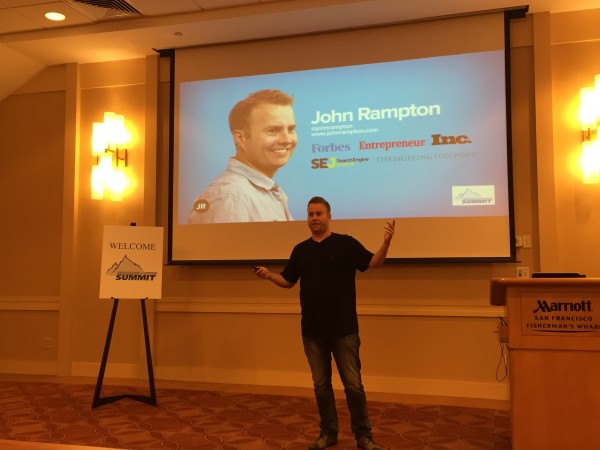
His public writing eventually appeared in Forbes, Entrepreneur and Inc. He also worked at Search Engine Journal, discussing search, pay-per-click advertising and content. Those subjects put him close to the machinery of discovery: the decisions that determine which business gets noticed and which remains a beautifully furnished empty room.
An address with a business attached
Buying Due.com fitted an existing fascination. Rampton’s first domain purchase, he recalled, was Adogy, acquired to present his agency work. He treated web addresses as online property and was candid about the range of outcomes: purchases, sales, losses and ventures that failed. A memorable name could help. It could also remain a very memorable expense.
The Due purchase became more interesting when paired with working software. In a March 2017 conversation, Rampton described combining the $130,000 address with a $20,000 purchase of invoicing assets. The proposition was to put a recognizable name around something people could already use, rather than wait for every component to be built afresh.
A name people could remember. Software they could use.
He reported that Due was processing about $60 million a month in transactions a year into operations. That was payment volume, a measure of money moving through the system. It should be read separately from the company’s revenue. In payments, confusing the two can make a business appear considerably richer than its bank account feels.
The problem behind the product was familiar to his circle of freelancers and entrepreneurs. Clients were slow to pay. Electronic invoices with payment options in the same place could shorten the distance between receiving a bill and settling it. His interest began with people describing a tiresome chore, then moved toward software that might remove some of it.
The customer who held the switch
Rampton also had a story about distribution going badly wrong. In 2017, he described an earlier ecommerce business whose revenue had become overwhelmingly dependent on Amazon. By his account, 93 percent came through that channel. When the account was shut off, the company could no longer support its employees.
He recalled dismissing the staff and liquidating warehouse stock. The business had been doing millions in monthly sales; that apparent strength had concealed a dependency. A large audience can feel like an asset you own until someone else closes the gate.
Rampton recalled in 2017.
The episode complicates an otherwise tidy entrepreneurial biography. Knowing how to bring in customers does not necessarily protect a company from losing access to them. Growth and control are separate achievements. Rampton’s advice afterward was to diversify revenue streams, a fairly plain sentence carrying a rather expensive education.
He returned to the collapse in an April 2025 conversation with Stuart Draper. He also described a past connection leading to work while he rebuilt. Relationships, in that telling, had a value that survived the failure of a company. They could still produce a next step when the inventory had gone.
Help, without presenting the bill
Rampton’s approach to connections has an unusually numerical expression. He has described a personal rule of thumb: some people you help will help you back; fewer relationships become commercial; a smaller number become financially significant. He treats helping three people a day as a practice. These are his beliefs about relationships, rather than a forecast anyone can put into a spreadsheet with confidence.
In his 2019 conversation with Cal Fussman, giving knowledge away was central to the discussion. It is an interesting position for someone whose work includes selling expertise. A useful explanation allows a reader to act independently. It can also make that reader remember who understood the problem when they later need assistance.
“Helping brings joy.”
John Rampton
His comments on community building around Hostt, a hosting venture, put the emphasis on introductions, advice and practical help. A collection of people on a mailing list does not automatically become a community. There has to be a reason to remain beyond the next promotional message.
There is a social instinct behind that commercial reasoning. In an early interview, Rampton complained that larger organizations brought more politics and weaker personal relationships. He enjoyed starting things. He also volunteered a less corporate enthusiasm: league bowling, with scores he placed between 180 and 210. Even his leisure came with a reported range.
A calendar full of questions
Calendar extended his interest from money to time. Before its public launch, Rampton said the team had interviewed more than a thousand people about how they used their calendars. Developers, marketers and a product colleague took part. Watching actual habits mattered alongside asking people what they wanted.
That is a substantial amount of listening for software meant to save time. The contradiction is useful. A calendar can look simple from outside: dates, boxes, invitations. Inside a working day, it has to accommodate interruptions, competing priorities and the small negotiations that turn booking a meeting into its own meeting.
Rampton had already talked publicly about his own scheduling frustrations. He praised Calendly for reducing the repeated emails needed to arrange appointments. He described making sure trusted colleagues could handle decisions while he attended conferences. The recurring ambition was to reduce the amount of business that required his immediate attention.
Family supplied a more personal test. After his daughter’s arrival, he described moving much of his work into early mornings and evenings to make room for time with her. He tracked his hours closely. Efficiency had a destination: portions of the day he wanted to spend with his family.
His willingness to hand work over is part of that calculation. In a productivity interview, he described training people to handle responsibilities that might otherwise wait for his return. Trust took years to develop. A calendar can reserve an hour, but a colleague who can make a decision can prevent the hour from being consumed in the first place.
There is something pleasantly unglamorous about this side of the story. The public version of entrepreneurship has stages, audiences and an impressive list of projects. The working version needs somebody to answer the question while the founder is on a plane. His comments make room for both versions, with the second doing much of the work that allows the first to happen.
What remains after the sale
Rampton and Joel Comm turned their interest in entrepreneurial behavior into the 2017 book Self-Employed: 50 Signs That You Might Be an Entrepreneur. Its organizing question was whether the working life of an entrepreneur suited the reader. That is a more personal question than whether a particular startup idea can attract customers. A business becomes part of someone’s days.
His public work still circles those days. Due now presents a retirement-focused business, with education about money and retirement alongside its offerings. Rampton’s October 2026 writing includes the risks of putting personal wealth back into a company and the practicalities of retirement for the self-employed. The concern has widened from collecting an invoice to what happens when work eventually stops.
At the 2020 Startup Grind Global event, he sat down with Medallia cofounder Amy Pressman to discuss customer experience. Listening to the person at the other end of a transaction runs through that conversation, his product research and his early marketing work. The scale changes. The person deciding whether something is useful remains inconveniently human.
The $130,000 address makes a tidy opening to Rampton’s story because it is such a visible bet. The less photogenic work follows: answering questions, finding customers, trusting colleagues, recovering from mistakes. Three letters can make a company easy to remember. They leave the rest of the job to the people behind them.
Keep the conversation going
John’s writing, conversations and public profiles.