The product Lona Therrien has marketed for most of her working life is a peculiar one: the bad thing that does not happen. A breach is stopped. A threat is seen early. A stranger fails to become you. There is no ribbon to cut for catastrophe avoided, only a quiet morning when the systems work and everybody gets on with lunch.
This is the central inconvenience of cybersecurity marketing. The danger is invisible until it is horribly visible. The technology is dense. The buyer is skeptical by profession. The language is awash in acronyms, and every promise must eventually face an engineer who can tell whether the varnish is load-bearing.
Therrien has been learning to operate inside that inconvenience for roughly 25 years. Her résumé reads like a compressed history of commercial cyber: @stake at the turn of the millennium, then Symantec, RSA, Mimecast, Cybereason, ExtraHop, and now Aware, the publicly traded Massachusetts company that makes biometric software. Through all those shifts, her subject has remained surprisingly stable. She makes difficult technology understandable enough for people to choose it.
A career that followed the threat
Therrien did not arrive in this world through computer science. She studied communications at the University of Georgia, then earned a master's in the same field at Miami University, with an emphasis in organizational consulting. That distinction matters. Technology companies often describe communication as the last mile, the attractive wrapper applied once the clever work is done. Her career suggests something more structural: communication is how an organization decides what it means before asking the market to agree.
Her early years at @stake placed her near the birth of cybersecurity as a recognizable business category. The consultancy, later acquired by Symantec, was populated by security specialists at a moment when the commercial internet was rapidly expanding the number of doors worth locking. Therrien moved through public relations, enterprise marketing, and global cybersecurity marketing. The vocabulary changed quickly. So did the audience.
The long route from network defense to identity
At RSA, where she spent close to nine years, her responsibilities widened from consulting to council leadership, public relations, analyst relations, and thought-leadership programs. At Mimecast she directed global corporate communications. At Cybereason she oversaw corporate marketing, messaging, customer programs, media relations, and events. Each move enlarged the frame: from telling the story, to deciding which story the company should be able to tell.
The progression is less glamorous than a founder myth and more instructive. There was no single garage, lightning strike, or dramatic pivot. There was an apprenticeship, repeated in increasingly demanding rooms. Technical experts needed accuracy. Journalists needed clarity. Analysts needed evidence. Sales teams needed language that survived contact with objections. Customers needed proof that the company understood the problem from their side of the table.
“Marketing is at its best when it's grounded in real customer needs.”Lona Therrien, on joining Aware
Brand on one scoreboard, bookings on the other
ExtraHop gave Therrien the full CMO canvas. She joined in late 2022, rose through senior global marketing leadership, and took the chief marketing role. Aware's account of her tenure credits her with a company-wide rebrand and with surpassing marketing revenue targets linked to pipeline and bookings. Her published professional profile adds the operational texture: a global team, a mandate to help drive revenue, persona work, funnel definitions, analyst programs, customer marketing, and close measurement.
Those details rescue “brand” from its airy reputation. For Therrien, it appears to live on two scoreboards at once. One records attention, share of voice, recognition, and whether the company occupies a distinct place in a buyer's mind. The other records conversion, pipeline, bookings, sales-cycle length, and retention. A beautiful campaign that cannot cross the corridor into revenue is a poster. A demand machine with no durable meaning is a discount code wearing a tie.
Her work at ExtraHop also put her in the public role of translating recognition into relevance. When the company won a 2024 SC Europe Award for behavior analytics and enterprise threat detection, Therrien's explanation connected the prize to a broader claim: network visibility had become essential to finding sophisticated threats. This is the small hinge on which serious B2B marketing swings. The trophy is news for a day. The reason it matters is the story customers remember.
Three puzzle pieces and a town hall
When Therrien announced her move to Aware in May 2025, she did not present it as a promotion in the usual ascending-arrows style. She offered a test. When considering a new opportunity, she wrote, she looks for three puzzle pieces: culture fit, a mission she believes in, and a place where she can make an impact.
The telling anecdote came from her first week. Aware's team invited her to speak at the company town hall. She read the invitation as evidence that “people and purpose align” - an early cultural signal, delivered not through a handbook but through a microphone. Shared energy, strategic alignment, and mutual accountability were the qualities she named. They are warm words, but “accountability” keeps the set from floating off.
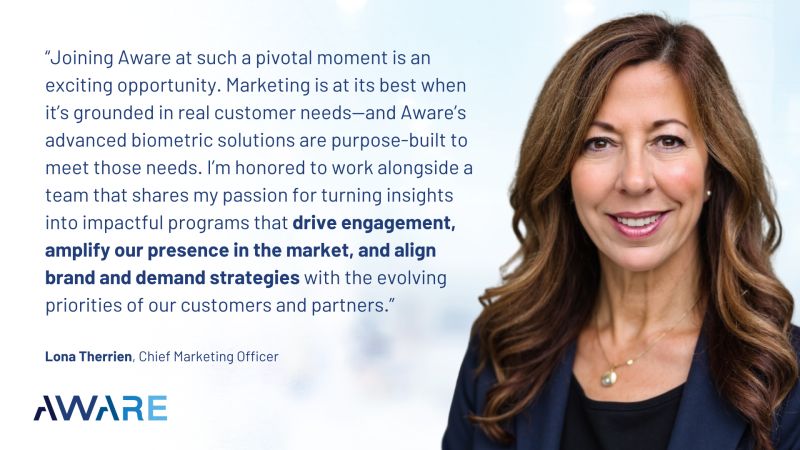
The mission piece is where her career takes its newest turn. “After years in cybersecurity,” she wrote, “it's never been more evident that identity is at the core of digital trust.” Aware builds modular software for fingerprint, face, and iris recognition, mobile authentication, identity proofing, and related workflows. The shift from watching the network to verifying the person is not a departure from her earlier work. It is the threat landscape moving closer to the body.
The credential is becoming the person
Security marketing has always had to balance urgency with restraint. Biometrics makes that balance more intimate. A password can be reset; a face is not issued by the help desk. Convenience and scrutiny arrive together. The marketer must explain speed, accuracy, and scale while respecting that buyers, partners, and the public bring serious questions about privacy, bias, deployment, and control.
Therrien's customer-first language is useful here because it rules out the lazy starting point: fascination with the machinery. The interesting question is not merely whether a system can recognize a fingerprint. It is what a bank, government agency, or enterprise needs the recognition to accomplish, under what constraints, and with what evidence. Product capability matters. Context decides whether capability becomes trust.
AI sharpens the problem. Synthetic media and automated fraud make old signals less dependable just as people expect authentication to become nearly frictionless. Aware's task is technical, but its market task is rhetorical in the oldest sense: present a case that can withstand examination. Therrien now leads the group responsible for that case across brand, demand, customers, and partners.
“Identity is at the core of digital trust.”Lona Therrien
Recognition has followed. Therrien was named to Women We Admire's list of top women chief marketing officers in 2024, appeared again in the organization's 2026 CMO list, and joined a CyberMarketingCon panel on what security marketers need to understand about the changing media landscape. The panel topic is apt. She entered the industry when public relations could still command the center of a corporate communications plan. She now works in a media environment splintered across analysts, creators, podcasts, social feeds, events, communities, and direct channels.
Yet the central craft is stubbornly unchanged. Find the true thing. Make it clear. Make it matter to someone other than the people who built it. Then measure whether anyone moved.
A career built in the translation layer
There is a fashionable desire to separate storytellers from operators, as though one decorates the stage while the other runs the machinery beneath it. Therrien's career makes the division look quaint. She has managed communications budgets and marketing teams, built analyst and media programs, shaped positioning, defined funnel stages, and carried a revenue mandate. The message and the mechanism belong to the same system.
That may be the most durable lesson in her path from @stake to Aware. In technical markets, trust cannot be a tone of voice pasted over the product. It is accumulated alignment: what the technology does, what the company claims, what the customer needs, and what the evidence supports. When those pieces lock, marketing looks less like persuasion and more like recognition - the moment a complicated problem sees itself clearly in a company's answer.
Therrien has spent a quarter-century making invisible threats legible. At Aware, she faces the more delicate sequel: helping institutions recognize people while persuading people that the institution deserves the privilege. It is an argument with no room for fog. Fortunately, clarity has been the job all along.