Logan Sugarman has an explanation for a problem that can occupy an entire software company. It involves soup. People care about how it tastes, he says, more than how it was made. For a founder who has spent years working with data and complicated systems, this is a pleasantly untechnical place to begin. Nobody orders lunch because the kitchen has an impressive integration strategy.
The observation came as Refresh worked on its message through the SHRM accelerator. The company had been explaining its features and connections. The lesson was to spend more time on what those connections accomplished for the buyer. An employee finding a resource, completing a task, or understanding the next step is a much more useful ending to a demonstration than another slide about the plumbing.
That adjustment offers a way into Sugarman’s career. He is the founder and CEO of Refresh, a New York entrepreneur whose work has also taken him through technology consulting and investing. The settings change. The question keeps turning up: how does information become something a person can actually use? Somewhere between possessing a resource and reaching it, value can get lost.
“more about how the soup tastes”
Logan Sugarman, on explaining the outcome
Three subjects, one recurring problem
Sugarman graduated from Johns Hopkins in 2000. He studied economics and psychology, with a minor in computer science. It is a combination that gives this story three useful lenses: incentives, behavior, and the systems through which decisions happen. A person can understand the financial reason for doing something and still find the process sufficiently annoying to postpone it until next Thursday.
His early career included Accenture, where he worked on information systems for financial-services clients such as E*TRADE and Wells Fargo. Trade and account activity could be organized into information a business could act on. He later worked in asset management, with roles including Swiss Re, Exis Capital and Kinyan Capital. Banks, insurers, portfolios and market data became part of his working vocabulary.
There is a practical relationship between those jobs and employee software. A system can contain plenty of information while leaving its user unsure what matters. A financial analyst must decide which signals deserve attention. An employee trying to complete a workplace task faces a smaller version of the sorting problem. The stakes and expertise differ; the need for a useful next action remains.
Refresh puts that question inside the employer’s relationship with its workforce. Payroll, learning and communications already have their systems. Sugarman’s company works on the experience that connects them. The business is built around a recognizable inconvenience: being sent from one place to another when you thought you were trying to do one thing.
Eight founders, no need for a sales pitch
In November 2018, Sugarman joined seven fellow Johns Hopkins alumni founders at the New York offices of Harry’s, the company co-founded by fellow alumnus Jeff Raider. It was the university’s inaugural Founders’ Forum. Each participant had been asked to bring a business topic to discuss. In the photograph of the gathering, Sugarman listens as Proscia’s David West speaks.
The prompts were direct. Participants were asked what they needed help thinking through and what kept them up at night. Founders of younger businesses sat with people running more mature companies. Kevin Callahan came from Texas to support the earlier-stage entrepreneurs. There was room for the sort of question that does not fit comfortably into a pitch deck.
It is a revealing scene without requiring a dramatic confession. Sugarman was there as a builder among builders. The room offered a different form of access: to people who understood the peculiar decisions of running a company. A polished introduction can tell you what someone does. A shared problem can tell you how someone thinks.
Such gatherings also change the meaning of a university connection. A degree is a completed chapter. A group of working alumni can keep reopening it, bringing new problems to an old affiliation. For Sugarman, Hopkins remained part of his professional life well beyond graduation. The institution also gave him a place to support the next generation of entrepreneurs.
The employee has other things to do
A workplace application has to compete with the rest of the day. A person may want a payslip, a training course or an answer about a company resource. The internal diagram explaining which department owns which system is unlikely to improve the experience. Imagine needing a map of the kitchen before being allowed to taste the soup.
Refresh is designed as an employer-branded application that brings workplace tools into one personalized hub. In his Human Cloud conversation with Tony Buffum, recorded at SHRM25 in San Diego, Sugarman described the connections between employee access, engagement and employer branding. The discussion also considered keeping relationships with former employees alive after they leave.
That last detail extends the idea of an employee experience beyond a current login. A person’s connection with an organization can outlast the job. An alumni relationship has its own practical questions: what remains useful, what can still be shared, and how does the organization stay in touch? The software has to accommodate the relationship rather than assume it ends with an access badge.
The consumer-design argument is straightforward. People become accustomed to services that help them reach an outcome. At work, they encounter the same phone, the same limited attention, and a different set of expectations. A system organized for administrators may require employees to learn the institution’s logic before receiving any help. That is a substantial favor to ask of someone on a short break.
Sugarman’s work sits in that gap. The test is ordinary enough to be unforgiving: can the person get through the task? A successful connection between applications matters because it changes an action at the other end. When it works, the user has less reason to think about the connection at all.
The class that became collaborators
In 2025, Refresh was one of three startups selected for SHRM Labs’ WorkplaceTech Accelerator from more than 500 applicants. Bites and TransCrypts were its classmates. The program put Sugarman in another room of founders, this time with a shared market and a direct opportunity to learn how HR buyers thought.
Refresh · Bites · TransCrypts
The experience mattered beyond the selection itself. Exposure to customers can reveal that the problem a company is proud of solving is only one part of what the buyer is trying to accomplish. Technical founders have good reasons to value technical work. Buyers have equally good reasons to ask what becomes easier on Monday morning.
At SHRM25, Sugarman appeared alongside Bites co-founder Hagai Horovitz, TransCrypts CEO Zain Zaidi and Sparrow CEO Deborah Hanus. The photograph catches a discussion rather than a solo announcement. It is an appropriate image for a business whose central proposition depends on making separate things work together.
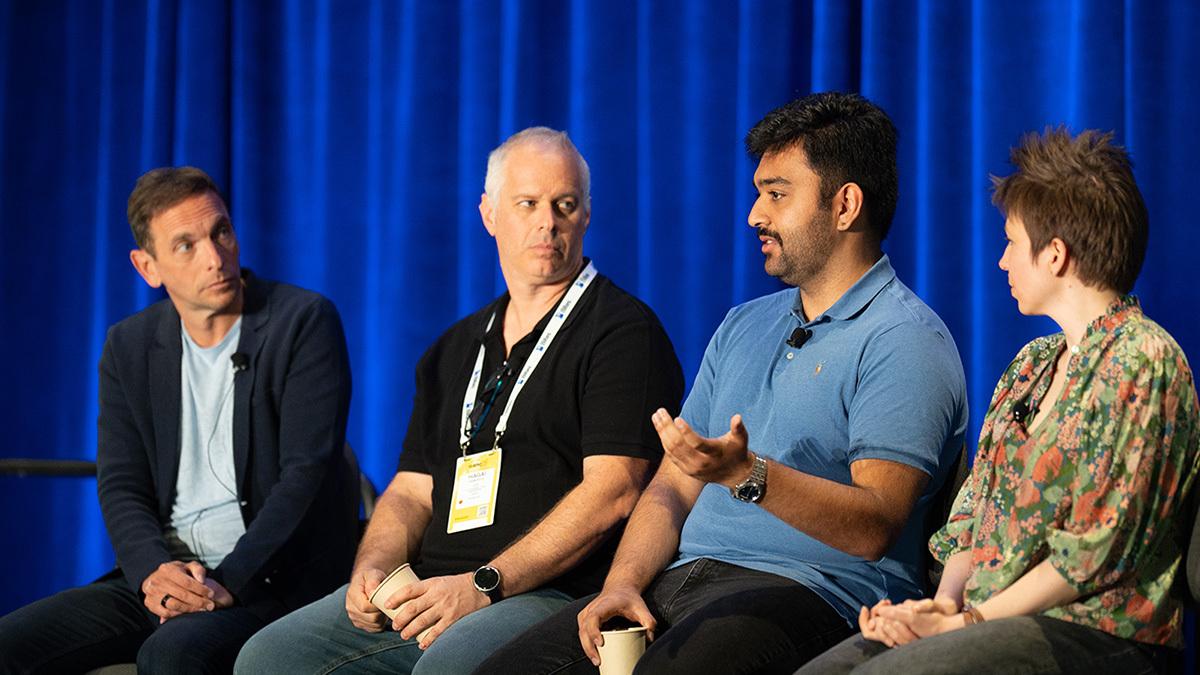
The three accelerator companies went on to integrate with one another. Refresh supplied the employee-facing entry point; Bites brought short-form learning; TransCrypts supplied portable verification of work and training records. Their relationship turned a cohort into a set of collaborators. The practical benefit of meeting other founders was a connection that could also reach their users.
An efficiency gain still needs a human answer
On the SHRM25 technology panel, Sugarman discussed automation alongside a complication that deserves attention: turnover can have a larger effect when a company has fewer people. Reducing routine work gives HR teams time for other tasks. Reducing headcount also changes how much disruption a remaining team can absorb when someone leaves.
That is a useful caution from someone selling software. The efficiency calculation continues after the demonstration ends. An organization has to decide how it will use the time it gains and how it will handle the work that remains. A faster process cannot make those decisions on the employer’s behalf.
The same scrutiny applies to AI interfaces. A blank box inviting a question may look wonderfully simple. The person using it still needs to know what to ask and recognize a useful answer. Sugarman has discussed the difficulty of treating a prompt as the finished user experience, comparing contemporary AI interactions with older command-based computing.
His concern fits the rest of the story. Complexity can move behind a screen without leaving the user’s workload. A better interface has to help someone understand the next action, rather than merely provide another place to type. The design challenge begins again each time a new capability becomes available.
A different kind of return
Sugarman’s work extends beyond Refresh. He is a co-founder and chief revenue officer at Triangle Digital, which connects environmental data with financial assets, and a co-founder and chief investment officer at Balcony Partners. Different markets ask for different kinds of expertise. In each setting, useful information needs a route into a decision.
There are less predictable chapters, too. His ventures have included galleries in Minneapolis and New York, and executive producer work on films including The Au Pair Nightmare. A résumé containing financial systems, employee software and a thriller title allows for a little variety. The workplace login screen, mercifully, need not borrow the thriller’s atmosphere.
In an April 2026 essay about choosing to become a founder, Sugarman described wanting greater agency over the work, the people involved and the values guiding it. Building required decisions with incomplete information and lessons in cash flow, leadership and persistence. He presented the return as personal as well as financial.
The soup observation now sounds like part of that education. A founder can know the machinery intimately and still need help describing why it matters. Sugarman’s continuing task is to make the connection clear enough that the person at the other end can simply get on with the day. The kitchen has work to do. Lunch should be easier.
Continue the conversation
Follow Sugarman’s work, watch an interview, or spend more time with the ideas behind Refresh.