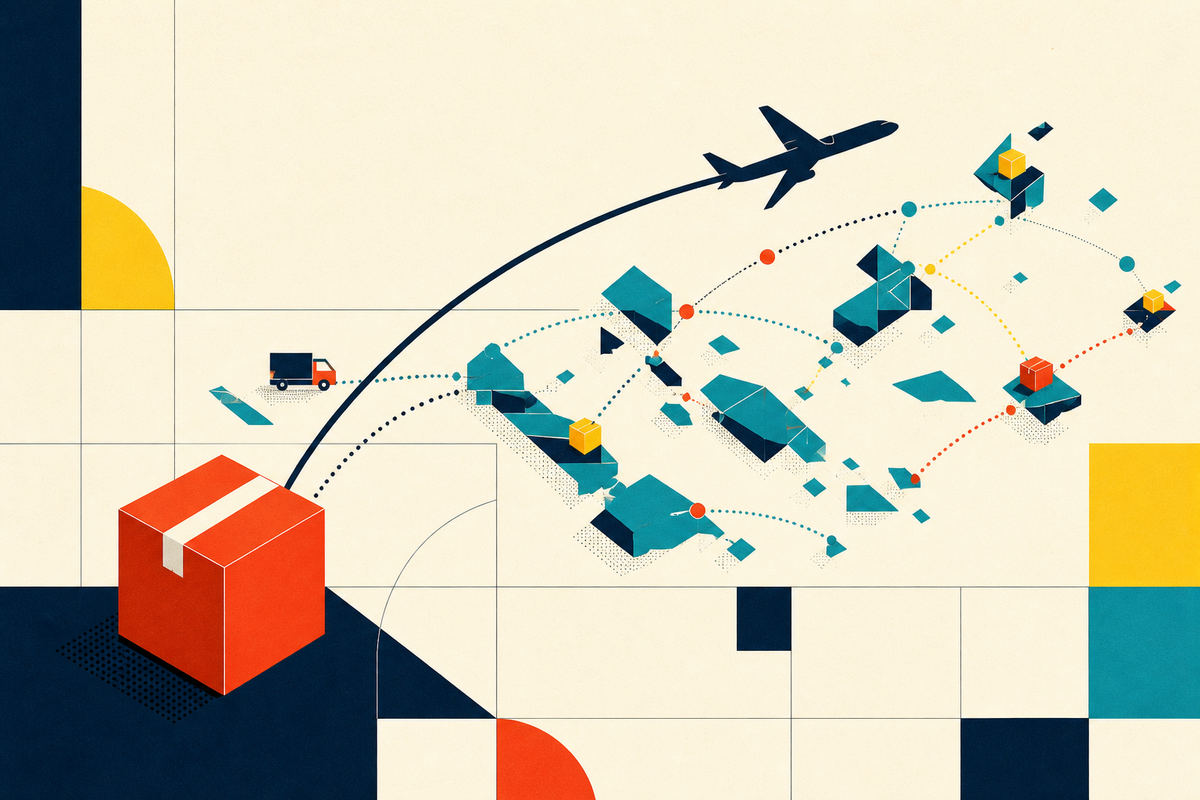
A parcel leaving Jakarta for Makassar has a geography problem before it has a delivery problem. Indonesia stretches across thousands of islands, and the route between seller and buyer may involve a motorbike, a sorting hub, an airport, another truck and one last courier who knows the neighborhood. Lion Parcel's unusual answer starts in the middle. Its parent, Lion Group, already operates the machines that can jump the water.
That inheritance changes the order in which a courier company can be built. Global operators such as DHL and FedEx became large parcel networks and then invested heavily in aircraft. Lion Parcel began inside an aviation group. As CEO Farian Kirana once put it, the planes came first; the logistics company followed. The strategic move was to turn an existing airline network into a middle-mile parcel spine, then organize everything that happens before takeoff and after landing.
A network made for awkward geography
PT Lion Express, the legal company behind Lion Parcel, was established on February 14, 2013. It now describes an operation that reaches 98 percent of Indonesia across all 38 provinces, with service to more than 50 countries. Its published network includes more than 7,000 agents, 15,000 couriers and 3,000 ground vehicles, backed by access to more than 350 Lion Group aircraft.
Scale alone does not make this network coherent. The difficult product is coordination. An agent accepts a package or the app requests a free pickup. The shipment is sorted, routed onto a ground or air linehaul, sorted again and assigned to the final courier. Tracking has to turn those handoffs into one readable story for the customer. Pricing must account for weight, volume, distance, urgency and return risk without making the checkout feel like a mathematics exam.
The clever bit is not putting a parcel on a plane. It is making five different handoffs feel like one delivery.
One network, many promises
Lion Parcel slices that infrastructure into a conspicuously named service ladder. JAGOPACK handles economical, less urgent shipments. REGPACK is the everyday regular tier. BOSSPACK offers priority delivery with an on-time commitment. VIPPACK is the premium option, advertised at under 24 hours on eligible intercity and inter-island routes. BIGPACK and BIGPACK FAST take larger items at economy or quicker speeds. MINIPACK, introduced in June 2026, goes the other direction by targeting light parcels. INTERPACK handles international delivery.
Economy, regular, priority and eligible under-24-hour delivery let customers buy the promise they need.
MINIPACK and BIGPACK acknowledge that a phone case and a chair should not be priced like the same object.
COD options collect shipping alone, or shipping plus merchandise value, at the recipient's door.
Fulfillment and corporate services add warehousing, dashboards, dedicated handling and negotiated pricing.
For individuals, the app turns this menu into pickup, rate checks, tracking, shipment reports and loyalty points. For larger businesses, Lion Parcel offers negotiated rates, dedicated handling, real-time monitoring, COD balance withdrawal and fulfillment support. The same shared infrastructure can carry one consumer package or a recurring corporate flow.
The seller problem behind COD Ongkir
Lion Parcel's sharpest product insight may be less glamorous than an aircraft: who pays the delivery fee, and when. Cash on delivery remains important in Indonesian online commerce, including for buyers who prefer not to prepay and sellers who need transaction confidence. Conventional COD can collect both the item price and shipping charge. COD Ongkir separates them. The seller receives payment for the merchandise, while the customer pays Lion Parcel only for freight when the package arrives.
That small rearrangement removes chores from the seller's day. There is no need to quote and collect shipping in advance, reconcile it manually or carry the delivery fee before dispatch. Lion Parcel handles the freight transaction, supports QRIS as well as cash, and offers a reduced return fee. Its on-time promise can also waive the freight charge when an eligible COD Ongkir parcel arrives late. The product is aimed squarely at online sellers and micro, small and medium enterprises that would rather spend an hour selling than an hour administering delivery.
A logistics service becomes useful when the merchant can stop thinking about logistics.
Software for the surge
The physical network created a computing problem. Ecommerce campaigns and holiday periods produce sharp peaks, while real-time tracking and routing generate continuous events. Lion Parcel's older on-premise setup demanded manual server provisioning and was difficult to scale down when demand eased. Working with Indonesian implementation partner Eikon, the company moved core systems onto Google Cloud, using Kubernetes Engine, Cloud SQL, Pub/Sub and related services.
The practical gains were less time spent feeding infrastructure and more time releasing logistics features. Lion Parcel adopted software-delivery measures covering deployment frequency, lead time, failures and recovery. Google Cloud reported that the change helped create more integrated, data-driven operations and contributed to an increase in freight volume of up to 50 percent in 2023. BigQuery is now used to analyze customer data, routes and warehouses, while the company has explored machine learning for a more personalized ordering and tracking assistant.
Published reach, viewed three ways
Who pays, and who competes
Lion Parcel makes money primarily when something moves. Consumers and sellers pay transaction fees based on route, size and service tier. COD adds service charges. Corporate accounts bring contracted volume and specialized handling. Independently operated points of sale extend the storefront network; agents receive shipping discounts or commissions and, in return, supply local distribution and customer relationships without Lion Parcel owning every counter.
The customer base ranges from a home-based fashion seller to national companies. Lion Parcel says more than 1,000 corporate clients use its network, and its public roster spans healthcare, electronics, banking, automotive, retail and ecommerce. The names shown include Samsung, Vivo, BCA, IKEA, Decathlon, Tokopedia, Blibli and healthcare distributors. A partnership with Pos Indonesia has used Lion Group air capacity to help accelerate domestic postal distribution. In 2026, AstraPay brought QRIS payments to agent counters; Lion Parcel said participating agents recorded revenue increases of more than 10 percent.
Competition is abundant. JNE, J&T Express, SiCepat, Pos Indonesia, Anteraja, Ninja Xpress and TIKI all fight for parcels, while marketplaces increasingly steer orders into their own delivery systems. For international traffic, the alternatives include DHL, FedEx and freight forwarders. Lion Parcel cannot win on aviation heritage alone. Customers experience the courier at the door, the accuracy of the tracking page and the response when a package is late - not the elegance of the corporate asset map.
The agent is part of the product
The neighborhood counter matters because logistics is still a trust business. A seller carrying several parcels can ask a person about packaging, dangerous-goods rules, a missing address or the cheapest eligible service. An agent can explain why a light but bulky box may be billed by volume. That conversation is hard to reproduce in a rate calculator, particularly for a new merchant dispatching the day's orders from a home or small shop.
Lion Parcel's agent proposition is deliberately simple: a local operator applies, receives access to the shipping system, branding, training and commercial discounts, then earns from parcel transactions. The company expands its physical reach without leasing every storefront. The operator gets a recognizable service to sell and a network that reaches far beyond the neighborhood. Lion Parcel has increasingly emphasized training existing agents, not merely recruiting new ones - a sign that counter quality and customer retention matter as much as the dot count on a coverage map.
Digitizing those counters is the next layer. QRIS payments through AstraPay reduce cash handling and give agents another familiar way to close a transaction. Central shipment data provides tracking, claims and reporting. The arrangement is a useful study in hybrid distribution: the app handles repeatable tasks, while a local person handles ambiguity. For an archipelago-sized business, both interfaces have to work.
The company between the wings and the doorstep
This is where Lion Parcel fits in the market: a technology-enabled Indonesian courier with an unusually integrated middle mile, broad consumer distribution and enough service variety to sell into both ecommerce and enterprise logistics. It is neither a software company that happens to book trucks nor merely spare cargo capacity with a red logo. Its expertise is the operating layer between those things - route planning, hub movement, agent economics, payment collection, tracking and recovery across difficult terrain.
The culture it publishes is similarly operational: rise to challenges, report results honestly, innovate through collaboration and trust the team. There is a playful edge. Service names sound like a cast of comic-book couriers, and LIOLIO, the company's virtual character, appears on its leadership page as “Virtual CEO.” Yet the serious test remains mundane. Can the box be collected, scanned, flown, sorted and delivered when promised?
PT Lion Express begins building Lion Group's parcel operation.
Farian Kirana becomes CEO as network digitization accelerates.
Freight tonnage rises by as much as 50 percent.
COD Ongkir expands around the needs of online sellers.
AstraPay digitizes agent payments; MINIPACK targets lighter parcels.
Indonesia will continue making that job harder than it looks. The same geography that protects Lion Parcel's aviation advantage also creates weather disruptions, remote routes and expensive failed deliveries. But it gives the company a clear place to stand. Lion Parcel did not have to imagine a network in the sky. It had to connect that network to the person waiting at home.