Five days is a reasonable amount of time to pack a suitcase. It is a ridiculous amount of time to replace a parcel carrier. Yet that, according to Chris Guggenheim, is the notice his ecommerce business received from UPS in 2019. He says the relationship had involved $55 million in shipping spend. The carrier considered the account insufficiently profitable and pulled the plug. Whether one loves or hates the old carriers, the episode exposed a basic truth: a company can be very large and still have remarkably little say over how its boxes get home.
Guggenheim had spent years helping artists and merchants sell directly to fans. His career began with music ecommerce, including work connected to Willie Nelson; later came a business serving thousands of Shopify Plus stores. He knew websites and checkout pages. The weak link was the journey after checkout, when a retailer surrendered control to a contract and a tracking number.
In brief
- The move: Use spare cargo space on scheduled passenger flights to move parcels across long distances.
- The handoff: Sort near airports, then inject packages into local and regional delivery networks.
- The buyer: Retailers, ecommerce operators, 3PLs and parcel carriers that want more route and carrier choice.
- The catch: Good lane density, dependable flights and clean handoffs matter more than a handsome routing diagram.
An airline ticket for the middle mile
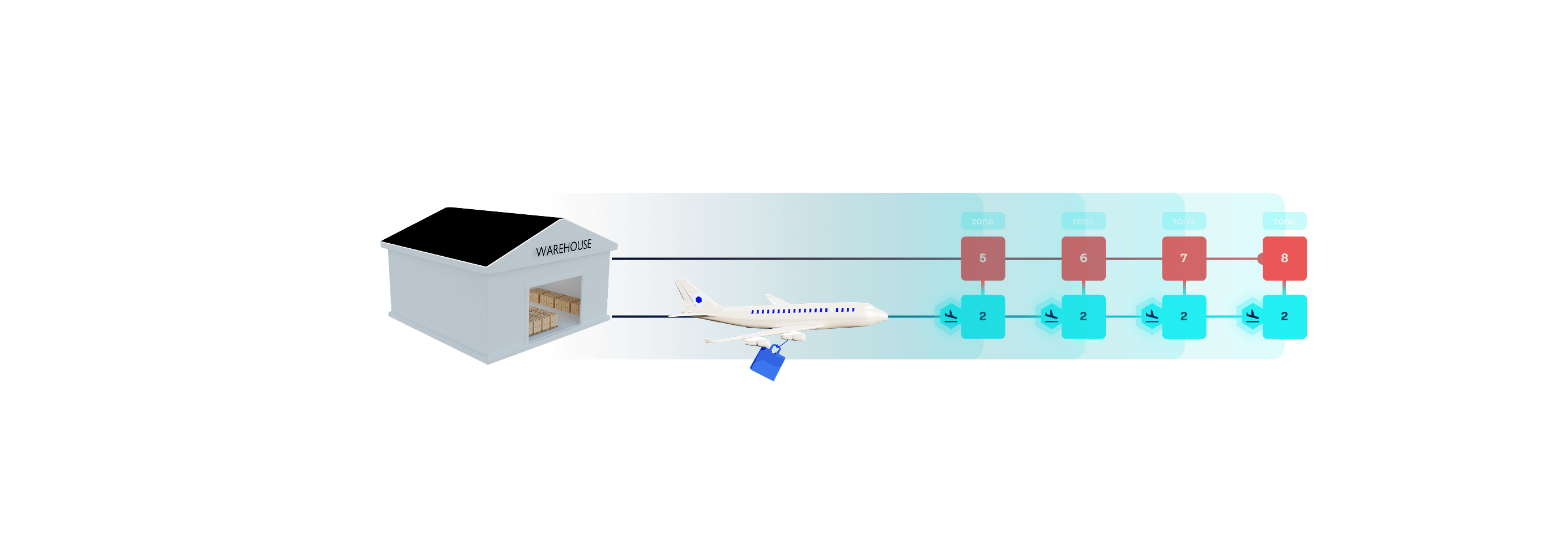
ClearJet, founded in Austin in 2022, came from a question Guggenheim asked after that carrier scare: why move every long-distance parcel through a single company's sprawling network when thousands of passenger flights already cross the country each day? Airplanes routinely leave with unused belly space. ClearJet buys access to that capacity, collects and sorts merchants' parcels, screens them for air transport, puts them on scheduled flights, recovers them at the destination airport and hands them to a delivery partner for the final miles.
The company calls the assembled system a “SuperCarrier.” The name is louder than the mechanism. It owns no passenger jet. Its work is to make assets owned by airlines, ground handlers and final-mile fleets behave like one bookable service. Software picks a route and keeps watch; people and facilities do the heavy lifting. One can change the flight, the doorstep carrier or the level of service without starting from an empty map.
The flight is the shortcut. The handoffs decide whether it pays.
ClearJet's Air Zone Skip product sells the long jump between an origin region and the destination region. Its Express Delivery service packages pickup through delivery into a two-day offering. The company's site also lists Express International and Express Returns, though the public descriptions currently say little about either. ClearJet Connect gives smaller direct-to-consumer shippers ground and express options through ShipStation. Larger customers can use an API, keep their own carrier accounts or use ClearJet's, and set preferences for price, speed and geography.
The bag that made the flight possible
The theory sounds almost suspiciously neat. Aircraft supplied the first unpleasant detail. Guggenheim has said that many American passenger planes are narrow-body jets with cargo doors too small for the pallets a conventional freight forwarder would use. ClearJet designed overpack bags that can hold ecommerce parcels and move through the airport more like passenger luggage. It is a wonderfully unglamorous answer to a systems problem: the software could discover the perfect flight, but the box still had to fit through the door.
Those bags are only one part of the physical job. ClearJet must match parcel cutoff times to airline schedules, run sorting operations, meet screening requirements and coordinate the recovery at the other airport. A delay can erase the advantage of a direct flight if the package misses the local carrier's injection window. That is why the company's claims about artificial intelligence deserve to be read alongside its airport and sortation work. The model is valuable when the route recommendation can be executed on a loading dock at midnight.
“These flights are going from A to B city. We're taking those same routes.”Chris Guggenheim, in a 2026 interview
A regional carrier borrows a national horizon
The most revealing customers may be other carriers. Veho built its reputation on doorstep delivery in its operating regions. A partnership with ClearJet gave it an air connection between those regions. OnTrac went further: in September 2025 it named ClearJet the exclusive launch partner for OnTrac Express, a service intended to join air zone skipping with OnTrac's seven-day ground operations for two- and three-day coast-to-coast delivery. The carrier said some customers were already using select capabilities as it prepared a wider rollout.
For a retailer with one or two fulfillment centers, this is more than an exercise in shaving hours. Building a warehouse in every major market is expensive. Putting a consolidated batch of packages on a direct flight can bring distant shoppers closer to an existing warehouse, then let a regional carrier do the part it knows best. ClearJet's public case studies also describe luxury retail, apparel, marketplaces and 3PL use, though most of those merchants are unnamed.
This also explains where ClearJet sits in the market. FedEx and UPS sell integrated networks with extraordinary reach. Regional carriers sell strength in smaller territories. Pure shipping software can compare labels but does not move a parcel through an airport. ClearJet's pitch lives in the seam between them: a physical middle mile, wrapped in routing and a single commercial relationship. Its terms describe route-dependent rate cards and weekly invoicing. There is no public universal price per package; the economics depend on origin, destination, size, service level and volume.
The numbers are promising. The lanes decide.
ClearJet says its service can reduce shipping costs by up to 35 percent and cut transit by one to three days. It reported moving more than 30 million parcels a year when it announced a $25 million Series B led by Edison Partners in August 2026. The round took reported total funding above $40 million. These are company figures, and “up to” is doing real work: a direct overnight flight on a busy lane is a different proposition from a thin route with awkward cutoffs.
One early retail example, recounted by Guggenheim, replaced a seven-day journey for goods arriving from Asia with a five-day one by sorting at Los Angeles International Airport and flying to 14 destinations. He put the customer's savings at $35 million. It is a striking case, but not a public tariff. A shipper trying to reproduce it would first isolate long-zone parcels, measure daily volume by destination, test flight and carrier cutoff times, and compare the entire dock-to-door bill with its current contracted rates. ClearJet offers a network simulator for precisely that first modeling step.
The harder cases are easy to imagine and worth pricing early: low parcel density, oversized or restricted goods, destinations with poor flight timing, weather disruptions, or a local delivery partner with a weak handoff. An independent parcel consultant quoted by FreightWaves questioned whether some long-distance flows justify the added middle-mile complexity and noted that large shippers may already hold substantial carrier discounts. ClearJet's answer is configurable routing and monitoring, not a guarantee that every box should fly.

His route into parcel logistics began on the shipper's side of the invoice.
That is the useful lesson in the five-day ultimatum. Diversifying shipping does not mean collecting a drawer full of carrier contracts. It means knowing which parcels belong on which network, having an executable second path, and watching the handoffs after the label prints. ClearJet's wager is that the next great parcel network can be assembled from capacity already moving. The aircraft may be someone else's. The consequences of a late package still belong to the shipper.