The conversation began with a database. At a gathering of the CoLab leadership program in Ein Gedi, Lili Ben Ami was talking with technology professional Yakir Daniel about a product that protected information. She asked whether technology could protect a woman in her own home. It was a small change of subject with rather large consequences. A familiar technical problem had acquired a human address.
Her younger sister, Michal Sela, had been murdered by her husband in October 2019. Michal was 32, a social worker and a mother. Ben Ami had been with her shortly before her death. Afterwards came questions that no verdict could settle: what had the family missed, what might have been recognised, and what could have happened earlier?
The question at Ein Gedi gave those questions somewhere to go. Other CoLab participants joined the discussion, including Tzilit Jacobson and Ofra Abramovich. Ben Ami already knew how to organise people around an institutional problem. Now she began assembling people whose working lives rarely met: developers, security professionals, specialists in domestic violence and women who understood the danger from experience.
In May 2020, she founded the Michal Sela Forum. The name held her sister’s memory; the work faced forward. A memorial can ask people to remember. Ben Ami’s version also asked them to turn up with skills, make something useful and stay long enough to see whether it worked. There would be considerable organising between the good intention and the useful thing.
“Our goal is zero femicide per year.”
Lili Ben Ami
A teacher who knew some C++
Ben Ami’s public life had begun well before the forum. Raised in Beit Zayit, outside Jerusalem, she was the eldest of six children. At the Hebrew University of Jerusalem, she studied in the Revivim program and completed a master’s degree in education. She has described university as the place where she encountered feminism, activism and a stronger sense of social responsibility.
She helped establish childcare facilities across the university’s four campuses and founded a role addressing gender and parenthood in the student dean’s office. The achievement was concrete: people who needed to study and look after children had somewhere to turn. It also required persuading an institution to treat an everyday obstacle as something it could change.
Later, working as a contract teacher, she campaigned for fair employment and direct hiring. In her own account, the struggle lasted six years before the school’s teachers moved to direct employment. She also worked in leadership education and encouraged women’s participation in party politics. These were long campaigns, conducted through meetings, coalitions and the less photogenic business of staying with a dispute.
There was another useful detail on her CV. Ben Ami had trained in programming at ORT Jerusalem and taught C++. She could speak to educators about institutions and to programmers about building things. A programming language makes an unusual accessory for a campaigning teacher, but this one would prove more useful than a drawer full of conference lanyards.
A birthday with a working brief
The first Safe@Home hackathon began on May 18, 2020, the day Michal would have turned 33. Over three days, teams worked on ways to recognise danger, communicate discreetly and summon help. The final was broadcast from the President’s Residence, with President Reuven Rivlin participating. A private family date had become a deadline for public work.
Seven projects reached that first final. Stay Tuned, the winning proposal, envisaged an app disguised as a news application, with spoken code words that could trigger emergency actions. Other teams explored discreet access to assistance and anonymous reporting. These were competition proposals, with further development ahead of them. Their variety was the point: the brief invited different professions to examine a problem they had usually left to somebody else.
An annual competition could attract attention. Ben Ami also needed a route beyond the awards ceremony. The forum built a sequence: ideas enter the hackathon, selected teams receive structured support through the Startup Academy, and alumni can continue in the Rooftop Community. The ceremony supplies a finish line for one stage; the next stage supplies more work.
- 01Safe@HomeBuild and test an idea at the hackathon
- 02Startup AcademyThree months of mentoring with Google for Startups
- 03Rooftop CommunityContinued support, expertise and connections
Who gets to write the brief?
The forum’s program called Nothing About Us Without Us makes a specific invitation. Women and young people with direct or close experience of domestic violence can join free workshops to propose technological solutions. Selected ideas can progress to the hackathon. Google participates in the program, and Ernst & Young hosts the workshops.
That arrangement changes who is present when a product is still an idea. Someone who has lived with danger may recognise a practical difficulty that a developer has never considered. The workshop gives that knowledge a place at the beginning of development, when assumptions can still be changed without unpicking months of work.
The Startup Academy, run in cooperation with Google for Startups, provides a three-month mentorship program for selected teams. Its offer includes workshops, professional advice and help developing a venture. Rooftop continues the relationship with access to mentoring, legal consultation, working space and connections. It is a patient structure for a field whose emergencies are anything but patient.
On March 3, 2025, six SafeTech ventures graduated from the academy’s fifth cohort at Google Campus in Tel Aviv. They had been selected from solutions developed during the previous year’s hackathon. Ben Ami’s contribution was increasingly visible in the machinery around the ideas: partnerships, selection, follow-up and places where teams could keep working after the audience went home.
by 2030
A goal to work towards, with development still ahead.
The right to keep your front door
Alongside the technology programs, the forum developed protection services. Michal’s Watch combines home security with practical support: a camera, a panic button linked to an emergency call centre and security patrol, self-defence lessons, and a warning letter from a law firm. The package is designed for eligible women living separately from the threatening partner.
The underlying ambition is easy to picture. A woman should be able to keep her job, her children’s school and her place in a community while receiving protection. Remaining at home becomes part of the design brief. The familiar rooms and daily routes of an ordinary life deserve attention alongside the emergency itself.
The Michal Sela Canines program adds trained protection dogs, individually matched to participating women. Training involves the woman and her family, with much of it taking place in their everyday surroundings. The program even provides for the dog’s later life through a pension fund. Amid the language of innovation, that is an unusually revealing administrative detail: someone has thought about what happens after the impressive introduction.
Ben Ami’s work moves comfortably between these different scales. One team may be developing software; another is arranging equipment or training. The common question concerns what a particular woman can actually use. A good conference presentation has a shorter set of requirements than a Tuesday morning outside the school gates.
An elephant, and a room full of people
By the sixth hackathon in 2025, the proposals included a device called The Elephant in the Room. The winning team from NeuroDerm designed a decorative elephant intended to detect signs of violence in surrounding audio and issue alerts. Other entries considered anonymous assistance, discreet access to support and financial patterns that might reveal economic abuse. The elephant, at least, did not pretend to be subtle about its name.
Thirty-one ventures competed in the semi-finals and seven reached the final. The judging panel brought Ben Ami together with leaders from Fiverr, Google Israel, Meta Israel, government and the innovation sector. Those connections supplied expertise and attention to an issue she had been asking the technology industry to take into its working day.
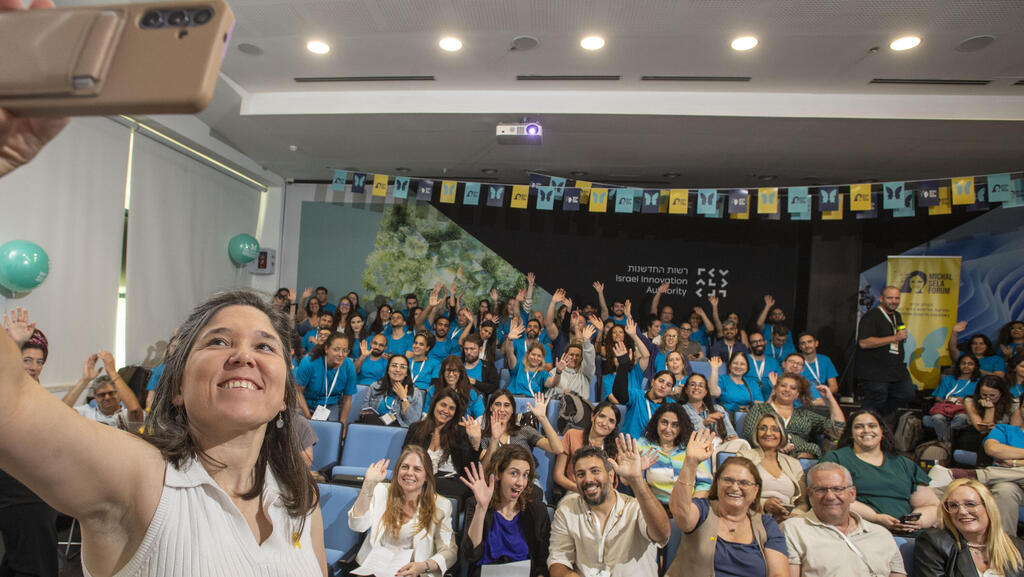
The event photograph catches a less formal part of the operation: Ben Ami holds up a phone for a selfie, with a room of participants waving behind her. It is a useful picture of the job. The founder is visible at the front, but the work depends on getting all those other people into the frame.
Making prevention somebody’s budget
Ben Ami also pursued a language familiar to officials who allocate money. The forum commissioned Social Finance Israel to examine the economic cost of intimate partner violence and femicide. Published in 2024, the analysis estimated an economic cost of NIS 8.2 million for each murdered woman. The figure was an estimate of consequences, never a valuation of a life.
She explained her purpose directly: “I thought that maybe if I could show this to decision makers, I could convince them to put money towards prevention.” The question now had a budget attached. Alongside the family account and the technical brief sat an argument about public spending. Each reached people who might otherwise consider the subject somebody else’s responsibility.
Recognition followed the organising. In 2021, she received the Rappaport Prize for Promising Groundbreaking Initiative and was among the first recipients of the Peres Center’s Medal of Distinction. Her work also travelled: Brazil’s Senate included her in a November 2022 seminar on initiatives to prevent violence against women. The forum describes a goal of helping establish 100 prevention startups by 2030. That remains a target, with years of development still attached.
A founder changes seats
In August 2026, Ben Ami joined Yisrael Beiteinu. Later that month, she announced the end of her tenure as the forum’s CEO, while continuing to accompany it voluntarily. The party placed her eleventh on its list for the 2026 Knesset election. Her public work had acquired another venue, with the compromises and arguments that party politics brings.
The move followed earlier involvement in electoral politics, including a place on the Labor-Gesher list in 2019. It also followed years of trying to make institutions act: a university, a school, technology companies, government departments. The settings changed; the habit of asking an institution to take responsibility was already established.
Back at Ein Gedi, the starting point had been a question about protecting a database. Since then, Ben Ami had helped build a forum, convene developers, support ventures and organise practical protection. Her stated goal remains zero women murdered in a year. There is no tidy final scene for an ambition like that. There is the next brief, the next team and the next opportunity to act earlier.