Charles Best’s first recruitment campaign involved eleven roasted pears. His mother made them with orange rind, apricot jam and spices. Best took them to the teachers’ lunchroom at Wings Academy, the public high school in the Bronx where he taught. There was a condition attached to dessert: anyone who ate a pear had to post a classroom request on the website he had just launched.
Eleven pears, eleven requests. As customer acquisition strategies go, it had the advantage of being edible. It also suited the problem. Best needed colleagues to believe that a stranger might pay for something their students needed. A working demonstration would be more persuasive than a speech about the future of philanthropy.
His aunt funded the first request. Best paid for the other ten himself, anonymously. The apparent arrival of donors encouraged his colleagues to spread the word. He later told the story openly, including his role as the undisclosed benefactor. The website had acquired teachers before it acquired enough strangers.
This was 2000. DonorsChoose began with the practical wishes that circulate in a school lunchroom: books to read, art supplies to use, places to take a class. The wishes already existed. Best’s contribution was to give them an address outside the building.
Before the website, a teacher
Best had wanted to follow his own English teacher and wrestling coach, Mr. Buxton. At Yale, he took part in a teacher preparation program and worked in fellowships at Wilbur Cross and Hillhouse high schools. He graduated in 1998. Teaching was a career he had deliberately prepared for, with a particular adult’s example in mind.
At Wings Academy, the distance between a lesson imagined and a lesson affordable became part of his working day. Copy paper was rationed. He made early-morning trips to Staples to photocopy pages of Little House on the Prairie. On a salary of about $30,000, buying supplies competed with everything else a salary is supposed to cover.
That experience gave his idea its shape. A teacher could explain a specific classroom project. A donor could decide whether to help. The question was small enough to answer: would you help buy these books for these students? Nobody had to settle every argument about American education before a box could arrive.
He kept teaching while building the organization. For five years, his professional life included the ordinary obligations of a schoolteacher; DonorsChoose became his full-time work afterward. The overlap matters. Teachers were colleagues whose requests he understood, rather than an audience he had first encountered through a business plan.
The machinery behind a generous impulse
The early website began as pencil-and-paper drawings. A programmer agreed to build it for $2,000. Best’s students helped with the work after school, including letters to potential donors. Their involvement was practical and public: the young people the project was supposed to serve also helped introduce it to the world.
An online request creates a deceptively tidy picture. Underneath it sits a succession of tasks. DonorsChoose reviews what a teacher asks for. Once a project is funded, the organization purchases the resources and ships them to the school. Donors receive a teacher’s thanks and an account of how the money was used. A click eventually has to become a delivery.
That purchasing step is central to Best’s reasoning. He wanted people to support teachers they had never met, including teachers whose communities could not supply a ready-made circle of affluent donors. Trust had to travel farther than a parent’s view through a classroom door. Reviewing requests and arranging purchases gave a stranger something concrete to rely on.
The organization’s nonprofit structure followed the same purpose. Best has explained that concentrating on better-off parents supporting their own children’s classrooms would have offered a different commercial opportunity. DonorsChoose committed itself to helping educators in lower-income communities be discovered by people outside those communities. That choice creates work, and the work needs paying for.
- 01Teacher requests
- 02DonorsChoose reviews
- 03Donors contribute
- 04Materials reach school
Getting a stranger to care
Best’s early problem was familiar to anyone who has built a marketplace: one group’s reason to participate depends on another group already being there. Teachers needed donors. Donors needed convincing projects and confidence in the process. The pears got one side moving. Students, correspondence and repeated introductions helped bring in the other.
By 2006, when Ashoka elected Best a fellow, its account described roughly 10,000 teachers, more than 20,000 proposals and $7 million in donations. Those figures belong to that period. They show how far the idea had travelled before crowdfunding became an everyday word, and how much of the growth preceded the celebrity associations now attached to it.
Oprah Winfrey helped expose DonorsChoose to a much larger audience. She would include it among her Ultimate Favorite Things. The appeal was unusually easy to demonstrate on television: an individual classroom had asked for something, and a viewer could help provide it. The public invitation retained the dimensions of the original request.
Stephen Colbert’s involvement took a more comic route. During his satirical presidential run in 2007, supporters could express enthusiasm by funding classroom projects. Craig Newmark helped make the connection. Colbert joined the board in 2009, giving an election joke a useful afterlife. American politics had, for once, produced something a teacher could unpack.
given by 4.7 million people to nearly 2 million teacher requests.
A taste for plain words
There is a revealing side project in Best’s career. He founded Irregardless, a crowdsourced writing guide that collected troublesome words and phrases, explained the objections and suggested alternatives. Science writer Carl Zimmer contributed a guide. Users could paste in their writing and see expressions flagged for attention.
The project adds a pleasing complication to the founder portrait. Alongside the logistics of school supplies sat an interest in sentences that waste the reader’s time. Even the name, Irregardless, invited an argument about language. Best was willing to make a website out of an irritation that other people might confine to the margin of a document.
In education, he has also argued for hearing teachers more clearly. “Teachers know how to improve education,” he said in 2014. The request itself gives that conviction a practical outlet. A teacher explains an idea in words a prospective donor can understand, and chooses the materials that would make it possible.
The pattern is recognizable without turning it into a slogan: give the person doing the work room to describe what the work requires. Best’s projects have made that description easier to offer, easier to understand and, in the classroom’s case, easier for someone else to act on.
“Teachers know how to improve education.”Charles Best · 2014
The founder makes room
In April 2021, Best announced that he would hand the chief executive role to a successor in 2022 and move to the board. By the announcement, DonorsChoose had enabled 4.7 million people to contribute more than $1 billion to nearly two million teacher requests. Those were the organization’s reported totals at the handover announcement, rather than a claim about its size today.
Alix Guerrier was introduced as the next CEO in December 2021, ahead of taking over in spring 2022. He brought experience as a teacher, education consultant, LearnZillion co-founder and GlobalGiving chief executive. The choice placed someone with his own education and philanthropy experience in charge of an organization still closely associated with its founder.
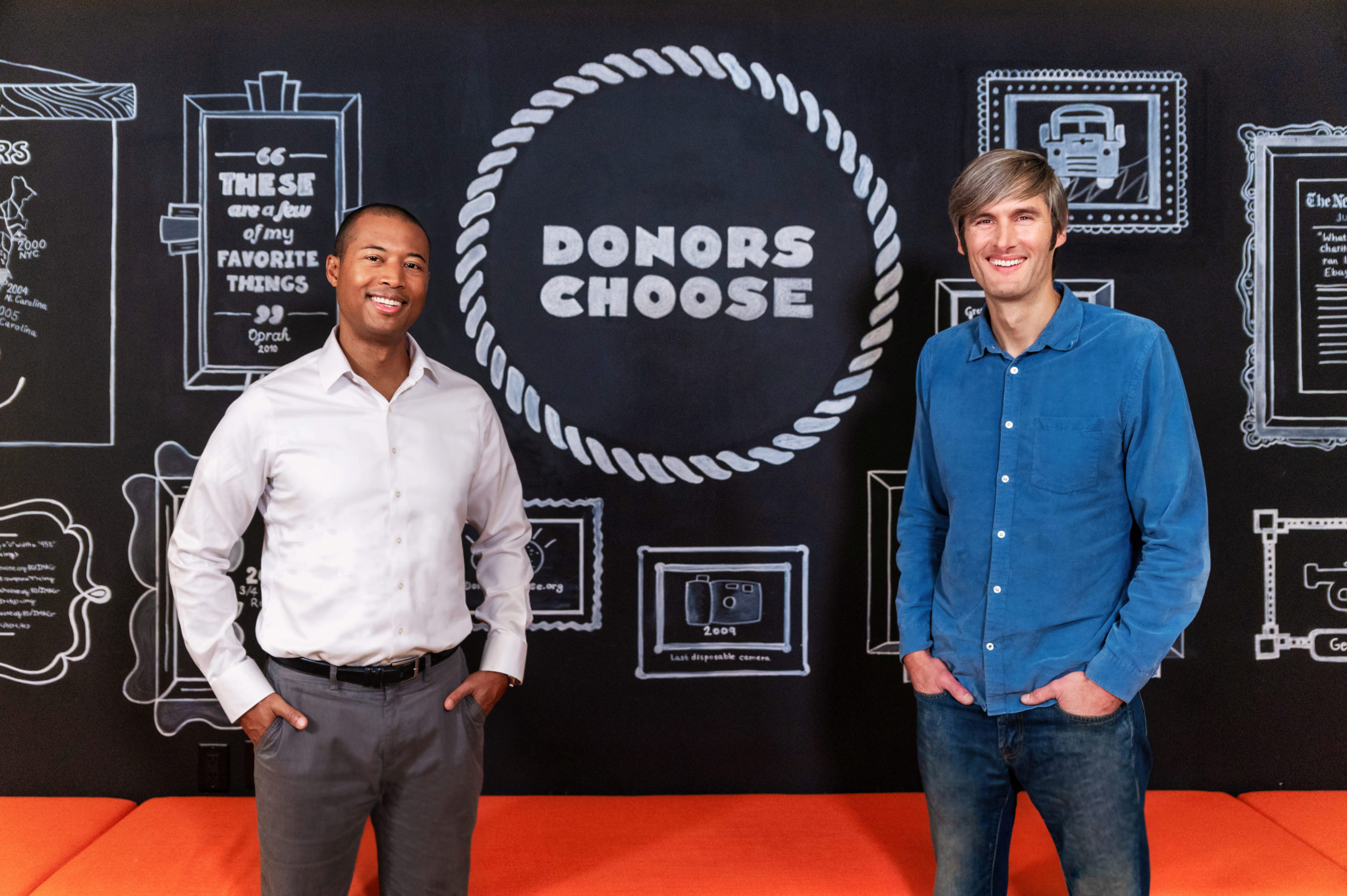
The photograph of Guerrier and Best together captures a plain organizational fact: the job could be handed to someone else. A founder’s idea can become large enough to employ a successor. After more than two decades, Best’s contribution included making space for that person to run it.
In 2023, Best joined Lakeshore Learning, initially alongside longtime CEO Bo Kaplan. He announced that he would move from New York to Los Angeles and learn about manufacturing and physical retail. The new job returned him to the objects behind the requests: the materials children handle, the furniture they sit at and the equipment teachers choose.
Still thinking about the classroom
His responsibilities now extend into the physical business of making and moving those materials. In October 2024, he accepted a Rural Investor Award for Lakeshore in Utah, where the company planned a 1.22 million-square-foot distribution facility. The project was expected to create about 550 jobs. A teacher’s request eventually leads to questions about warehouses, too.
Best also remains publicly connected to DonorsChoose. In May 2026, he appeared in its tribute to Colbert, celebrating a practice in which Late Show guests received DonorsChoose gift cards. The same mechanism let another person select a classroom to support. The invitation had found its way from a school lunchroom to a television guest’s parting gift.
His stated ambitions for classroom giving include a useful limit. He has said he would welcome an end to the need for donations to cover basic supplies. He has also described the potential for classroom-request data to inform decisions beyond the website. A record of what teachers ask for could help others understand what schools lack.
There is room in that ambition for the interesting extras: a museum visit, a science project, something a teacher thinks will catch a particular class’s attention. Best’s work began by taking those wishes seriously. Before the totals and the television appearances came eleven requests, and before the requests came his mother’s dessert. A pear was a modest price for getting an idea out of the lunchroom.
Follow the classroom thread
- Explore DonorsChoose ↗
- Lakeshore Learning ↗
- Charles Best on LinkedIn ↗
- Charles Best on Twitter / X ↗
- Listen: Best on the power of small goals ↗
- Watch: Oprah and Colbert tell the DonorsChoose story ↗
- Interview: the early experiments, in Best’s words ↗
- Carl Zimmer on Best’s writing-guide experiment ↗
- Read: the 2026 tribute to Colbert ↗