Before Vikra Ijas helped build an online route for other people’s generosity, he had a reliable system for his own. He asked his mother to distribute his donations. The arrangement had an obvious virtue: he trusted the person handling the money. It also had an obvious limit. A country cannot ask everybody’s mother to become its donation infrastructure, however competent the mothers may be.
That small difficulty is a useful place to begin with Vikra. The desire to help was already present. What was missing was a convenient way to connect it with someone who needed help. Kitabisa, the Indonesian fundraising platform he co-founded and now leads, grew around that gap between wanting to contribute and knowing how to proceed.
There is a human scale to the problem that survives all the talk of platforms. Someone has a cause. Someone else has money to spare. Between them sit distance, uncertainty and the entirely reasonable wish to know where a donation will end up.
The long way back from Auckland
Vikra’s route into this work ran through New Zealand. He moved to Auckland with his family in 2004. When they returned to Indonesia in 2006, he stayed. University followed, although his initial choice of finance and accounting did not. A marketing class caught his interest, and he changed his course of study.
He completed a Bachelor of Commerce at the University of Auckland, specialising in marketing and international business. His early work included Gopher, a New Zealand startup expanding into Indonesia. In 2013, he worked at PT Mitra Usaha Sportindo, managing projects for Manchester United Soccer Schools in Jakarta. Before donation campaigns, there were other kinds of audiences to understand and other operations to make work.
The Kitabisa connection came through Rhenald Kasali and Alfatih Timur, known as Timmy. Timmy had begun the social initiative in 2013. Vikra joined in June 2014 as chief marketing officer. Their interests met at a practical question: how could an online service help people participate in the kind of collective support Indonesians already understood?
Gotong royong, the practice of sharing work and burdens, gave that question a familiar starting point. The behaviour had a history. The website had to earn its place in it. For Vikra, marketing would involve explaining why people should bring a familiar act of generosity into an unfamiliar setting.
Marketing
Product
CEO
Industry leadership
The product nobody owes you a click
The early work did not produce a neat lesson in inevitable success. Vikra later described taking Kitabisa to makerspaces, social activists and campuses, and discovering that audiences were not necessarily ready for what the team offered. A founder’s enthusiasm, it turned out, did not automatically become somebody else’s need.
At a startup discussion in 2018, he spoke about the gap between a product that seems appealing to its makers and one that people actually use. He also credited help from Bukalapak, people at Gojek and the wider startup community. In his telling, building the company involved accepting instruction from outside it.
That admission gives his career some texture. A marketing executive can spend a working life polishing the explanation. Vikra’s account leaves open a more awkward possibility: the offer itself may need work. Anyone who has lovingly prepared a pitch for an indifferent audience will recognise the distinction, usually with a slight wince.
In January 2018, he became chief product officer. The move put him closer to the experience after the pitch: what a person encounters when they arrive, what makes sense, what requires effort. Marketing and product meet there, at the moment a curious visitor has to decide what to do next.
By February 2020, Vikra had been selected as an Endeavor Entrepreneur at the organisation’s international panel in Riyadh. The recognition arrived after years spent doing the less ceremonial work of finding an audience and improving a service. The sequence matters. There were customers to understand before there were panels to attend.
A little ego goes a long way. Too far, sometimes.
Vikra’s own writing suggests that the person behind these decisions is interested in what ambition does to its owner. In a 2015 essay, he considered lessons from Ramadan for entrepreneurs. One of his headings was wonderfully economical: “Master thy ego.” It is a demanding management programme for three words.
He connected religious practice with self-control, daily preparation, contribution to community and clarity of purpose. The essay treated business as part of a person’s conduct, with consequences for the people around them. It also made room for a Beyoncé reference. Solemnity, apparently, was optional.
“Master thy ego.”
Vikra Ijas, writing about entrepreneurship in 2015
That concern with ego has a practical counterpart in his advice about products. If a founder insists that an idea must work because it is theirs, there is little room left for the user. His writing and his startup lessons repeatedly bring the attention back to other people: what they need, what they understand and whether they find the service useful.
He has taught these questions in public, too. At COMPFEST’s startup academy, he explained minimum viable products and ways to test an idea before building too much. The methods included landing pages and services initially delivered with substantial human assistance. A small test could tell a team something a grand plan could not.
His YouTube work, under the name Catatan Anak Startup, or CAST, brought similarly direct questions to aspiring founders. Video titles asked about founders who cannot code, startups spending money and the danger of falling in love with an idea. These are questions a newcomer might hesitate to ask in a room full of people pretending to know the answers.
His interest in how people choose a direction has brought him into another kind of conversation. He is among those interviewed in Henry Manampiring’s The Compass, a book about decisions, character and the Greek idea of virtue. Its other interviewees include Zenius co-founder Sabda PS and rapper Saykoji. A fundraising founder sits comfortably in that company: the questions surrounding work, purpose and a useful life reach well beyond the people who happen to be building technology companies.
Getting people to come back
A fundraising service has two audiences to attend to: people raising money and people considering a donation. Vikra made that balance explicit in his 2025 presentation on Kitabisa’s first decade. The platform snapshot was substantial: more than 12 million lifetime donors and more than Rp5 trillion in donations facilitated.
Figures presented by Vikra at Asia Philanthropy Circle. Cumulative platform measures.
He also discussed regular giving and the donor community, alongside the different ways fundraisers bring attention to a campaign. This is where the work becomes more complicated than attracting a large crowd once. A person can be moved by one appeal. Giving regularly asks for a continuing place in their life.
Consider the different clocks involved. A campaign may need support immediately. A donor may give whenever a story reaches them. An organisation running a continuing programme has commitments that extend beyond either moment. Bringing those clocks into a workable relationship is a product problem and an organisational one.
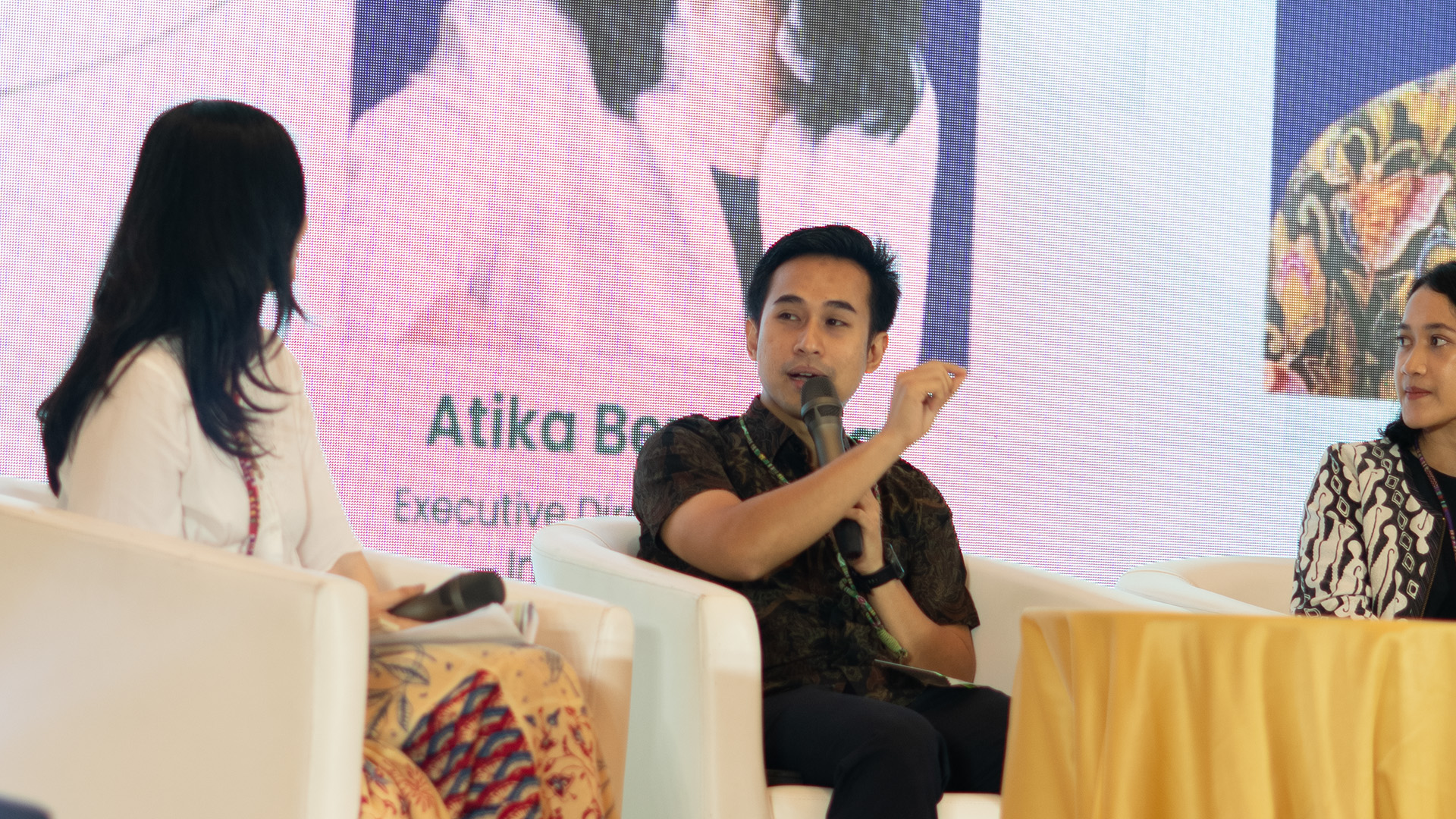
At FIFEST in August 2025, Vikra returned to the difficulty of acting alone. “Kalau sendirian pasti kerasa susah, tapi kalau ramai-ramai pasti KITA BISA,” he said. Loosely translated: alone it feels difficult; together, we can. The company name fits rather neatly inside the sentence.
He also acknowledged that gathering people and donations could still leave a shortfall against larger, more complex problems. One response was endowment funding through waqf, intended to make support useful over a longer period. The ambition was becoming more demanding: generosity needed a structure that could continue working.
The distinction is easy to appreciate without a finance vocabulary. A successful appeal answers what people can do today. A lasting programme must also answer what happens next month. Vikra’s public discussion of the latter shows how far the work has travelled from putting an appeal on a website.
A conceptual guide to the approaches he discussed, rather than a comparison of financial returns.
The work after the applause
Vikra became Kitabisa’s CEO in 2024. By then, his responsibilities had crossed the boundaries between attracting people, serving them and organising the teams doing both. Leadership adds another audience whose needs cannot be solved with a better campaign page: colleagues who need the organisation to function.
His public work has also widened. In September 2026, a partnership announcement pictured him with Bybit Indonesia CEO Lawrence Samantha. The collaboration supported the restoration of educational facilities after flooding in Sumatra, including schools in Langkat. It offers a concrete example of the coordination involved after public attention has moved elsewhere.
The same month brought an industry assignment. On September 21, Vikra was appointed secretary-general of Asosiasi Fintech Syariah Indonesia for the 2026–2029 term. The announcement also identified him as president commissioner of SalingJaga. Work that began around a donation platform now includes helping shape conversations across an industry.
There is a tempting way to tell a founder’s story in which every earlier job becomes a clue to the final title. Vikra’s path is more interesting when its practical turns remain visible: a change of university major, an early startup job, football-school projects, audiences that needed a different proposition, advice borrowed from peers.
And somewhere near the beginning, a mother helping her son pass on a donation. The attraction of that arrangement was personal confidence. The challenge he has spent years working on is making participation possible between people who have never met. Every additional donor enlarges the circle. The next person still needs a reason to trust it.