Sumardi Fung’s introduction to Ethereum came with a question he could not answer. It was 2017. A friend mentioned the cryptocurrency; Fung wanted to know what it was. His opinion of Bitcoin was already fairly settled: he thought it was a scam. Then another conversation, this time around badminton, sent him home to read about the technology. A future exchange founder had begun with a raised eyebrow.
That is a useful place to begin his story. Cryptocurrency biographies can sound as though their subjects were born expecting a distributed ledger. Fung’s account has the more convincing inconvenience of doubt. He encountered something unfamiliar, investigated it, and changed course. The important turn came before a funding announcement or a company name. It came when an objection became a question.
Today, Fung is co-founder and co-CEO of Reku, the Indonesian investment platform that offers cryptocurrency and US stocks. Between that first question and the current business lies a sequence of experiments: learning to mine, working with friends, building an exchange, and making a complicated product easier for other people to use. His route into finance had already taken several detours.
A computer was his second classroom
Fung’s formal education ended early. He completed primary school and attended the first year of junior secondary school. In his account of childhood, he described himself as mischievous and little inclined to study, while crediting himself with an aptitude for mathematics. Computer games became an interest, particularly games with a logical structure. “Saya suka game yang logic,” he said - he liked games based on logic.
He went on to teach himself more about computers. The distinction matters: leaving school and stopping learning are separate events. In Fung’s case, the second did not follow the first. A game has rules, a system, and consequences. You can try something, see what happens, and try again. That rhythm provides an apt way to read the practical experiments that followed in his business career.
His work before Reku included co-founding Modifikasi.com, an automotive forum. His LinkedIn career record dates that chapter from February 2004 to July 2017. It is an easily overlooked part of the biography because a car forum and a crypto exchange sit in different corners of the internet. Both, however, put a digital platform between an individual and a community of people with a shared interest.
He also worked in foreign exchange and futures trading from 2005 to 2017. Those years gave him experience with markets before he began exploring crypto. The chronology prevents a misleading reading of the later pivot: he was learning a new technology while bringing an existing familiarity with trading. The asset was unfamiliar. Buying, selling, and running a market were considerably less so.
Ten GPUs and a practical question
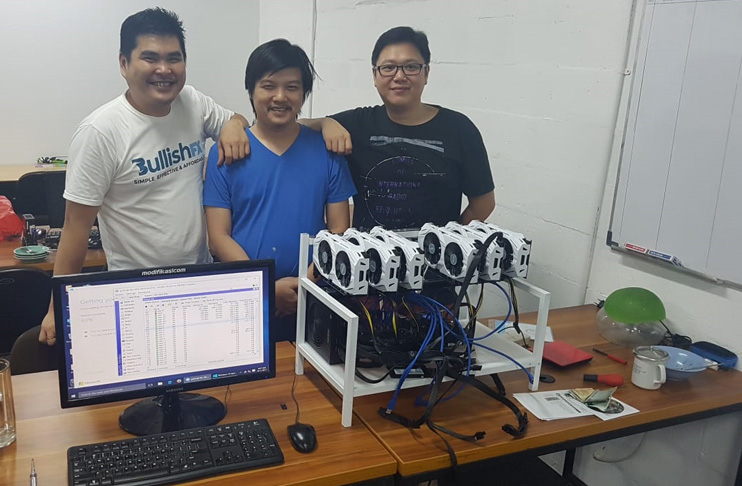
The first crypto venture involved equipment. Fung, Robby, and Johny experimented with mining in 2017, beginning with ten graphics processing units. They learned how the process worked and calculated the costs. Their initial conclusion was that the activity could be profitable. The business began at the level of a machine that had to run, rather than an audience that had to applaud.
Reku’s own history describes the founders’ mining operation expanding to 2,000 GPUs. That figure belongs to the early operation, not to a description of today’s Ethereum network or Reku’s present equipment. Its significance here is the change in scale: a trial became a substantial undertaking. The founders were acquiring operational experience with the assets they would later help other people trade.
Early company history, 2017-2018. Hardware counts, not investment returns.
Mining raised a wonderfully ordinary commercial question: where should the resulting assets be sold? The founders examined existing exchanges. That brought the project closer to Fung’s earlier experience in trading. A new technology had produced a familiar problem of market access. The next business opportunity was taking shape at the point where production met a customer’s ability to buy and sell.
There is a pleasing lack of grandeur in that sequence. A platform can begin with a manifesto. It can also begin because the people operating the machines need somewhere to transact. Here, experimentation supplied a reason to investigate the next part of the system. Each answer created another piece of work. An exchange would require more than enthusiasm for the assets passing through it.
The exchange arrived before the short name
The team began building Rekeningku.com in 2017 and publicly launched it in January 2018. Robby was a childhood friend of Fung’s, and the founding story also includes Johny. Those relationships belong in the account because this was a collective undertaking. The familiar image of a lone founder is a poor fit for a business whose early work was shared across a small group.
Rekeningku started as a website and later became available as a mobile app. The development was carried out by the company’s own team. Its stated priorities included selected tokens, accessible features, withdrawals, and round-the-clock live customer support. These are practical choices. A person who cannot complete a transaction or reach someone with a question is unlikely to be impressed by an ambitious account of the future.
In August 2022, the company announced a shorter name: Reku. Users had already been using and liking the abbreviation. It is an unusually sensible origin for a rebrand. A customer had effectively done the editing; the business adopted the result. The change made the name more compact while keeping a connection to the service people already knew.
A business in five turns
- 2004Co-founds Modifikasi.com
- 2017Mining experiments; exchange development
- 2018Rekeningku public launch
- 2022Reku name; $11m Series A
- 2024US stock offering announced
Capital meets the machinery
In September 2022, Reku announced an $11 million Series A led by AC Ventures, with Coinbase Ventures and Skystar Capital participating. The announcement also reported $3 billion in gross transaction value for 2021. These are two different measures: one records financing received by the company; the other records trading activity through its platform. Neither is a figure for Fung’s personal wealth.
At the time of the announcement, the company had 80 employees and planned to add more than 50. Jesse Choi had joined as chief operating officer. His background included management consulting and private equity, bringing a different set of experiences into a team with roots in trading and technical operations. Growth now involved hiring and extending the business alongside maintaining the platform.
Fung’s public explanation of the opportunity concentrated on guidance. “Even today, crypto is a complicated asset class to understand,” he said in the funding announcement. That observation is especially interesting coming from someone who had learned by taking the system apart himself. His own path had required curiosity and effort. A consumer product has to accommodate people who arrive with different amounts of both.
“Even today, crypto is a complicated asset class to understand.”
Sumardi Fung, September 2022
The question for such a founder is how much of his own learning process should be required of the customer. Technical familiarity can make it easy to forget the difficulty of a first encounter. Fung’s comments acknowledged that gap. The business proposition included helping people understand what they were using, alongside providing the mechanism for a trade.
The order book has a first-time visitor
In a September 2023 interview, Fung described the problems Reku had tried to address: transaction costs, customer support that was unavailable around the clock, and interfaces that could bewilder an inexperienced user. He explained Lightning mode as a simpler view, showing buy and sell prices without the mass of numbers presented in a conventional trading interface.
The design problem is easy to picture. A screen full of changing figures may be informative to someone who knows what every column means. For a newcomer, it may simply be a screen full of changing figures. A product has to decide what to show first, what to explain, and how to let someone proceed. The same interface cannot assume the same knowledge from everyone.
Fung also discussed crypto literacy and warned against buying merely because a friend suggested it. That concern gives the origin story a useful echo. A friend’s question helped start his own investigation, but investigation was the essential next step. The distinction is a question of agency: another person can introduce an idea; understanding it still requires work.
Friends, colleagues, and a wider brief
Reku’s leadership now lists Fung and Choi as co-CEOs, with Robby as chief compliance officer. Its January 2024 account of the team describes complementary backgrounds: Fung’s involvement in building the infrastructure, Robby’s work on compliance and industry relationships, and Choi’s business experience. The partnership has changed in composition and scope as the company has developed.
In May 2024, the company recorded Fung and Choi attending the opening of Crypto Literacy Month, where Robby participated in his industry leadership role. It offers a concrete view of the team beyond an app: founders appearing together in an effort concerned with public understanding. Education had become part of the company’s outward-facing work as well as a product consideration.
That September, Reku announced access to more than 600 US stocks. The expansion announcement described a platform working with Pasar FX and Alpaca Securities, with tools for tracking stocks and crypto investments. Choi presented the new offering as an extension of the company’s work. Fung’s co-led business had moved beyond the original category of assets that brought its founders together.
The widening brief makes the first Ethereum question look less like a destination and more like an entry point. Fung’s career connects computer interests, an automotive community, trading experience, mining, and an investment platform. The connecting thread is visible in the work: learn how a system operates, build something people can use, and keep dealing with the questions that use produces.
There is room for amusement in the distance travelled. A conversation around badminton is a modest opening for a business biography, which is part of its appeal. The machinery, colleagues, financing, and product decisions came later. At the beginning stood a person prepared to ask what a thing was. For Sumardi Fung, that turned out to be a consequential habit.