The first career Ligia Zamora chose had concrete in it. She was good at math and science, and at eighteen the sober logic of civil engineering seemed irresistible: here were serious subjects leading toward a serious profession. After college, she spent two years designing highways in New Jersey. The calculations worked. The career did not. Zamora would later describe herself as being about as far from her passions as a person could get, a wonderfully severe verdict on a job devoted to shortening distances.
The correction came from somebody else's imagination. A hiring manager offered her a product-marketing position, a role she had never considered and for which her job title supplied no obvious invitation. Zamora believes he saw potential. Once inside marketing, she discovered that engineering had travelled with her. Analytics mattered. So did the scientific method, systematic problem-solving and the useful suspicion that a claim ought to withstand inspection. She had not wasted her technical training. She had simply been reading its destination too literally.
A résumé that only looks straight from a distance
Zamora's route through enterprise software reads like a compact history of the industry's changing obsessions. She worked on CRM products at Remedy, moved into product management and marketing at PeopleSoft, then led small-business product work at SuccessFactors. She became vice president of products at web-analytics company Coremetrics, followed by product-marketing leadership at mobile-app platform Kony and enterprise-content company Alfresco. Five years at Veeva Systems put her in global product and content marketing. In 2020 she joined Eightfold AI as Chief Marketing Officer, working in the emerging market for AI-driven talent intelligence.
The company names are tidy. The lived experience was not. Zamora has described her path as moving through civil engineering, business development, product management and marketing by following curiosity and the desire to learn. Elsewhere, she has used the image of a jungle gym: pivots, lateral reaches, backsteps and comebacks. Ladders flatter the person already at the top. Jungle gyms are more honest about how much gripping, stretching and occasional dangling a career requires.
“I mostly just followed my curiosity and desire to learn new things.”Ligia Zamora, on her non-linear career
That experience hardened into a hiring philosophy. Zamora says she looks for intelligence, curiosity and appetite for learning. She calls such people “athletes,” a term for adaptable operators rather than decorated specialists. Past performance remains useful evidence, yet a five-year-old job description is a poor prison for somebody's next five years. Her own career depends on that proposition. A manager once hired the product marketer who was still hidden inside the highway engineer.
The title is a label, not the work
In a public essay, Zamora wrote the sentence with refreshing economy: “Titles aren't careers.” She was pushing against the reflex to treat people management as the mandatory tollbooth on the way to importance. Someone may love writing, data analysis, accounting or design, then accept management because the org chart presents it as progress. The promotion arrives; pleasure in the daily work quietly leaves.
Her alternative is accumulated experience. Degrees and certifications begin the education, while repeated contact with real problems develops judgment. A title may reward that judgment, but it does not manufacture it. The distinction feels especially pertinent in enterprise software, where acronyms can gather faster than understanding. Zamora has marketed human-capital systems, CRM, content management, analytics, AI and now pricing and rebate technology. The durable job beneath those categories is translation: learn a complicated mechanism, locate the commercial stakes and give buyers a sentence sturdy enough to carry both.
Product marketing gave her an unusually good seat for this work. It lives between what engineers build, what salespeople promise and what customers are actually trying to accomplish. The job punishes vagueness from every direction. Technical fluency without a buyer's problem becomes documentation. A bright slogan without product truth becomes a very short meeting. Zamora's progression from product manager to product-marketing leader let her work both sides of that border. At Coremetrics she held a product title; at Kony, Alfresco and Veeva, her remit centered on explaining and positioning products. Each stop added another dialect of the same commercial language.
A former Kony colleague, Bob Tiani, publicly remembered her as energetic, focused and funny under deadline pressure. He wrote that her team repeatedly delivered high-quality materials despite tight schedules and high expectations. The recommendation supplies a useful bit of texture to an executive biography otherwise filled with product categories. Zamora's public writing is serious about learning, yet it rarely treats seriousness as a reason to become solemn. Even her retirement plan arrives with a joke about signing out of dashboards and handing off marketing-qualified leads.
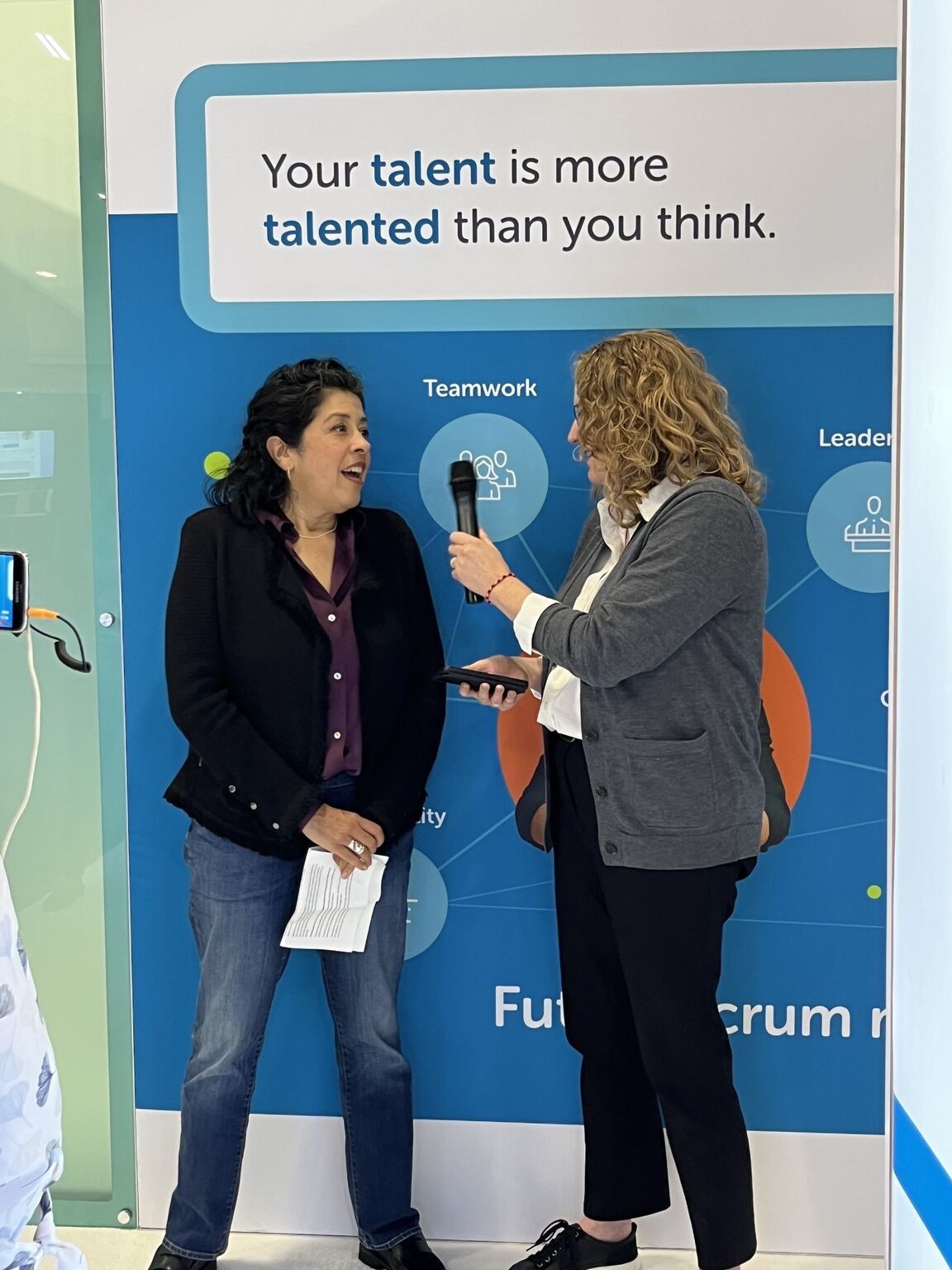
At Eightfold, the microphone became literal. Zamora co-hosted The New Talent Code with Jason Cerrato, interviewing HR practitioners and analysts about skills, workforce design and AI. Her on-air advice retained the structure of an engineer's checklist: do the homework, understand the problem, agree on the organization's priorities, then assess the available technology. She had little patience for adopting a shiny system before naming the problem it was supposed to solve.
The show began in 2022 and placed Zamora beside leaders attempting changes that looked attractive on conference slides and difficult on Monday morning. Conversations covered skills-based organizations, internal talent, AI regulation and the practical work of gaining support across a company. Her questions tended to pull guests from abstraction toward sequence: where do you start, who must agree and what changes in the room where decisions are made? Marketing often gets caricatured as amplification. Here it functioned as inquiry, with the CMO asking experts to show their working.
The Zamora test for a new technology
- Study reputable reporting, analysts and practitioners.
- Define the problem before shopping for a solution.
- Win agreement on the few priorities that matter now.
The accidental audition
Podcasting also revealed a second craft. While reviewing an explainer video, Zamora decided the voiceover was soporific. The agency, reasonably enough, asked her to show them what she wanted. She sent a recording. Their reply was an invitation to the studio. Zamora went on to become the voice of Eightfold product videos, learning that one of the skills she enjoyed most had been sitting inside an ordinary round of creative feedback.
She has called voiceover artistry her “secret retirement plan,” although the secret was announced to thousands of LinkedIn followers and is therefore operating with the discretion of a brass band. The plan is sincere. Zamora has said she would need to learn how the trade works, what artists charge and where companies find talent. Her larger point is characteristic: enthusiasm deserves respect, then research. “Stop stargazing and start putting a plan together,” she advised readers.
“Don't underestimate yourself or your passions.”Ligia Zamora, after discovering voiceover work
The anecdote makes a neat companion to her first pivot. In both, another person heard or saw a capability that her current role did not formally require. In both, she agreed to test it. Potential was neither mystical nor guaranteed. It became visible through a small piece of work: a hiring conversation, a sample recording, a willingness to enter the next room.
The new chapter: making trade intelligible
Zamora now appears on Enable's leadership team as Chief Marketing Officer. The San Francisco software company works in the unglamorous, consequential machinery of B2B trade: pricing, rebates and the agreements connecting manufacturers, distributors and retailers. Enable says its platform has processed $2 trillion in transactional value. Its task is to make commercial relationships clearer when the spreadsheet, contract and accounting system disagree.
The move also carries her across another category boundary. At Eightfold, the central object was talent: how organizations find, understand and develop people. At Enable, the object is margin and commercial performance. Both businesses ask executives to replace fragmented records with a more coherent view, and both sell into organizations where adopting software requires persuasion well beyond the buyer. The category changes; the organizational puzzle rhymes. Zamora's long tour through enterprise systems has made such changes less like reinvention and more like learning the next industry's nouns.
There is a recognizable fit with Zamora's career. Enterprise marketing rewards people who can respect detail without drowning the audience in it. Pricing and rebates are full of nested terms, delayed consequences and money that can remain hidden when data sits in separate systems. A former engineer with years in product management knows what complexity looks like from the inside. A practiced host and voice artist knows the cost of explaining it badly.
Her arrival also completes no grand circle. That would betray the story's central pleasure. Roads imply destinations, and Zamora has spent decades arguing for a career roomy enough to revise them. The civil engineer did not disappear when marketing began. She became the part of the marketer who checks the structure. The product manager became the part who asks what the thing actually does. The podcast host learned to make expertise conversational. The aspiring voice artist listens for energy.
A clean career narrative is usually the work of hindsight, a publicist with an eraser, or both. Zamora offers something more useful: a route in which wrong turns keep yielding equipment. Her résumé contains major software companies and C-suite titles, but its animating event remains modest. Somebody believed she could do work she had not done before. She tried it, liked it and eventually extended the same wager to other people.
The lesson is not to abandon expertise whenever Tuesday feels dull. It is to notice when the skills beneath a job can travel farther than its title. Curiosity can be a form of diligence. A sideways move can add a dimension. And sometimes the engineer responsible for the next useful route is the person willing to leave the highway.