Move the form to the left. It sounds like advice from someone who has spent too long staring at a landing page. Yet on Spiralyze’s website, this small rearrangement becomes an unusually revealing exhibit: 45 wins, 29 neutral results, 43 losses. Nearly as many defeats as victories. What, exactly, is a marketer supposed to do with that?
Spiralyze’s answer is to keep looking. One successful redesign tells you what happened once. A collection of experiments can help you decide which question deserves your next visitor. The Atlanta agency has built its business around finding those questions, then doing the work required to answer them.
- Spiralyze improves website conversions through managed A/B testing.
- Its prediction engine looks for recurring patterns across other websites.
- People handle research, copy, design, development and measurement.
- Published pricing includes $25,000 a month or a performance-based arrangement.
A small move. A complicated answer.
The form-placement example has a particular charm. It offers a concrete change while displaying evidence against treating that change as a commandment. Spiralyze groups similar experiments and weights their relevance to a client’s industry, visitors and objective. A cybersecurity demo page and a shoe checkout need not produce the same answer.
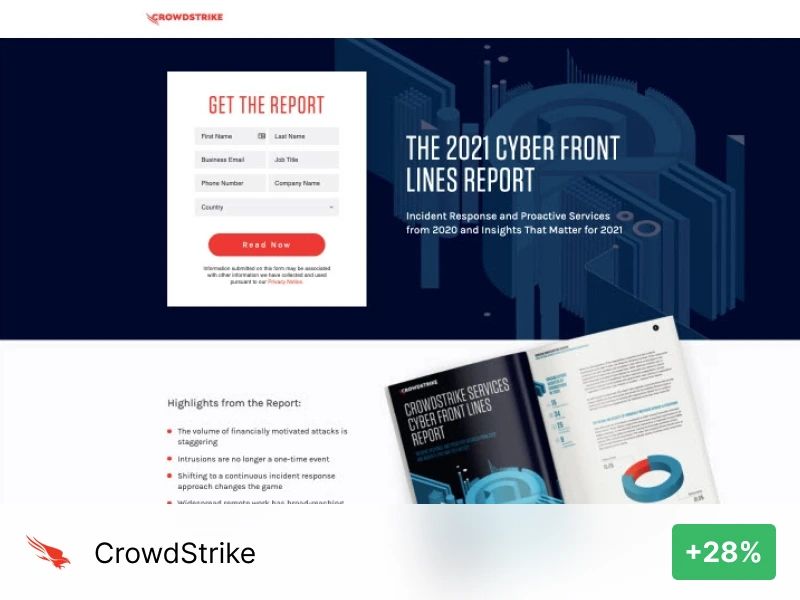
The company says its engine observes tests across 78,000 websites. That is an observation pool, not a client count. Its client page separately reports more than 300 customers served, spanning software, ecommerce and other businesses. Familiar names include CrowdStrike, Workday, Gusto and Netflix.
Borrowing the odds
There is a catch inside the word “observes.” In a September 2026 interview, CEO Sahil Patel explained that the company watches variations and the version a website subsequently keeps. That behavior offers a clue about the outcome. It does not reveal the private statistical report behind somebody else’s decision.
Read the prediction as a way to rank hypotheses. Your own experiment still has to establish whether the change helps your audience. A winning pattern elsewhere can lose here, as the agency’s own example makes plain. The interesting ambition is to improve the selection of bets across a program.
The test still needs a team
Spiralyze occupies the space between buying testing software and staffing an internal experimentation department. Alternatives include agencies such as Speero and Conversion Rate Experts, or assembling your own specialists. Spiralyze’s pitch combines its external pattern library with responsibility for delivery.
That responsibility runs from customer interviews and heatmaps to copywriting, design, development, quality assurance and analytics. It also includes hard-coding successful changes. A winning test that never becomes the permanent website is an unfinished job, however attractive the presentation announcing it.
The published process begins with designs ready for discussion at kickoff. Research and instrumentation follow; early tests launch in roughly two to three weeks. Weekly reviews cover results, new designs and the next experiments. The backlog matters: each gap between tests leaves available traffic answering no new question.
The research layer also gives the agency a way to ask why visitors hesitate. A session recording can show where someone stops; an interview can explain the concern. Neither automatically establishes which redesign will convert better. The test supplies that comparison, while the research helps choose something meaningful to compare.
The price of a better bet
The published flat fee is $25,000 monthly, with month-to-month terms. A separate performance option ties fees to uplift, with nothing upfront. A pilot concentrates on a few valuable pages. All three appear on the pricing page; the performance formula and pilot price require a proposal.
That distinction matters when reading the homepage promise of a 30% lift in 90 days. It is the company’s advertised program outcome. An individual experiment can lose. The signed scope and measurement rules determine what the commercial promise means for a particular engagement.
Nor does a 30% lift mean 30 percentage points. Imagine 10,000 visits producing 400 conversions. A 30% relative improvement would yield 520 conversions at the same traffic, moving the rate from 4% to 5.2%. These are illustrative numbers, not a Spiralyze customer result.
For a buyer, the useful calculation starts with the value of the additional qualified customer. A conversion metric needs to match that value: a newsletter signup, a demo request and a completed purchase represent different commitments. Agree on the event, the eligible traffic and the way downstream quality will be checked before judging the result. Otherwise, an impressive percentage can leave the commercial question unanswered.
A customer crosses the table
Patel’s route into the business supplies a useful detail. He used Spiralyze at ER Express in 2016, sold that company in 2021 and joined Spiralyze in 2022. He had already evaluated the service from the other side of the invoice. Testing helped turn him into a believer; later, founder Gajan Retnasaba needed a partner.
Retnasaba had described the difficult economics in a 2020 Mixergy interview: under the performance arrangement then, work could precede the first payment by four to six months. The agency financed the effort while waiting for a win. That gives its obsession with execution a practical explanation.

“Be short term annoying”One of Spiralyze’s published values
The company’s stated culture reflects that pressure. Its About page emphasizes measurable results and persistence, including the instruction quoted above. That is an employer’s description of its values. For a client, the observable version is simpler: a team willing to question a favored design and bring another experiment to the next meeting.
Start with something worth seeing
A reader can borrow the discipline without buying the service. Patel recommends showing the product, making copy easy to scan and answering the objection closest to the signup button. In his RocketReach example, spelling out the free lookup allowance helped visitors understand what they would receive.
Begin with a real uncertainty. Choose a measurable action, compare versions and follow the leads beyond the form. Spiralyze’s results framework includes qualified leads, opportunities and closed deals. More submissions are useful only if they contribute to the business you meant to build.
Traffic sets the pace. Patel has suggested roughly 50 to 100 monthly conversions as a practical starting range for B2B testing, rather than a universal statistical threshold. Sparse traffic, unreliable tracking or an unclear offer can leave a program waiting for answers. Borrow the hypothesis. Let your visitors decide whether to keep it.