Before Li Jianwen founded Denglin Technology, an investor suggested that he wait. Li had experience in graphics processors and an interest in building an AI chip along the lines of Google's Tensor Processing Unit. Northern Light Venture Capital's Yang Lei proposed a different first assignment: spend a few months at the firm, talk to people across the industry, and decide what to build afterwards. For a prospective chipmaker, conversation was a relatively inexpensive material.
Li took the detour. The company he established in Shanghai in November 2017 pursued general-purpose computing on graphics processors, or GPGPU. That choice would become the organising idea of his next chapter: retain the flexibility that developers need while changing how the hardware does its work. His story begins with an experienced engineer allowing an attractive first idea to be questioned.
A useful interruption
Yang's account gives the founding story an unusual centre of gravity. An investor helped delay a product decision rather than hurry it towards a pitch. Li's period with Northern Light gave him room to examine a market before committing to an architecture. The distinction mattered because a chip is a particularly expensive way to discover that yesterday's question has changed.
His background made the eventual direction understandable. Li studied microelectronics at Tsinghua University and earned a master's degree there in 1990. Before Denglin, he served as a vice president at Vivante, working on GPU and general-purpose GPU intellectual property. His career already involved the relationship between a processor design and the companies that would incorporate it into their own products.
At Denglin, another round of listening followed. Cofounder Wang Ping later described Li spending more than half a year visiting dozens of customers to understand their requirements. Wang placed those conversations near the beginning of the company's development. The founder was investigating the jobs his future product would have to perform, with the buyers supplying an inconveniently useful part of the specification.
More than half a year.
Wang Ping's account of Li's early customer visits offers a different measure of progress from a chip's clock speed.
The problem with a moving target
The difficulty Li identified was the pace of change in AI. A processor designed around a narrow set of assumptions could face a different market by the time it was ready. General-purpose computing offered flexibility; specialised designs promised efficiency. Denglin's proposed answer was a system in which software and different kinds of computing hardware could work together.
Years later, his public explanations remained focused on that balance. At a Tsinghua alumni forum in March 2023, Li discussed the demands that generative AI placed on chips. He described GPU+, Denglin's software-defined architecture, and the role of fast memory on the chip. He also emphasised the importance of an established software system, given how much AI development already depended on CUDA.
That is a less glamorous sales problem than announcing a faster processor. A customer has models, tools and habits already in use. Changing the hardware can mean changing work around it. Li's emphasis on the software ecosystem recognised that a chip competes inside somebody else's daily routine. The developer who has to make it run gets a vote.
Li also explained why a startup might concentrate on computing rather than try to enter graphics rendering at the same time. In comments reported in 2023, he described the GPGPU product cycle and customer switching as more manageable. A changing AI market offered openings, while an established graphics market presented a different competitive problem. His choice concerned where a new business could get started as well as what its engineers could design.
The engineer's name in the paperwork
There is a quieter record of Li's technical work beneath the product presentations. A US patent application filed on July 2, 2018 names Jianwen Li as the inventor of a configurable random-access memory arrangement using through-silicon connections. The original applicant was Shanghai Denglin. A patent on the application was granted on May 13, 2025.
The subject is memory and the connections used to operate it, rather than a sweeping promise about artificial intelligence. It places Li personally in a specific piece of engineering work during Denglin's early years. The application also provides a useful counterweight to the executive biography: here is a founder whose name appears where the technical mechanism has to be described.
Memory would also feature in his later public discussion of AI computing. The patent and the presentations serve different purposes, and neither establishes a product benchmark. Together, however, they make the technical interests concrete. Moving data, arranging computation and coordinating the two are recurring concerns in the work associated with his name.
From one to ten, with deliveries attached
By 2021, Li was describing a different stage of company building. Denglin's Goldwasser products were entering commercial use, and his language shifted towards execution. He distinguished the task of proving that a company could make a product from the task of bringing it to market repeatedly and improving its iterations.
“We've made it from zero to one.”
Li Jianwen, 2021 · translated from Chinese
His next concern was how to move from one to ten more effectively. In September that year, Yang Jian joined Denglin as vice president of global operations. Yang had previously held senior supply-chain responsibilities at Huawei. Li discussed reliable product delivery as a priority while supply chains were under pressure.
The appointment reveals an important connection in Li's career as a founder. Processor expertise helped make the product possible; operating expertise helped address what happened after a customer wanted it. The engineering team needed a counterpart capable of organising supply and production. A delivery date has a wonderfully clarifying effect on an architectural discussion.
Li also spoke about choosing investors who understood the time involved. In comments published in January 2022, he pointed to the long research and iteration cycles of the technology business when explaining the appeal of professional investors such as Qualcomm. The timetable he described required patience as well as money.
Further investment brought another occasion to state the direction. When China Internet Investment Fund backed Denglin in 2023, Li spoke about continued development of the company's own core intellectual property and expansion into related computing applications. The financing announcement tied capital to research and commercial production. It put another obligation behind the long development cycles he had described: investment had to support work that could eventually reach customers.
Making room for other people's work
Li's product philosophy extended beyond the processor itself. At the announcement of Denglin's Hanhai partner programme, he set out three priorities: address a customer's problem, do so at an attractive cost relative to performance, and make adoption easier. The third priority made migration effort part of the commercial argument.
The programme brought together hardware manufacturers, software businesses, algorithm developers and providers of industry solutions. Its commitments included technical assistance, product certification, joint marketing and help with deployments. These were practical arrangements for getting a processor into a working system, where several companies might each own a piece of the result.
Li also expressed an aspiration to build a profitable company. That belongs alongside the architecture in any account of his ambitions. It sets a business test for the engineering effort. A design can generate interest at a conference; a business must find customers whose reasons for buying survive the conference.
The meetings get bigger
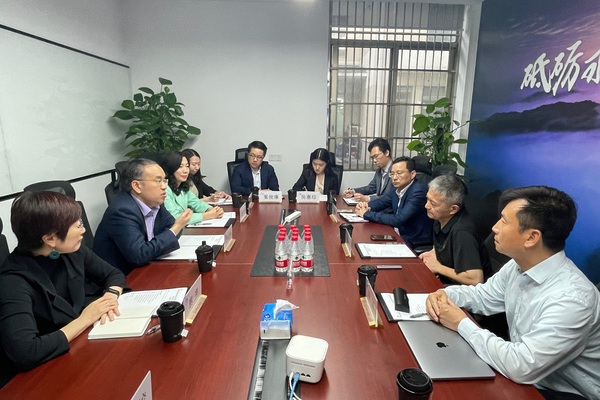
On June 19, 2024, Li met Hong Kong's Secretary for Financial Services and the Treasury, Christopher Hui, during Hui's visit to Denglin in Shanghai. The meeting placed the founder in a discussion about specialist technology and Hong Kong's financial offering. The photograph is suitably workmanlike: a meeting table, papers and people listening.
A year later, the setting was a product launch in Suzhou. On June 19, 2025, Denglin and Tianjin Banwei Technology held a joint event introducing Denglin's Nashi GPU series and Banwei's ACE-E edge large-model systems. Li attended alongside colleagues and partner executives. The event connected a chip company's products with the systems another business could put around them.
That connection is the practical continuation of his earlier partner strategy. The launch covered specific KS-series products and edge computing equipment. Customers would encounter complete products and combinations of products, rather than an architecture in isolation. Li's role now included appearing with the people responsible for turning the processor into something a buyer could deploy.
The same question, further along
In February 2026, Li accompanied a visiting delegation led by China Mobile Cloud's chairman, Fang Li. He presented Denglin's work in manufacturing and edge computing, including visual inspection applications. The discussion again concerned how computing products could fit into an existing industry and how partners could help deliver them.
He also appeared at an April 9, 2026 event involving Oriza Holdings and a major state-owned information-industry group. By September, Denglin's activities included participation in a Wuxi integrated-circuit conference and a broader Jiangsu industry network. The company now uses the Suzhou Denglin Technology name. Its founder's original Shanghai venture had acquired a wider set of industrial relationships.
There is continuity beneath the changes of venue. Before the company existed, Li was encouraged to test his intended direction against other people's experience. In its early days, he went out to hear customers. Later came software compatibility, supply-chain leadership and partners able to build systems around the chips. Each step added another person whose requirements the design had to accommodate.
Changing his initial plan did not leave Li without a direction. It gave him a more demanding one: make a processor flexible enough for changing applications, then make a company capable of supplying it. The interesting part of his story is how often that second task has sent the chipmaker back into conversation.