Lex Corwin’s first crop was a fiasco with a good address. He was 16, freshly returned to New York from a semester at a working farm in Vershire, Vermont, and newly equipped with the dangerous confidence of someone who had learned how soil behaves. Seeds arrived from Amsterdam. The growing happened on a neighbor’s Connecticut property. The property sat on Stone Road.
The harvest dwindled to one plant and an ounce Corwin later described as unsmokable. He solved the quality problem with better cannabis bought elsewhere, added tobacco, rolled spliffs and sold them to friends. It was teenage enterprise in its least boardroom-ready form. Yet the useful parts were already there: a memorable name, a product he would personally use, an instinct for presentation and a refusal to let the first batch have the last word.
The polished version arrived years later. Corwin moved west for Lewis & Clark College in Portland, played tennis, wrote for the student newspaper and worked around growers while learning cultivation, manufacturing and distribution. In 2016, at 23, he started Stone Road and bought a farm near Nevada City, California. The young operator who had once borrowed a neighbor’s land now had 57 acres and a much less forgiving customer than his high-school friends: a regulated market.
A farm lesson hiding inside a founder story
Corwin’s biography can look like a tidy chain of inevitabilities: New York teenager goes to farm school, moves to Oregon, enters cannabis and buys California land. Real stories rarely cooperate so politely. What endured was less a plan than a habit of proximity. He wanted to see how things grew. He wanted to work across the steps that turned a plant into a packaged product. Even now, his description of being a chief executive includes sales, production, cultivation, public relations, legal work and accounting. The title is grand. The calendar is not.
His parents, both businesspeople, offered advice. Corwin nevertheless described himself as self-taught and said he had started roughly eight ventures by age 25. That combination explains a certain looseness around ceremony. In one workplace interview, asked which purchase under $100 had most improved the operation, he could not produce one. The item exciting him was a pressure washer that cost about twice the limit. His larger point was sharper: the people doing the work mattered more than showy equipment.
That self-education never settled into a single specialty. In Portland, Corwin was close enough to the legal trade to learn its handoffs: cultivation produces the raw material, manufacturing makes it consistent, distribution gets it through a fragmented system and retail finally introduces it to a customer. A weakness anywhere can undo the care that came before. Stone Road would eventually bring some of those steps closer and entrust others to partners. The arrangement sounds technical. Its creative consequence was simple. Corwin could tell the brand story with the vocabulary of someone who had handled the product before it acquired a label.
“It’s about the people you hire, not the equipment you use.”Lex Corwin
There is a farmer’s pragmatism in that answer and a tennis player’s preference for repetition. Corwin competed at college level. Farming also rewards attention repeated long after novelty has wandered off. Neither activity respects a lovely pitch deck. A bad return or a neglected bed tells the truth immediately.
The landscape is doing the copywriting
Stone Road’s farm is off-grid and solar-powered. Its water comes from deep artesian wells. The team reuses living soil, makes compost teas and deploys ladybugs and predator mites against pests. Cultivation occupies less than an acre. Corwin has framed the remaining land as wild and untamed, a phrase with genuine marketing charm because the acreage makes it measurable.
The most expressive part of the farm is what stays untouched.
This is where Stone Road’s creative advantage becomes interesting. Plenty of consumer brands add environmental language after the product and packaging exist. Corwin had a physical place that could discipline the imagery. He brought designer Santiago Carrasquilla, a friend from his music-video days in New York, and packaging designer Alex Stikeleather to the farm. They took thousands of photographs. Those images became the basis of early packaging and campaign work, with new iterations continuing to draw from the archive.
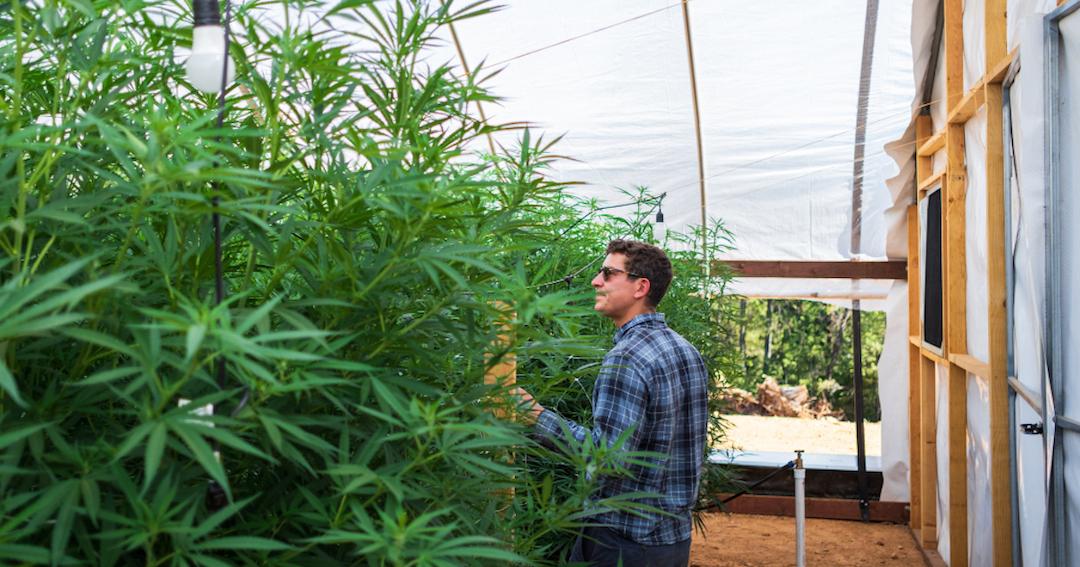
The lesson is portable. A brand acquires texture when the people shaping it visit the place where the promise is made. They notice the particular green of a leaf under greenhouse plastic, the geometry of netting, the improvised tools and the expensive things nobody photographs. Generic luxury is easy to assemble. A real landscape has stubborn details.
Corwin also understood that cannabis marketing had inherited a dreary choice between juvenile psychedelia and the objectification of women. He wanted an adult visual language without making the product precious or remote. Stone Road’s campaigns became polished, playful and openly queer. Corwin’s identity was not rented for June and returned in July. The company described itself as queer-led, supported LGBTQ organizations and developed “Queer All Year” as an explicit campaign idea.
“A brand is a reflection of the person who started it.”Lex Corwin
A beautiful package still has to get paid
The charming version of Stone Road ends with the photo shoot. The operator’s version begins after the invoice is sent. Corwin has spoken plainly about business partners who sued or robbed him, rolling papers spoiled in storage that led to a vast product failure, wildfire threats, hail, pests and retailers slow to pay or unwilling to pay at all. In 2023, he said the company was carrying close to a million dollars in outstanding receivables. In early 2024, he discussed one delivery company’s collapse while Stone Road was reportedly owed around $50,000.
These are not eccentric footnotes. California’s cannabis market put independent brands between heavy regulation, falling wholesale prices and retail customers that could stretch payment for months. Corwin’s response was not a thrilling growth hack. Stone Road cut the number of retailers it served, reduced its product line, brought sales in-house and focused on what moved consistently. He personally began examining, smelling and testing every item before it reached the market.
Keep the promise close. Narrow the product line, choose partners for the parts that travel well, and put founder attention where inconsistency could break trust.
For a period, the core full-time company was Corwin and chief operating officer Sabrina Wheeler. The pair used local production and distribution partners to expand beyond California into Oklahoma, Massachusetts and Michigan. By 2023, Stone Road was reported in more than 400 retail outlets across four states. Corwin said the operation had done just under $5 million in 2022 sales when out-of-state revenue was counted. The figures are a dated snapshot, but the model remains instructive: expansion did not require pretending every task belonged on payroll.
A tiny team can be an advantage until it becomes a dare. Corwin’s public comments contain both sides. He likes doing a little of everything and dislikes doing a little of everything. He jokes that prospective founders should avoid California, then continues investing his time there. He presents no quick buck and no clean finish line. Curiosity seems to be the renewable resource. He has said he wants to see how the experiment shakes out.
The independent company as a point of view
Stone Road’s aspiration is not mysterious. Corwin wants carefully grown cannabis with no artificial additives, sold at a price ordinary regular customers can afford. He wants the farm and packaging to reduce unnecessary waste. He wants queer people to see themselves in the company’s imagery. And he wants an independent operator to keep its personality while larger holding companies gather brands into portfolios.
Those ambitions pull against one another. Care costs money. Affordable prices compress margin. Multi-state expansion introduces partners and distance. Independence removes a cushion. Sustainability is easier to promise than finance. Stone Road’s coherent identity does not eliminate the contradictions; it gives Corwin a way to decide among them. If a product fails his own inspection, it does not ship. If an account repeatedly fails to pay, reach becomes less valuable than survival. If a campaign could belong to anyone, the farm archive offers something more specific.
The original Stone Road plant was terrible. This may be the most useful detail in the entire story. Founder mythology loves the perfect prototype, the immediate demand and the visionary who knew. Corwin’s beginning had borrowed land, poor output and an improvised correction. What survived was the name and the nerve to try another version.
A decade into the company, the road has become literal and figurative: a Connecticut origin, a California property and a path through a market that routinely punishes smaller operators. Corwin’s work suggests that taste alone is insufficient and endurance alone is dreary. Put them together and a company can remain recognizable. The farm supplies the proof. The design supplies the invitation. The ledger, rude as ever, decides whether there will be another season.