Long before John Oram ran a company with cultivation rooms, manufacturing lines, delivery routes and retail counters, he was the person asking what was actually in the product. It was not the obvious route into entrepreneurship. Oram had studied chemistry, biochemistry and applied mathematics in Boulder, then spent seven years at UCLA earning graduate engineering degrees. His research life revolved around agricultural pesticides, coastal water and the patient business of following contaminants through complicated systems. The work was demanding. It was also, by his account, unable to quiet an entrepreneurial itch.
The opening arrived through a friend who operated an early California medical cannabis dispensary. The friend needed reliable supply. Oram began consulting on cultivation facilities in 2007, initially as a sideline. He already understood hydroponics from personal experience, and he understood from science that a product without measurement carries a question mark. The sideline soon exposed a larger vacancy: California had legal medical cannabis, but little of what a mature industry takes for granted. There was no orderly supply chain, no common quality language and no routine analytical infrastructure.
So Oram left nonprofit research. In 2008, he partnered with another scientist and used a home-equity line to buy secondhand analytical equipment. The venture became CW Analytical Laboratories, one of the early laboratories dedicated to cannabis. The first sales pitch was almost comically ahead of demand. Producers were not required to test, and some laughed at the notion of paying chemists when an informal human appraisal had always seemed sufficient. Oram and his colleagues kept measuring.
“We spent the next year establishing the fundamental science of testing cannabis and cannabis products.”John Oram
The boring layer becomes the business
Emerging markets often celebrate the visible novelty and neglect the plumbing. Oram went directly to the plumbing. The laboratory's work gave manufacturers a way to make products consistent, print meaningful potency information and move beyond the cheerful vagueness of the old “pot brownie.” It also gave him an unusual view across the market. A testing lab sees everybody's process, not merely its own. It sees where variation enters, where labels lose contact with reality and where a promising product fails because nobody can repeat Tuesday's result on Thursday.
That vantage point led toward products, and products led toward NUG. Oram spun out from the laboratory and founded the company that became NUG in 2014. Rather than occupy one neat square in the value chain, NUG expanded across cultivation, extraction, infused-product manufacturing, statewide distribution and stores. Oram's explanation was straightforward: if the company intended to stand behind what it sold, control over the steps mattered. It was a scientist's answer wearing an operator's boots.
When the store joins the experiment
Vertical integration sounds tidy in a slide deck. In practice, each noun is its own stubborn business. Cultivation has living inventory. Manufacturing has tolerances and schedules. Distribution has routes and shelf space. Retail has permits, staffing, merchandising and customers whose questions do not care how elegant the org chart looks. Oram learned the last part after NUG opened stores in Sacramento and San Leandro. He admitted that any notion of retail being easy had departed quickly.
Yet the stores mattered for a reason beyond the register. He called them “big billboards” for NUG: places where people could encounter the brand rather than merely spot a package among many. In an industry trying to move from subculture to ordinary commerce, the room itself carried an argument. A considered counter, a comprehensible selection and an informed interaction could make a regulated purchase feel less like crossing a social boundary.
The useful lesson is subtler than “own everything.” Oram's own advice to prospective founders was the opposite of empire building: do not bite off more than you can chew. Love retail? Do retail. Prefer making chocolate bars? Make chocolate bars. His warning has the authority of someone who chose the complicated route and received every invoice complexity could send.
Own the moment where your promise is most likely to break. Add another layer only when it fixes a problem the previous layer has made visible.
California changes the rules of the game
NUG's broad model met a brutal test when adult-use regulation arrived in 2018. Oram said the number of outlets serving the market fell dramatically as the new system took effect. A company could be legally established, operationally competent and still watch its available shelf space contract. Taxes and local restrictions added more friction. The same regulation that made testing indispensable also made the legal market harder to navigate. Progress, like retail, declined to be simple.
Oram responded in public with numbers rather than incense. He discussed revenue declines and recovery, store counts and effective tax burdens. The scientist had become a spokesman for market mechanics. He argued that normalization required more than polished packaging. It required a legal channel capable of competing with the one outside it. A normal experience cannot exist only at the counter; the permits, taxes and supply chain behind the counter must work too.
This is where NUG's integrated structure looked both exhausting and useful. A wholesale brand can hear about retail trouble secondhand. NUG could observe it from both sides of the counter: as a producer trying to win placement and as a store deciding what deserved the shelf. That feedback loop made the company a laboratory of another sort. No beakers, just customers, inventory and the occasional product that refused to move.
“These stores are just big billboards for us. Here's our brand, come see it and experience it.”John Oram
Precision with a human tolerance
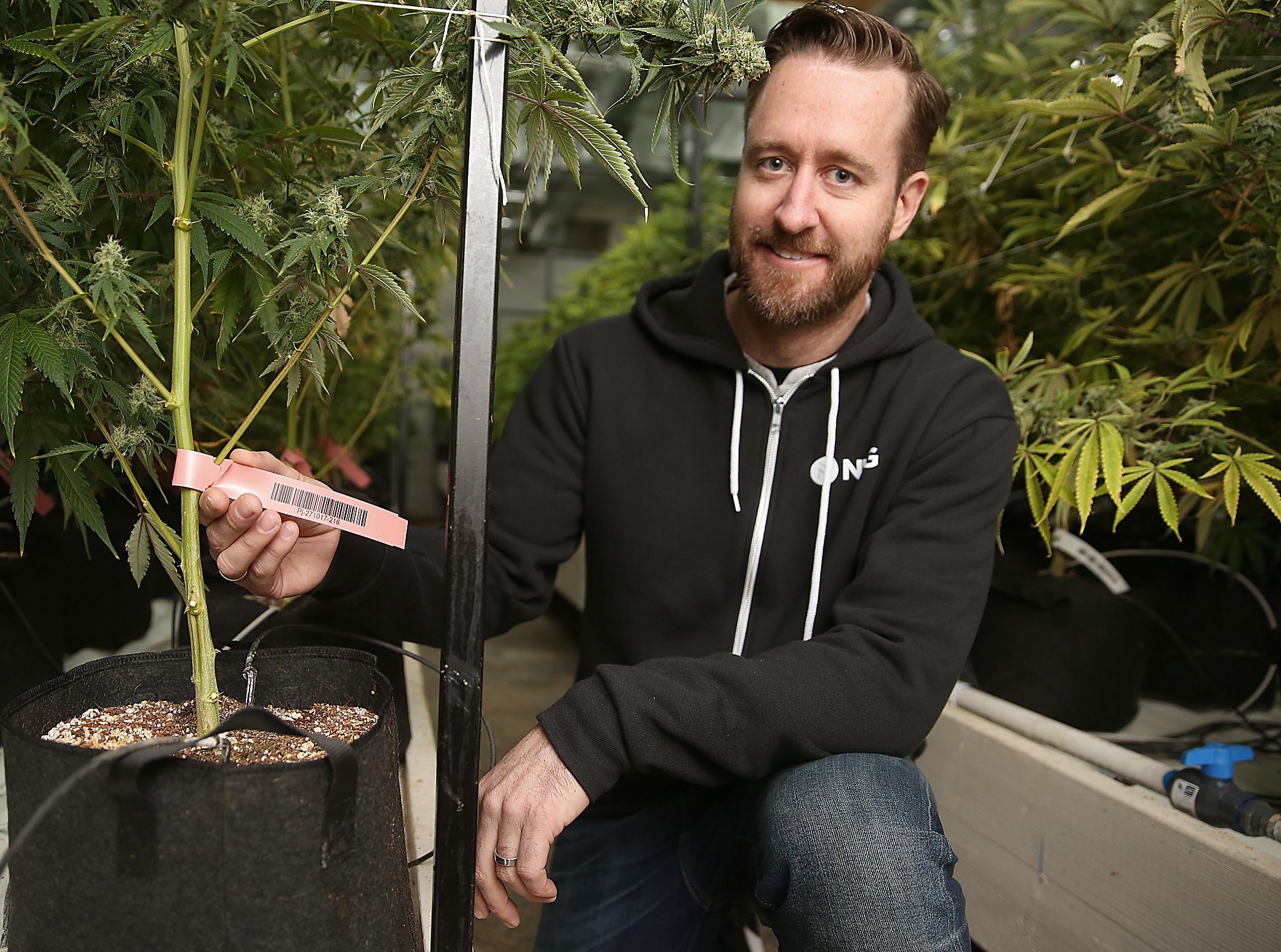
For all the instrumentation in Oram's story, he is not presented publicly as a worshipper of machines. During a visit to NUG's Oakland operation, two trimming machines were gathering dust while 35 people trimmed plants by hand. The machines had been tried. The result was not good enough. “We'd rather do it all by hand,” he said. Efficiency lost to the product.
The same operation tracked plants through their history, controlled lighting and irrigation centrally, and designed its own tables, trays and transport racks. This is Oram's recurring pattern: automate where control improves, retain the human hand where it does not. Science, properly understood, is less a romance with equipment than a willingness to let evidence embarrass the equipment.
That pragmatism appeared in NUG's role with Oakland's cannabis equity program. The company agreed to incubate six equity-qualified businesses, offering space, business support and access to professional guidance. The program moved slowly. Permitting delayed greenhouses, while shelf space and brand awareness did not wait. Oram met with partners regularly and explored co-branded products that might provide a revenue path before their own cultivation spaces opened. His stated aim was not to satisfy a requirement with six cheap structures. He wanted the partner businesses to succeed.
The commitment was also structurally sensible: failed partnerships would serve nobody, including NUG. The distinction matters. Durable cooperation often works because ideals and incentives are allowed to shake hands instead of pretending they have never met.
The engineer off duty
Oram's public persona softens considerably away from operations. He grew up in Alameda and lives in Berkeley. Before graduate school, he traveled and chased what he called an endless winter. He later described his favorite imagined place as the top of a snowy mountain with his wife and two daughters, preparing to race downhill. His daughters competed in snowboarding. Naturally, he claimed he always won.
At home, his specialty is buttermilk pancakes, made for his children and their friends on weekends. He has called himself the sous-chef to his wife and professed a democratic devotion to pizza at breakfast, lunch or dinner. Add an affection for tiki cocktails and the operator who spends weekdays worrying about permits becomes easier to picture: exacting about a laboratory method, cheerfully partisan about a pancake.
The through-line is not cannabis. It is the pleasure of making an unruly system behave without sanding away everything human about it. A contaminant moving through an estuary, a sample moving through a lab, a plant moving through cultivation, a product moving onto a shelf: each presents a chain that can be observed, measured and improved. Oram's career changed industries, but it never really changed verbs.
Recent public records still place him inside the patient work of California cannabis. A state notice recorded a November 2025 retail-license submission by Oram for a Fairway Drive location in San Leandro, while licensing records refreshed in August 2026 continued to associate him with an active NUG retail license in Oakland. Nearly two decades after that first cultivation consulting job, the experiment continues at the least glamorous and most consequential level: rooms, rules, permits, neighbors and the daily work of making an unusual business ordinary.
Oram once said he wanted something more than academic research. What he found was not an escape from hard problems. It was a denser collection of them. The reward was ownership: of the questions, the decisions and, sometimes, the used analytical instrument that could make a hazy market legible.