The most useful object inside March and Ash is not kept under glass. It is the glass. More precisely, it is the flower bar at the center of the sales floor - a circular invitation to slow down, inspect the menu and ask a human being what any of it means. In a business crowded with gummies, cartridges, tinctures, ratios and regulations, furniture became strategy.
Blake Marchand got the idea from restaurants. While living downtown, he noticed that he naturally waited at the bar. It was where people gathered and where a menu turned into a conversation. When he and childhood friend Jon Saco prepared to open March and Ash in San Diego's Mission Valley, three other cannabis retailers already held licenses along the same strip. Their shelves would carry many of the same brands. The room had to do more of the work.
The first store opened in September 2018. Its proposition was almost domestic: create a place where Marchand's mother or grandparents would not feel caught off guard. That customer test led away from the hurried, assembly-line dispensary and toward open browsing, warm materials and staff called concierges. It also gave the company a durable answer to the category's central problem. Legal cannabis can be confusing before it is enjoyable.
The product is permission to linger
March and Ash is, plainly, a licensed cannabis retailer. Adults shop for flower, pre-rolls, vapes, edibles, concentrates, drinks, topicals, CBD, accessories and, at some locations, clones. They can buy in a store, order online for pickup or request delivery where the service is available. The chain earns money on those retail transactions and on branded merchandise. It is not a vertically integrated grower selling one house label; its value lies in selection, navigation and trust.
That matters because a broad menu can become its own tax on attention. A 2020 profile counted roughly 4,100 SKUs from about 125 brands in each of three stores. A later fulfillment case study counted more than 300 brands sold across eight locations. Scale widened the choice set without making cannabinoids any easier to understand. The flower bar and concierge turn inventory into a guided decision.
“We wanted it to be a store where my mom or my grandparents could come in and feel comfortable.”Blake Marchand, co-founder and CEO
In 2024, the company described its main audience as parents and working professionals between 35 and 60. That is a revealing target. The experienced shopper may know the strain; the newer shopper may arrive with a desired effect, a medical recommendation or a concern about smoking. Both need specificity without pressure. March and Ash's operating promise - education, safety and satisfaction - is built for the asymmetry.
The assortment also lets the chain meet shoppers at several price points without pretending every purchase is a wellness pilgrimage. A customer can arrive for a familiar pre-roll, compare terpene profiles at the bar, pick up a low-dose drink or ask about a topical. Discounts bring another practical layer: participating stores advertise programs for veterans, seniors and disabled guests, while first-time offers vary by location. This is specialty retail with a controlled-substance checkout, not a clinic and not a lifestyle club. The company's own disclaimer is clear that its site does not provide medical advice.
A chain with an allergy to copy and paste
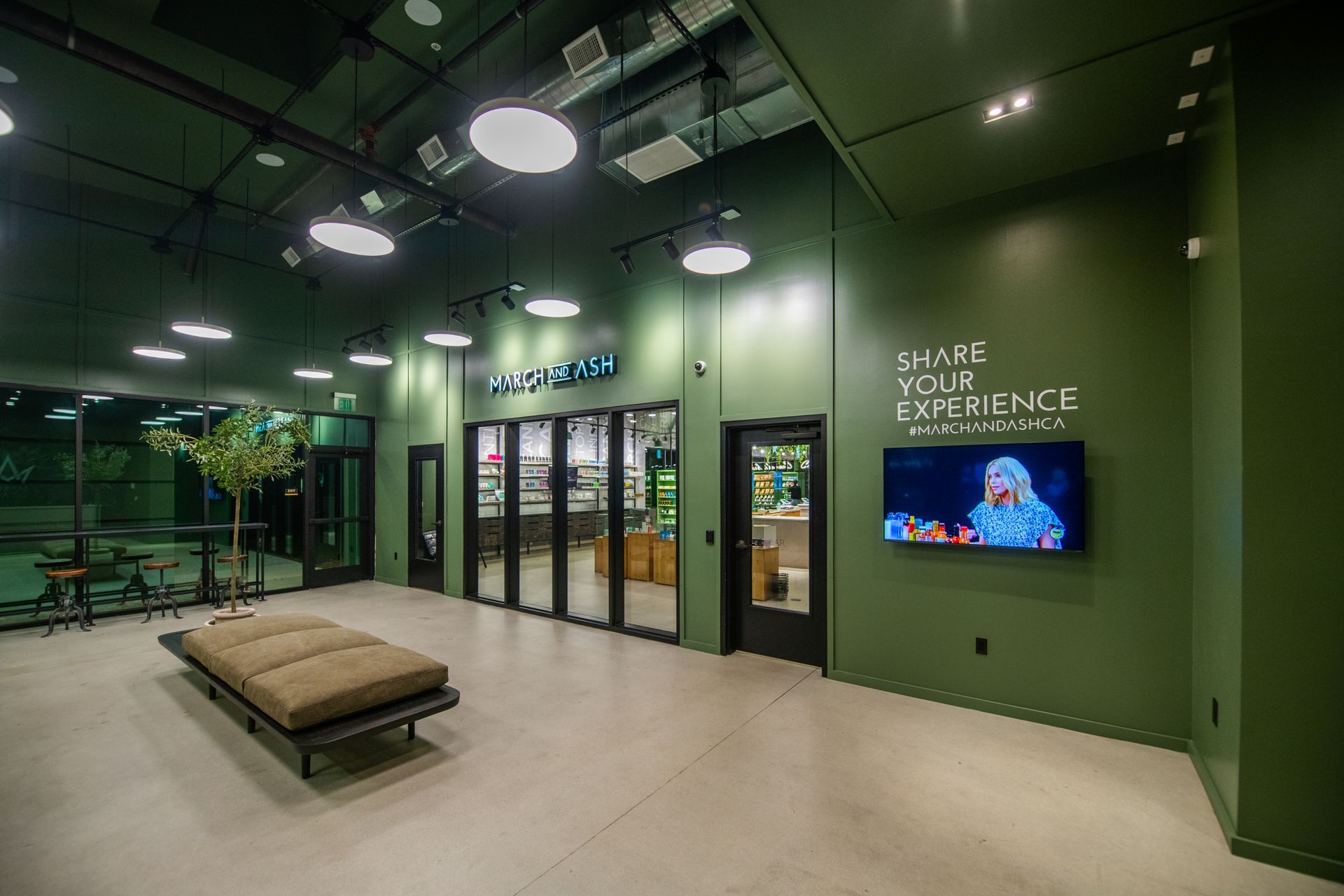
March and Ash scales an operating system, not a showroom. Every exterior is forest green. Every store has a flower bar. Inside those guardrails, the company gives each location a local plot. Mission Valley borrowed polish from nearby Fashion Valley. Imperial put a restored World War I-era tractor beneath barn-like wood. Vista nodded to vineyards, avocados and the city's industrial history. City Heights revived an auto-body shop. Imperial Beach commissioned local artists for a mural shaped by its surf culture.
This is expensive in the organizational sense even when construction budgets stay private. A bespoke store requires research, community feedback, designers who can translate both, and contractors who will not turn complexity into delay. An early Imperial profile called out the growing pains directly: even detailed buildouts produce “bogeys,” and the general contractor must coordinate trades efficiently. The first thing the model punishes is the fantasy that a chain opening is merely a replication exercise.
The approach changed the usual expansion question. Instead of asking how to reproduce Mission Valley, the team asked what made each place recognizable to the people living there. That is a subtle but consequential inversion. The brand becomes a host, not a visiting franchise set. Public Affairs Director Spencer Andrews put it neatly: customers know they are in a March and Ash, but they also know the store was tailored.
That difference sits in a crowded Southern California market beside local operators and chains such as Urbn Leaf, Wellgreens, STIIIZY and Mankind. Product overlap is unavoidable. Licenses create scarcity, but they do not create affection. March and Ash's moat, to the extent it has one, is a bundle of details that are slow to assemble: permitted locations, trained staff, neighborhood credibility, a recognizable spatial ritual and an online operation connected to live store inventory. Competitors can imitate any single detail. Reproducing the bundle across cities is the harder assignment.
The unglamorous machinery behind the bar
Bespoke does not mean improvised. Cannabis retail stacks ordinary store problems on top of age verification, testing rules, local licenses, banking constraints and delivery controls. March and Ash's online system requires a $30 delivery subtotal. Orders from $30 to $49.99 cost $3.99 and must be scheduled; orders of at least $50 qualify for free delivery and an ASAP option where available. First deliveries are capped at $150, and a valid ID must meet the driver.
Those numbers are the customer's visible cost of convenience. The operator's cost sits behind the interface: cash management, live local inventory, compliant handoff and enough delivery density to make the route work. Centralization helped. LeafLink says its retail-fulfillment service held inventory until stores needed it, saving warehouse space and freeing cash. Its case study reports more than 3,200 orders across eight locations. COO Jon Saco's practical endorsement was that distributors no longer had to visit eight separate shops.
The legal market's most stubborn competitor is not another polished chain. It is the unlicensed seller that avoids taxes and many compliance expenses. Marchand has also pointed to fragmented municipal rules and limited banking access as persistent constraints. Design cannot repeal any of them. A beautiful room works only if customers value confidence, product testing, selection and advice enough to absorb the legal market's price and friction.
What another operator can actually steal
Do not copy the tractor. Copy the hierarchy. March and Ash protects two visible constants - green outside, flower bar inside - and spends the remaining creative budget on relevance. The useful artifact is not a mood board but a decision rule: standardize the pieces that produce recognition and service quality; localize the pieces that produce belonging.
The five-part theft
- Pick one customer who exposes the intimidation in your category.
- Put the object people need to discuss at the center of the room.
- Train hosts for curiosity and judgment, not only product recall.
- Keep two or three brand constants, then research the neighborhood.
- Centralize the dull work - receiving, inventory and vendor coordination.
The people system is equally portable. March and Ash has hired restaurant veterans because hospitality can be taught across categories. Jessica Quesada, the first concierge hired for Mission Valley, arrived with 15 years in restaurants and later moved into visual merchandising and apparel. Her path suggests the floor is not merely labor beneath the brand. It is a recruiting ground for the people who understand the customer ritual best.
Community claims also need artifacts. The company helped San Diego City College assemble a Business of Cannabis course, supplied industry speakers, worked with animal rescue group The Animal Pad and ran a food drive that collected more than 4,000 pounds. Its educational media ranges from product interviews to a sponsored local podcast. These activities make sense beside the store strategy: explain an unfamiliar industry, show up locally, reduce the cultural distance.
There are conditions where the playbook breaks. Hyper-local design is wasteful when customers choose almost entirely on price, when leases are too short to recover buildout costs, or when a market is growing too quickly for research and custom construction. The flower bar loses force in pure delivery. Patient service becomes a bottleneck if staffing is thin. And no amount of hospitality repairs unreliable inventory or a compliance failure.
March and Ash's achievement is more modest and more useful than reinvention. It noticed that a regulated transaction was socially awkward, then borrowed a familiar behavior from restaurants. People gather around a bar. They ask the person behind it what is good. They take a moment. The company made that moment repeatable, wrapped it in local scenery and built the machinery required to keep the shelves full. The lesson is not to make every shop look expensive. It is to make the difficult part of shopping feel ordinary.