Before Blake Marchand sold cannabis, he knew how to read a parcel. The San Diego native had built and run a local real estate brokerage, a career spent close to the things that make property more than an address: zoning, timing, financing, and the patience required when a city must say yes. When legal cannabis arrived as a serious business opportunity, he did not discard that experience. He used it as the key.
In 2016, the available route into San Diego retail was narrow. A prospective operator needed a correctly zoned property and a conditional use permit, then had to survive the long interval between application and opening day. Marchand identified a building on Camino del Rio South in Mission Valley and entered the process. He later described two years of permitting and construction, with his life savings at risk. The first March and Ash opened there in September 2018.
The hard part had been permission. The interesting part was what to do with it.
A room built around a pause
Three established dispensaries already operated along the same stretch when March and Ash prepared to open. The shelves could only provide so much distinction. Licensed retailers often stocked many of the same products, while the prevailing shopping experience hurried customers through a guarded, counter-led transaction. Marchand looked outside the category for a better script.
While living downtown, he noticed his own behavior at restaurants. Waiting for a table, he would head for the bar. The bar made delay social and useful. It gave people something to study, someone to ask, and a reason to settle in rather than hover by the door. He wondered what would happen if a dispensary worked the same way.
“I started thinking it would be a cool idea to build a dispensary around a flower ‘bar.’”Blake Marchand, on the observation behind the first store
The flower bar became the center of the sales floor. Customers could browse the menu, inspect the available flower, and speak with staff called cannabis concierges. The design relieved a subtle pressure: asking one more question no longer meant holding up a checkout line. A piece of furniture became a queueing system, an education format, and a statement about how the company wanted people to behave.
Marchand’s stated sales philosophy fits the room. He has said the company does not push products and would rather a visitor leave without a purchase than take home something selected under pressure. In a category dense with formats, brands, and unfamiliar vocabulary, restraint can be a form of service. It is also a long-game bet: confidence may earn a return visit even when the first conversation earns no sale.
Borrowed expertise, carefully spent
Founders are often advised to begin with a blank sheet. Marchand began with a zoning map. His real estate background helped him see that entry into a regulated market depended on more than consumer demand. The property itself had to qualify. Municipal rules varied. Capital was harder to secure. A strong retail concept had no value if the proposed address could not legally contain it.
That practical knowledge continued after opening. Each expansion required another civic relationship, another local rulebook, and another case for why a March and Ash store belonged there. Public records trace that work across Imperial, Vista, City Heights, Chula Vista, Sabre Springs, Imperial Beach, Palm Desert, and proposed projects including Santee. The paper trail is part of the company story because paperwork is part of the product in a licensed business.
Marchand owns and operates a San Diego County real estate brokerage.
He pursues the Mission Valley property, permit, and build-out for the first March and Ash.
Stores open in Imperial Valley, Vista, City Heights, and Chula Vista.
March and Ash and CannaCraft announce a combination under Groundwork Holding.
The retailer reaches eight locations and continues seeking permits in additional California cities.
The founding group also carried an older kind of infrastructure. Marchand has known one business partner since first grade and another since freshman year of high school. He describes them as brothers, each with a defined role in the company. Long friendship cannot replace operating competence, but it can make candor less ceremonial. In a business full of hearings, cash constraints, and local scrutiny, trusted relationships reduce one category of uncertainty.
Consistency gets one color
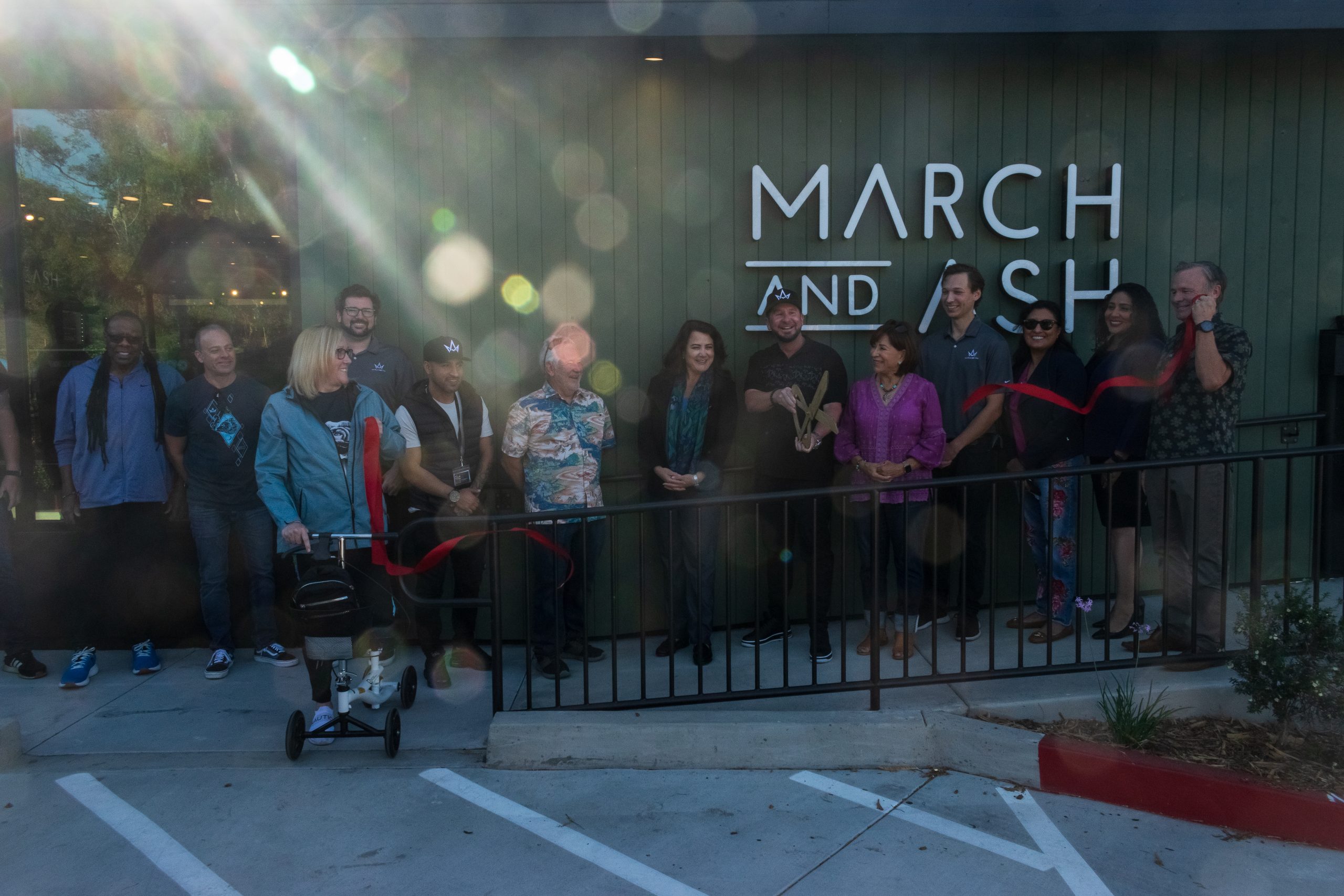
As March and Ash added stores, it avoided the easiest chain-store habit: duplicating the first successful room. The brand kept two physical signatures. Exteriors were painted forest green, and each shop contained a flower bar. Nearly everything else could respond to its surroundings.
Mission Valley received a polished interior suited to the district. Imperial Valley drew on the area’s agricultural identity, complete with a tractor and farm-inspired materials. City Heights preserved the tougher character of a converted auto-body shop. In Imperial Beach, where the dispensary was the city’s only licensed shop, community input led the team to work with a nonprofit arts group and local artists on a mural informed by beach and surf culture.
Polished finishes for the neighborhood where the first store opened.
Agricultural cues, including a tractor and farm-inspired surfaces.
Darker tones and floor details that remember the former auto shop.
A community-informed mural with local artists and coastal references.
The formula holds recognition and belonging in the same hand. Drivers can spot the green exterior. Once inside, they encounter a room that has listened to the place. The choice costs more attention than a universal plan set, and it requires humility once the company moves beyond its founders’ familiar ground. Marchand’s own advice for new markets is to seek local feedback rather than arrive wearing a corporate costume.
There is a transferable idea here for any business expanding from a hometown. Standardize the promise. Localize the expression. March and Ash’s promise is an unhurried, informed retail encounter; the flower bar protects that across locations. A tractor, mural, or dark industrial floor can then tell customers which location they have entered.
The family test
Marchand was born and raised in El Cajon, attended Valhalla High School, and earned a business administration degree from San Diego State University. His public biography keeps returning to local ties. He coaches his son’s baseball team, follows the Padres, and still names family as his proudest accomplishment. His father encouraged him to keep taking the risk required to enter cannabis. Marchand stayed in California because he did not want to leave family when legalization elsewhere first tempted him.
Those details matter to the business because his early retail test was personal: create a store where members of his own family could walk in without feeling out of place. The answer was not soft branding alone. It required visible professionalism, a staff ready for questions, and a room that did not treat curiosity as delay.
“Never give up. Choose the right business partners.”Marchand’s advice to people pursuing the field
The phrase is plain enough to print on a coffee mug. His career gives it sharper edges. “Never give up” meant two years before the first opening. “Choose the right partners” meant friends whose history reached back decades. The lesson is less about heroic persistence than matched persistence: the property knowledge, the relationships, and the operating roles all had to survive the same long clock.
Growth without the photocopier
By 2024, March and Ash had eight Southern California locations. A 2022 transaction combined it with California producer CannaCraft under a holding company while leaving both operating structures intact. Marchand remained co-founder, partner, and CEO of the retail business. He later spoke about moving farther up the California coast and, eventually, taking the brand beyond the state.
Expansion tests the very quality that made the stores distinct. Local consultation is easy to celebrate when there are a few locations near home. It becomes a management system when the map grows. Who listens? Which details deserve permanence? What remains fixed when a neighborhood asks the brand to change? March and Ash’s current answer is deliberately spare: green outside, flower bar inside, and a lot of room between them.
Marchand’s route into cannabis offers one clean piece of founder arithmetic. He did not need to become a different person to enter a different industry. He needed to recognize which old skills had become newly valuable. Real estate supplied the property logic. Restaurant behavior supplied the retail idea. Childhood relationships supplied a leadership circle. San Diego supplied both the first market and the standard he wanted each store to meet.
The result is a business built from thresholds: the zoning line that decides where a shop may exist, the doorway that decides whether a customer feels comfortable entering, and the bar that decides whether that customer can pause. Marchand crossed the first threshold with paperwork. He designed the next two around trust.