A car park is an unpromising place to look for a theory of the future. It has painted lines, a payment machine and, if fortune smiles, a space wide enough to open the door. Chris Green has put considerable money behind the possibility that it can acquire a more interesting job. Give the right location access to power, add the systems to run it, and a place for stationary vehicles can become part of the machinery that keeps a city moving.
That is a useful way into Green’s career. The founder and CEO of GreenPoint Partners works with things that occupy actual ground: truck terminals, charging sites, agricultural properties. Alongside them sit operating teams and technology. His question is what these ingredients can do together. The answer has taken him from rural Australia to New York, with a long apprenticeship inside one of Australia’s financial institutions along the way.
Three subjects, one career
Green grew up on a farm roughly three-and-a-half hours outside Sydney. Later, at the University of Sydney, his education covered a combination that looks unusually well suited to his eventual work. He earned a Bachelor of Laws with honours and a Bachelor of Commerce covering computer science and accounting. Contracts, computers and the accounts: between them, a fair proportion of an investment committee’s awkward questions.
His early work included a business analyst role at PwC and consulting assignments involving retailers such as Hackett and Kingfisher. In February 2002 he joined Macquarie, entering its real estate group. He stayed for 16 years. From 2008 to 2018, he led Macquarie Capital’s real estate business, working across relationships with institutional investors, developers, owners and managers.
The geography expanded too. In 2013 he moved from Australia to New York. This was a career involving both the financing of property and the development of businesses around it. Green also chaired the real estate investment committee and served on Macquarie Capital’s global management committee. He had acquired experience of making decisions about an operating company as well as the assets on its books.
“There is something special about real estate. It’s tangible.”
Chris Green
The attraction is easy to understand. A financial model can be revised in an afternoon. A building stays put and makes demands of its owner. Green’s interest in physical development, alongside growing businesses, became a theme that survived his departure from Macquarie in 2018.

A founder with an operator’s address book
He founded GreenPoint Partners in 2019, with New York as its headquarters. In April that year, Goodman announced his appointment as a director of Goodman Limited and Goodman Funds Management Limited. His new firm and his board work placed him among people confronting a shared problem: property businesses were having to make decisions about technology that could change how their assets were used.
By May 2022, GreenPoint had closed its first technology fund at $134 million, or approximately $200 million when associated co-investment capital was included. Its investments included companies such as Built Technologies, OpenSpace and Envizi. Investors included PSP Investments, Goodman, Ivanhoé Cambridge and Lendlease. The connections brought property owners and software businesses into the same conversation.
That conversation has a practical purpose. A technology business needs customers who understand its product. A property business needs tools that work inside an existing operation. GreenPoint’s early model gave each a route to the other. The firm also began investing through a real estate private equity strategy, including an investment in European logistics business Infinium. Technology investing and property ownership could inform each other.
GreenPoint now describes its approach through the different speeds at which technology, businesses, property, infrastructure and natural capital change. This gives Green’s work a recurring tension. Software may change quickly; land and infrastructure ask for longer commitments. Bringing them together requires an operating business capable of managing both clocks.
The car park gets a second job
In February 2023, GreenPoint announced the acquisition of a £305 million UK car park portfolio. It contained 37 facilities and nearly 15,000 spaces, with locations in cities including London, Manchester, Liverpool, Bristol and Birmingham. Most were operated by NCP. GreenPoint planned to work with the operator on operational improvements, electric vehicle infrastructure and services enabled by technology.
The familiar property had acquired additional possibilities. Drivers still needed parking. Fleets moving towards electric vehicles would also need dependable places to charge. A useful location could serve both demands, provided the electrical infrastructure and the operation could support them. The humble car park was being asked to broaden its qualifications.
By May 2025, GreenPoint had created Lysara by consolidating ownership of the legacy Infinium Logistics business and contributing a 44-asset property portfolio. Scott Parsons joined as CEO. The platform brought together ownership, development, operations, technology and energy systems engineering, with ambitions to expand across Western Europe. Its customers could include taxis, rental cars, delivery vans and heavy goods vehicles.
In the United States, GreenPoint and EV Realty announced an April 2024 joint venture for a $200 million charging hub buildout. GreenPoint contributed real estate investment expertise; EV Realty would develop, operate and manage the sites. Power availability was central to selecting properties. An excellent address for a delivery fleet needs an electrical connection equal to the task.
A conceptual view of the integrated platform approach. Each part has to work with the others.
A gate worth paying attention to
Truck parking offered another version of the same problem. In March 2023, GreenPoint announced an investment in Austin-based Semi-Stow and a dedicated $500 million truck and trailer storage platform. Its first two property acquisitions, in Houston and Dallas-Fort Worth, offered collective capacity for more than 1,000 trucks and trailers. Capital would support both the operating business and the purchase of sites.
For a logistics operator, the journey includes the moments when a vehicle stops. Parking, storage and access to a terminal form part of the service. Green’s investment put money behind improving that experience through a national property portfolio and an operator with the systems to run it. There is little glamour at a terminal gate. There is, however, a good deal that can go slowly.
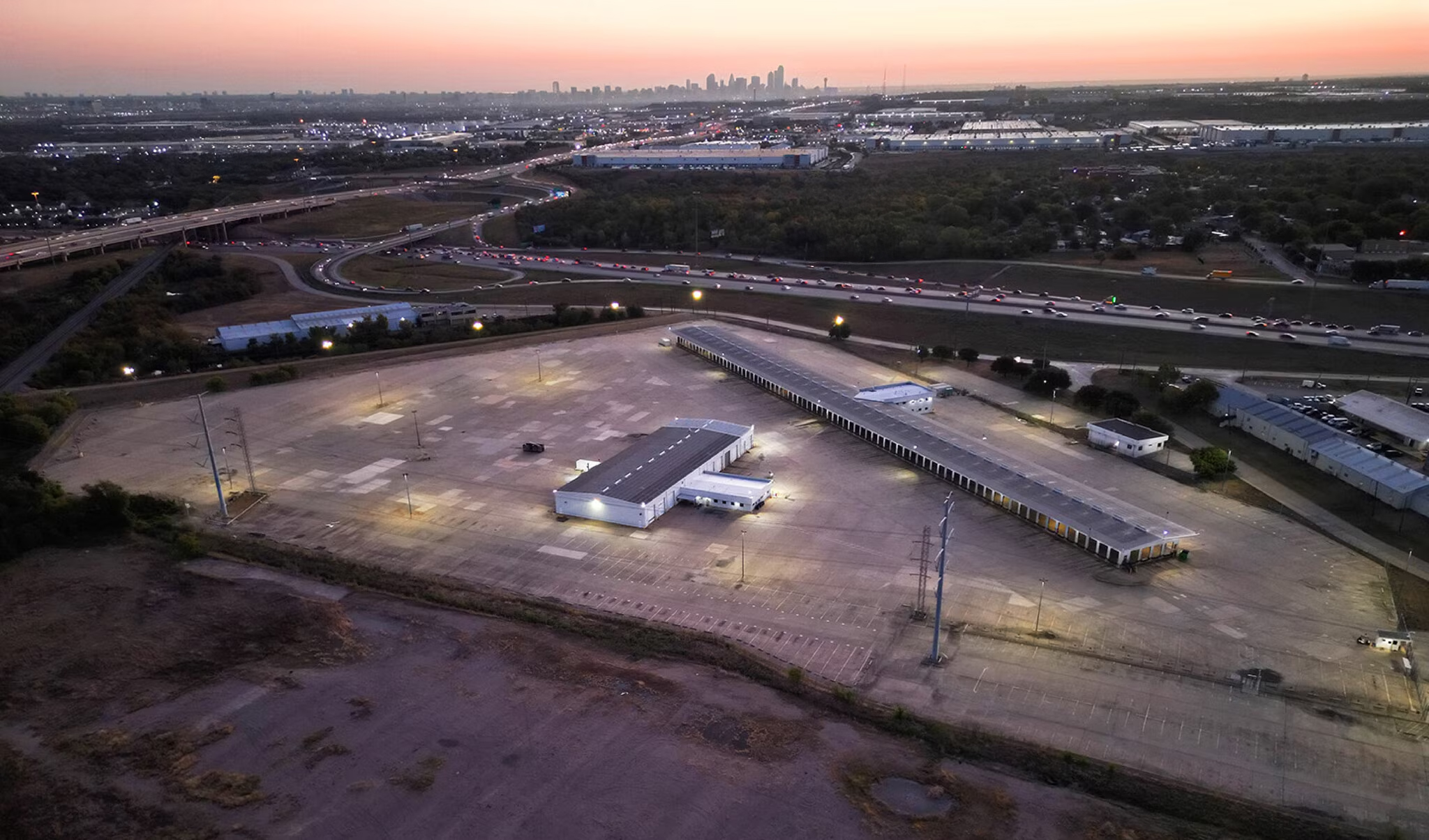
In September 2025, Outpost and GreenPoint announced that additional capital doubled their truck terminal platform capacity to $1 billion. At that point, the network included more than 25 assets covering over 400 acres and served more than 3,000 customers. Outpost had also launched gate automation technology after training and testing it across more than a million gate events.
The investment logic is visible at the entrance. The property provides the place; the operator manages the traffic; technology handles access and information. Green’s role is to help finance and assemble the business around those interdependent tasks. The customers, meanwhile, need the gate to open and their freight to keep moving.
Equity commitments across GreenPoint’s inaugural flagship fund and associated vehicles.
This measures fund-series commitments. Outpost’s separately announced platform capacity is a different measure.Back to the paddock
There is a rural chapter in this urban and industrial story. Green is co-founder and chairman of Wyuna Regenerative Agriculture, established with co-founder and CEO Steve Green. Announced in October 2022, the Australian platform combined agricultural property investment, sustainable grazing and nature-based carbon removal projects. It began with an existing 100,000-acre portfolio and sought to expand to 500,000 acres.
Those were starting figures and ambitions, rather than a claim that the expansion had already happened. The first managed investment vehicle attracted anchor commitments from Australia’s Clean Energy Finance Corporation and Goodman. The work proposed on the land included responsive grazing, improved management and regeneration of native ecosystems, with carbon projects operating under Australia’s credit framework.
For someone raised on a farm, agricultural investment gives the career a geographical echo. It also fits the pattern of financing an asset alongside the people responsible for its use. Land management cannot be completed at the signing ceremony. The investment has to be followed by work, season after season.
What happens when the shop drives over?
Green’s public discussion of autonomous transport extends that interest in how space is used. In Goodman’s Thought starters series, he considers a future in which a retail vehicle brings a selection of goods to the customer. A mobile shoe shop is one example. The customer could try the shoes without travelling to a fixed store.
The idea is speculative, and he presents it as a possibility. Yet it exposes the questions that connect his investments: where vehicles wait, how they receive power, and what different patterns of movement might mean for property. He has also discussed the computing infrastructure autonomous vehicles would require, including data centres and processing closer to the vehicle. A change on the road reaches well beyond the road.
There is another kind of network in his life. Green joined The Opportunity Network’s board in 2018. He previously served on the Macquarie philanthropic foundation’s board, and he and his wife founded a workforce development nonprofit for refugees in Australia. Access to people and opportunities has had a place alongside his professional investment work.
GreenPoint’s September 2025 fund close brought backing from institutions including La Caisse, Texas TRS and funds managed by GCM Grosvenor. It gave Green more capital with which to pursue the operating platforms he had begun building after banking. The work remains tied to specific places and their uses. A terminal needs a functioning gate. A charging hub needs power. A grazing property needs management. A place to park turns out to contain quite a few moving parts.