The assets between the assets
A truck stop is easy to ignore from 30,000 feet. Up close, it can be nine acres of freight choreography: trailers coming and going, drivers waiting on access, security cameras watching gates, dispatchers hunting for space. GreenPoint Partners looks at that scene and sees a network waiting to be assembled. The New York investment firm supplies the capital, finds or builds the sites, installs an operating team and adds a technology layer. The humble yard starts behaving less like a patch of asphalt and more like a platform.
That pattern explains GreenPoint better than the usual labels. It is a real-assets investment manager, founded in 2019 by former Macquarie real-estate executive Chris Green. But it borrows instincts from private equity, infrastructure, venture capital and company building. Its four stated sectors - transport and logistics, energy and environment, digital infrastructure, and living - are broad. Its method is more specific: find a physical market undergoing digitization, electrification or automation, then put assets, people and software under one roof.
The parking lot becomes a product
Outpost is the clearest specimen. The GreenPoint-backed company owns and operates truck terminals and drop yards, shared infrastructure that lets fleets expand without purchasing every property themselves. By September 2025, Outpost reported more than 25 assets on over 400 acres and a customer base exceeding 3,000 national carriers, regional fleets and enterprise shippers. GreenPoint and Outpost said new capital had doubled the platform’s capacity to $1 billion.
The real twist is at the gate. Outpost developed a system that uses computer vision, hardware and AI agents to manage access, inspect vehicles, track events and communicate with drivers. Before offering it to other terminal operators, the company says it trained and tested the product across more than one million gate events at its own facilities. Owning the test bed gives the software team something a stand-alone startup would have to beg customers for: live operating data and a place to learn.
“We build vertically integrated platforms that are positioned to define the next era of real assets.”Chris Green · Founder and CEO
The customer benefit is practical rather than futuristic. A carrier can add terminal capacity without tying up capital in land. A terminal operator can automate repetitive gate work. A shipper gets a more resilient network. GreenPoint, meanwhile, can seek returns from property, operations and technology rather than relying on rent alone. That stack is the firm’s answer to a familiar infrastructure problem: value leaks whenever the landlord, operator and software vendor optimize for different things.
Electrification is a land problem
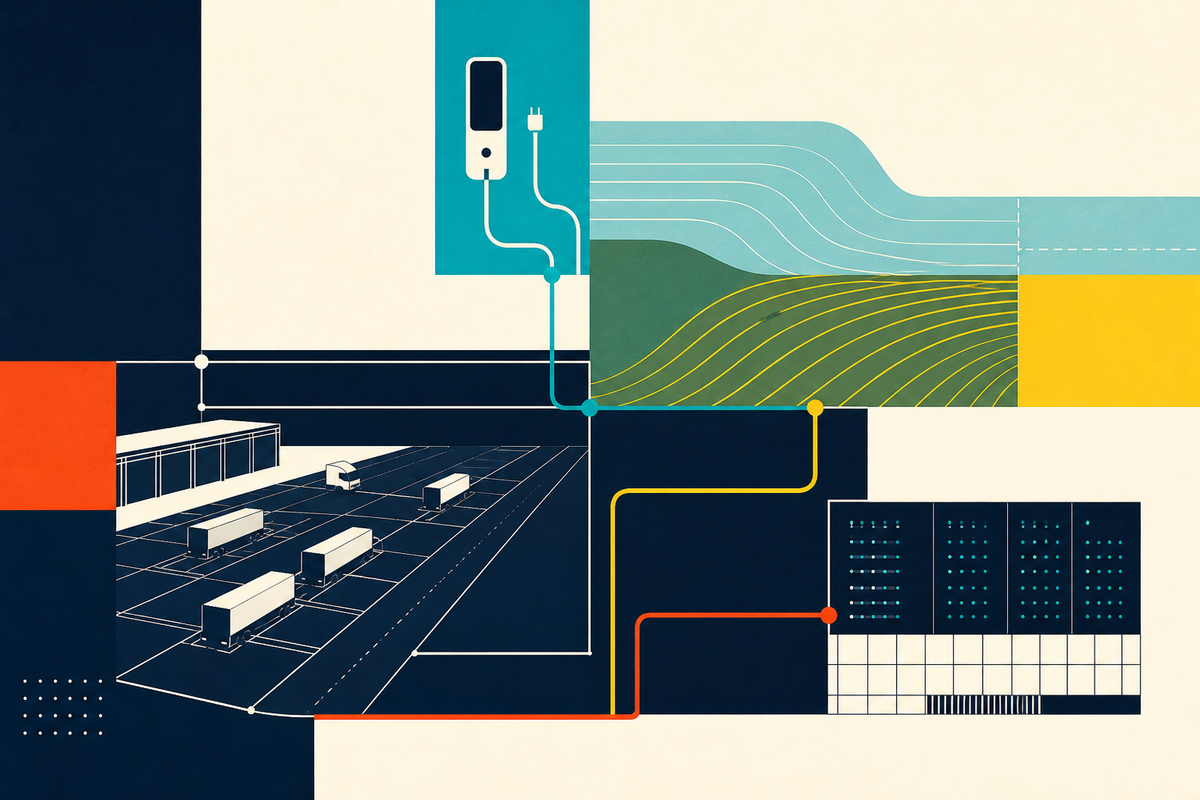
Commercial-vehicle charging makes the thesis even more tangible. An electric truck does not simply need a plug. It needs high-capacity grid access, enough land to maneuver, a location near a freight corridor, permitting, reliable equipment and an operator who understands fleet schedules. Those pieces rarely arrive together. GreenPoint treats their coordination as the investable product.
In the United States, it formed a $200 million joint venture with EV Realty in 2024 to develop high-power charging hubs for medium- and heavy-duty vehicles. The initial plan called for “Powered Properties” with roughly 50 to 100 chargers, beginning in California. EV Realty would operate the hubs; GreenPoint would provide most of the joint venture capital. The arrangement sits between property development and energy infrastructure, which is precisely the seam the firm prefers.
In Europe, GreenPoint consolidated the legacy Infinium Logistics business and contributed a 44-asset portfolio to create Lysara. The platform owns, develops and operates parking and charging infrastructure for taxis, rideshare and rental cars, delivery vans and heavy-goods vehicles. An initial £340 million commitment from GreenPoint seeded the effort. By May 2025, Lysara said it had secured about 50 MVA of grid power - enough, by its estimate, to supply 24,000 homes at peak load - as it pursued sites around logistics hubs such as Heathrow and London Gateway.
A firm that prefers verbs
Many real-estate funds buy a building, appoint a manager and collect income. Venture firms generally buy minority stakes and leave the physical balance sheet elsewhere. Infrastructure funds can own critical systems without building a consumer or enterprise technology product around them. GreenPoint deliberately crowds those boundaries. Its language is full of verbs - build, transform, operate, integrate - because the business model depends on creating an operating company, not merely closing a transaction.
The firm’s direct customers are institutional investors seeking exposure to real assets. When GreenPoint closed its inaugural flagship fund and associated vehicles in September 2025, it disclosed more than $1 billion in equity commitments and named La Caisse, the Teacher Retirement System of Texas and funds managed by GCM Grosvenor among its supporters. GreenPoint earns the economics typical of a private fund manager - management and performance-based compensation - while its platforms charge their own customers for space, services, infrastructure or technology.
Those two customer layers matter. The pension fund is buying a managed investment; the carrier arriving at an Outpost terminal is buying useful capacity tonight. GreenPoint has to satisfy both without confusing them. Better gate throughput or fuller yards can improve a platform’s operating performance, but fund investors still judge risk, governance, valuation and cash returns. The model therefore asks a small investment team to translate daily operating details into institutional-grade assets. GreenPoint’s separate operator group is designed for that translation, bringing builders and executives into decisions that a conventional deal team might handle mostly through spreadsheets and outside managers.
That makes comparison slippery. Brookfield, Stonepeak and other large managers compete for institutional capital and infrastructure deals. Charging developers, industrial-property funds and logistics technology companies compete at the asset level. GreenPoint is much smaller - roughly two dozen employees, with offices in New York, London and Sydney - and argues that its advantage is the ability to compose all those pieces. The risk is the mirror image of the pitch: vertical integration creates more ways to improve a business, but also more things to execute at once.
Farms, homes and data centers
The same architecture appears in less asphalt-heavy settings. GreenPoint established Wyuna Regenerative Agriculture in 2022 as its first climate-infrastructure platform investment. Wyuna’s territory is land management, agricultural production and environmental assets in Australia. Long-duration capital matters here because changing land practices and measuring results take years, not a venture fund’s sprint between rounds.
One Living, launched in Australia, attacks a different coordination failure: housing that middle-income buyers can no longer afford. GreenPoint says the developer-builder standardizes design and procurement, controls more of construction and can choose whether to sell, rent or retain homes. In 2026, One Living publicized rights to its first site on Sydney’s Northern Beaches, where it aims to deliver more than 140 apartments subject to planning approvals. Its stated ambition - more than 25,000 homes over a decade - is a goal, not a completed pipeline, but it shows how far GreenPoint is willing to stretch its platform template.
Digital infrastructure is the newest and least visible part of the public portfolio. GreenPoint has published research on the power, cooling and computational demands of AI data centers, but has disclosed fewer operating details than it has for freight or charging. The interest is consistent: data centers are buildings whose value depends on power, engineering, connectivity and software-era demand. They are real estate that cannot be understood from a rent roll alone.
The unglamorous advantage
GreenPoint’s portfolio is easiest to understand as a collection of bottlenecks. Trucks need secure terminals between giant warehouses. Electric fleets need grid-connected land before mandates and vehicle orders become practical. Regenerative agriculture needs patient capital and measurement. Housing needs fewer handoffs between design, procurement, construction and ownership. These are not novelty problems. They are coordination problems, and coordination is expensive.
The firm’s public culture reflects that mix of practicality and curiosity. Its team page divides investors from finance, legal and compliance, then gives its operators their own group. Its research moves from freight theft and data-center power to an essay that uses MIDI, techno music and a horse that reportedly prefers metal to explain how technical standards create training data for robots. This is not the customary voice of a property manager. It is the voice of a shop trying to notice when an old asset is about to acquire a new layer.
There is a useful idea here even for founders who will never buy a truck yard: sometimes the technology business is hiding inside the asset, and sometimes owning the messy physical workflow is how a company earns the data to build it. GreenPoint’s experiment is to do both with institutional scale. The firm does not need every parking lot or farm to become a software company. It needs the combined system to work better than the disconnected parts. That is a quieter claim than “reinventing infrastructure,” and a more testable one.