In 2017, Levi Brooks helped give a fax machine something interesting to print. His Los Angeles studio, Use All Five, built Artifax, a website that let people choose an artwork, attach a message, and send it to an elected representative. The occasion was a proposed cut to federal arts funding. The delivery system belonged to an earlier office civilization. Somewhere between the smartphone and the paper tray, a constituent could get through.
Brooks had artists among his clients, friends, and colleagues. The issue was close to the studio’s working life. Artifax gave people a starting point for a letter they might otherwise postpone: an image they could respond to, then words of their own. Eight days after launch, he reported roughly 800 faxes. A later studio discussion recorded more than 4,000. Those numbers count messages sent, with no grand claim about votes changed. They are still a pleasingly concrete answer to the question of what a design studio can do between commissions.
A browser, a paper tray, a point
The choice of fax had a little mischief in it. Brooks had encountered the idea that faxing could reach elected officials when more familiar channels were crowded. Here was an overlooked route into an office. Users could work through the website without owning the machine at the other end. The recipient got something physical. The sender got to participate without becoming an expert in congressional communications or the maintenance of a temperamental printer.
Artists and designers contributed different visual languages. The collection allowed for emotion, abstraction, and direct argument. As the project expanded in 2018, it took on concerns beyond its original arts-funding brief. A website could become an invitation to speak, with enough structure to help and enough choice to leave the speaker recognizable. That balance appears throughout Brooks’s career: create a route, then let another person decide how to travel it.
- 01Choose art
- 02Add words
- 03Find a representative
- 04Send the fax
A digital beginning. A paper arrival.
The education before the degree
Before there was a studio, there was a magazine aisle. Brooks’s mother had worked in graphic design and later pursued plein air painting. In high school, he found another education at Borders, reading design publications and books. A family computer capable of running Photoshop gave him a place to try things. The combination was straightforward: look at work, become curious about how it was made, attempt something yourself.
Online, DeviantArt offered other people to learn from. At UCLA, design acquired a more formal setting. Brooks studied Design Media Arts, graduating in 2006. The movement between print, software, a community, and a university matters. His route into the profession involved both looking and exchange. You could encounter a visual idea on a page, then go somewhere else to discover what happened when you put it to work.
Two graduates and a name with ambitions
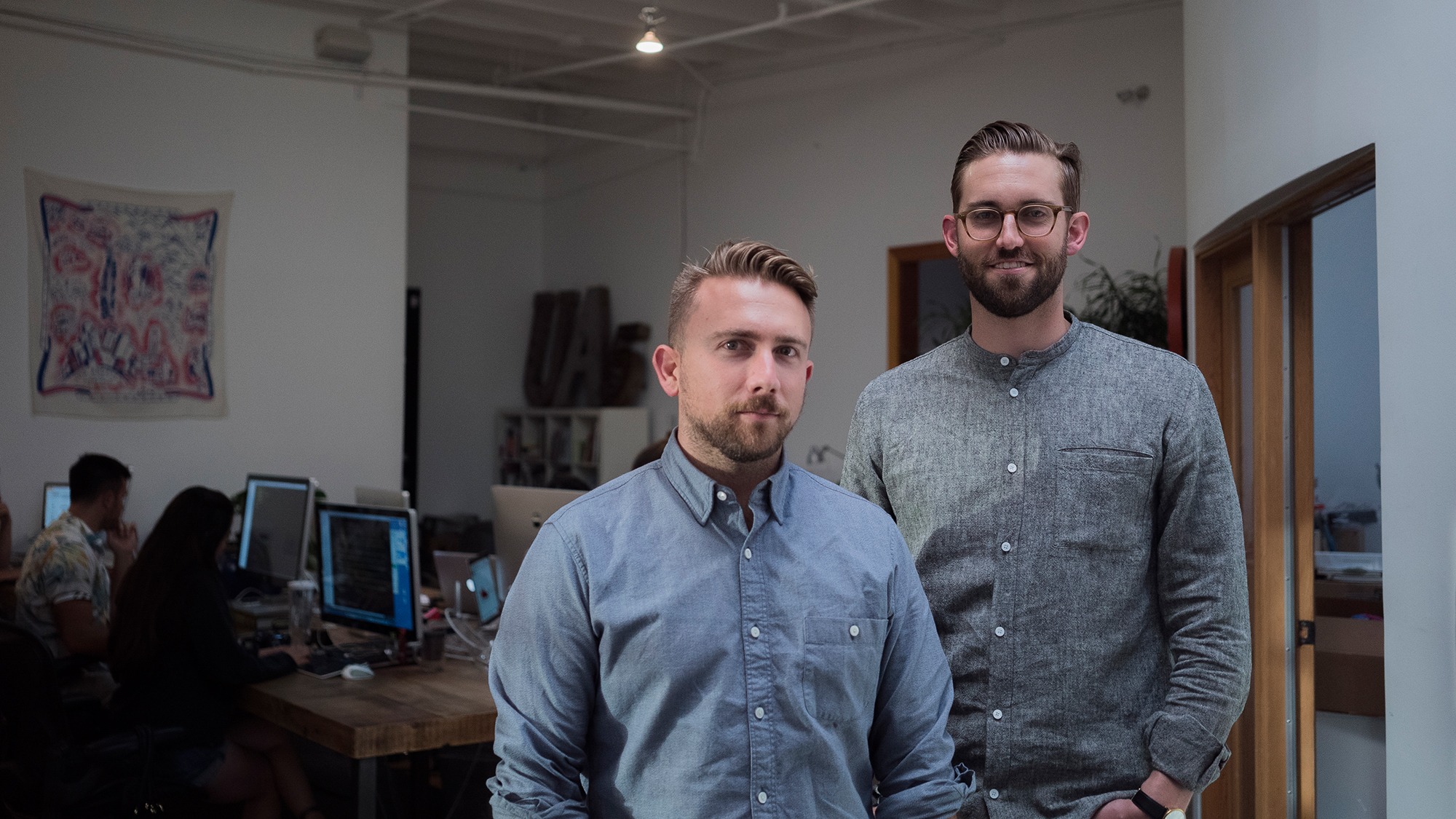
Brooks met Jason Farrell at UCLA orientation. They became friends and later roommates, making creative work together while developing their own freelance practices. Professor Henri Lucas helped them think through the studio they wanted to establish. By graduation, starting a business together seemed possible. Their first premises were in Venice. The plan had become an office, which is one efficient way to make an idea start demanding rent.
The name Use All Five referred to experiences engaging the senses. The founders wanted to make environmental work; digital projects provided a practical beginning. Over time, the two settled into the roles they still hold: Brooks as CEO, Farrell as CTO. A project archive for Morphosis Architects, Morphopedia, helped establish the young studio’s reputation. Subsequent work connected them to cultural institutions and technology companies. An ambitious name had survived the ordinary necessity of earning the next commission.
“He had skills that shielded my weaknesses, and vice versa.”
Levi Brooks, on Jason Farrell
By the time of their 2016 UCLA studio visit, Brooks could describe a chain of relationships linking Morphosis, MOCA, and the Guggenheim. This was how growth looked from inside: a project, someone’s trust, another introduction. The client list becomes more legible when you read it as a history of people willing to work together again.
The museum gets more than one doorway
The Guggenheim’s Storylines exhibition website offers a useful example of a plan changing through conversation. Early proposals were more directed. Chief curator Nancy Spector asked the studio to consider how visitors might explore through ideas emerging from the exhibition’s texts. The resulting experience connected terms with artworks, allowing people to follow relationships through the material.
That is a different proposition from putting an exhibition brochure online. The visitor can move through a web of associations. The institution supplies knowledge; the designers and developers give that knowledge a form someone can navigate. A good collaboration allows either side to revise the question. Brooks’s team had to listen closely enough to build an experience that the first proposals had not yet contained.
It also gives the work a useful test. Can someone find an inviting beginning? Does the next action reward attention? Is there room to discover something beyond the first screen? In a museum, wandering can be part of the pleasure. A website can allow some of that pleasure without abandoning the visitor to a maze.
When the audience gets to answer back
For Bonobos’s #EvolveTheDefinition project, Use All Five worked on a website featuring 172 interviews about masculinity. Visitors could contribute synonyms of their own, helping reshape the displayed definition. A subject usually encountered as a fixed dictionary entry became a collection of voices and responses.
Brooks described the apparently endless interview grid as a technical challenge. Smaller layouts were joined in real time to produce the larger experience. The visible result looked simple because considerable effort had gone into its construction. That is a familiar bargain in interface design: the people making it wrestle with complexity so the person arriving can begin without a lesson.
The project also made participation visible. A contribution changed what others encountered. As with Artifax, the audience had something to do beyond watching. The outcome depended partly on what people brought with them, an element Brooks found exciting precisely because it could not be entirely prescribed.
Interviews in the Bonobos project.
One definition opened to more voices.
Someone has to keep the studio running
Ask Brooks about being CEO and the answer returns to decisions, recruitment, winning work, and the overall direction of the business. He has described a day divided among meetings and smaller conversations, “all building up to something bigger.” A creative company still needs someone to decide which work to pursue and which people can help it happen.
His own description includes contributing to design and code. The job crosses between making and organizing the conditions for other people to make. The studio’s stated values emphasize collaboration, curiosity, and room for different voices. Those ambitions acquire substance in everyday choices about who gets heard, who gets responsibility, and whether an experiment has time to become useful.
Designer Troy Curtis Zaretsky-Kreiner has credited Brooks and Farrell with supporting projects and the development of Silk, the studio’s branding division. The account adds another perspective to the founder story. A company’s creative life includes what its colleagues are encouraged to initiate, alongside the work its founders imagined on graduation day.
The next tool might begin at the next desk
Brooks’s recent account of replacing the studio’s time-tracking software brings his interest in AI down to a recurring invoice. Strategist Ryan Daniels talked to colleagues about their needs and built a prototype. Farrell then rebuilt the tool with engineering experience and AI assistance. The distinction between a promising idea and dependable software remained part of the story.
Brooks’s enthusiasm concerned the ability to shape a tool around the people using it. A colleague could explore the problem, make something tangible, and bring it to someone equipped to handle the engineering. The prototype became a basis for collaboration. The work still required conversations, priorities, and judgment about what the studio actually needed.
The setting is less glamorous than a museum opening, which makes the example useful. An internal dashboard has daily users who can tell you immediately where it fails. For a CEO who spends so much time keeping work moving, the chance to improve that machinery has an obvious appeal.
Twenty years, and another room of students
Brooks’s working life has also included teaching and public conversation. LMU lists him as an M-School instructor. He co-hosted the Los Angeles gathering localhost.us with J.J. Kaye, and appeared in Google Design’s 2016 SPAN program. USC listed him for a public Roski Talk on October 20, 2026. The studio that began after university now supplies material for classrooms of its own.
In its twentieth anniversary year, Use All Five remains the business Brooks leads with Farrell. The screens and tools have changed. So have the questions clients bring through the door. The recurring pleasure in this story is seeing an unfamiliar possibility become something another person can use: a visitor’s route through artworks, a colleague’s prototype, a constituent’s message reaching a paper tray. The fax machine had been waiting there all along.
Follow the conversation
Explore Use All Five, Brooks on LinkedIn, and Brooks on X.
Read the UCLA studio visit, the design interview, and the Artifax story. Watch Brooks at Google Design’s SPAN LA. See the USC Roski event listing.