In 1989, a question arrived at UCLA’s Daily Bruin that could have been mistaken for a small matter of distribution. Could Ten Percent, the campus LGBTQ+ newspaper, appear as an insert? For students worried about being identified simply by picking up a copy, the arrangement offered a way to read it without announcing themselves. A newspaper inside a newspaper could make a public campus feel a little less exposing.
Valarie de la Garza was editor-in-chief. Some people in the advertising and editorial departments worried that advertisers would object and withdraw their money. She argued for inclusion and for an editorial vision that would guide the business. The student publications governing body agreed. The insert went ahead, advertising revenue held up remarkably well, and other campus publications representing ethnic and racial communities followed.
Consider the precision of that decision. The obstacle was partly where a reader had to stand to get the news. Changing the packaging changed the terms of participation. It is a useful place to begin with de la Garza, now Fenton’s chief executive: a practical adjustment, a commercial objection, and an insistence that the people being addressed deserved consideration before the anticipated complaints.
South Gate goes to UCLA
She grew up in South Gate, in working-class Southeast Los Angeles, and became the first person in her family to attend college. At UCLA, the distance between her educational preparation and that of other students brought the consequences of unequal opportunity into focus. Geography had already done some sorting before anyone arrived for class.
Her degree was in sociology. Her education also took place at the Daily Bruin, where she became its first Latina editor-in-chief and served in that role in 1989–1990. She graduated in 1991. Sociology asks how institutions organize people’s lives; editing a newspaper requires deciding what those institutions, and those people, will look like on the page. Her later career would keep those questions close together.
A university can put people from very different backgrounds in the same lecture hall without erasing the differences they bring. De la Garza’s account of arriving at college treats that discovery as a reason to pursue social impact. The experience gave her a frame for the work ahead: pay attention to the conditions that determine whether someone can take part.
An audience is made of individuals
Her public relations career began in the 1990s at emerging Latino PR firms. Latino communications was still treated as a specialty at the edges of the business. Over the following decades she worked across agency sizes, including The Rogers Group and MSLGROUP, and ran her own consultancy, De La Garza PR. The career combined consumer marketing with nonprofit and public-sector work.
That range matters. Her professional biography includes Latino marketing for Big Brothers Big Sisters of America. In discussing consumer accounts, she has named Nestlé and Kellogg’s and described the resources brands devoted to understanding their customers. Research, testing and a clearly defined result belonged to the work before the campaign reached its audience.
She argues for bringing that discipline into social impact communications, even when budgets are smaller. A good intention still needs a workable plan. Spending time on research can feel like a delay to an organization impatient to act; it can also prevent an expensive conversation with the wrong audience. For a communicator, enthusiasm is a pleasant starting condition. It cannot answer every question on the brief.
Counting, voting, showing up
Before Fenton, de la Garza led communications and marketing at the California Community Foundation, including a rebranding effort for the century-old organization. At Fenton she went on to lead its West Coast offices. By the time she was named CEO in March 2021, she had spent about four years with the firm.
Two Los Angeles campaigns stand out in the account of that appointment. She led We Count LA, aimed at participation in the U.S. Census among Black, Latino and Asian American Pacific Islander communities. She also helped conceive and execute Every Vote In, Los Angeles County’s 2020 effort to encourage voting. Both put communication next to a specific civic action.
Being counted and casting a vote require a person to do something. A campaign has to reach beyond recognition to participation. These projects make the connection between her earlier editorial work and her agency career unusually concrete: the people a message hopes to reach have reasons, circumstances and concerns of their own. The job includes taking those seriously.
Fenton had been founded by David Fenton in 1982 for progressive social change communications. De la Garza took responsibility for an existing institution with a long history and a national operation. Becoming its first woman and first person of color CEO added another first to her résumé, decades after the campus newspaper.
One hundred days to find out
The CEO opportunity had not been on her own list of expected next steps. Rather than treating the title as a complete answer, she sought advice about the work that would come with it. A friend encouraged her to look closely at the discretion she would have, her relationship with the owner, and whether she could carry out her vision.
She proposed a 100-day interim period. Fenton owner James Marcus agreed. The arrangement gave both sides a chance to experience the relationship and evaluate the responsibilities. It turned a very large career question into something she could examine through daily work.
There is refreshing practicality in that story. Leadership biographies often compress uncertainty into a sentence before proceeding to the appointment. De la Garza gives the uncertainty a duration and a method. The calendar became a way to gather evidence. She could learn what leading the company actually involved while the company learned how she would lead it.
Her March 2021 appointment followed a period as interim CEO after Ben Wyskida’s departure. She has since spoken about the importance of considering what an opportunity allows you to do. The useful question extends beyond whether a title looks impressive on a business card. What decisions come with it?
The interim period she proposed before committing to the CEO role.
A room full of colleagues
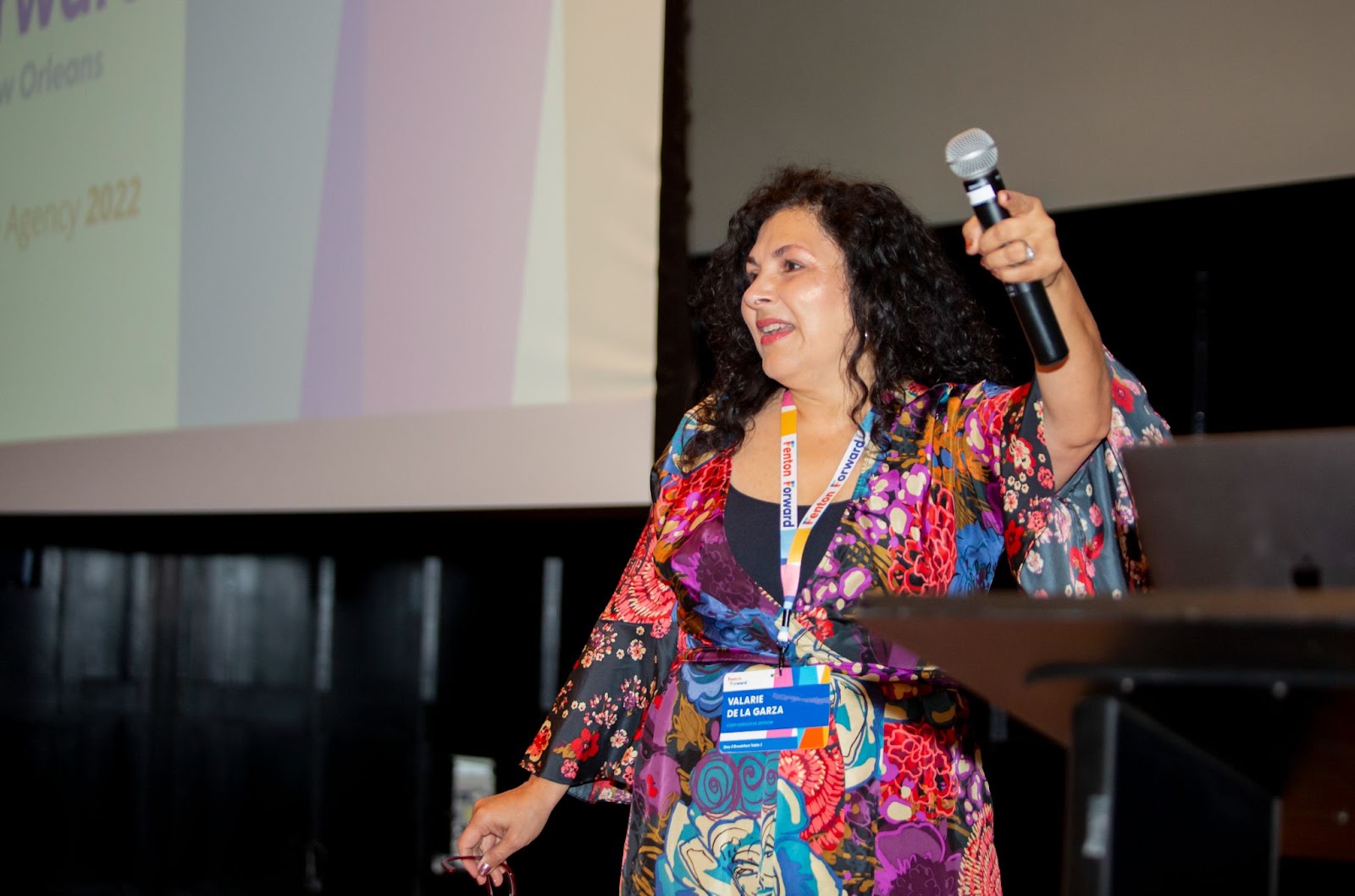
In late 2022, Fenton staff gathered in New Orleans for a four-day retreat called Fenton Forward. More than 120 people came together to mark the agency’s fortieth year. De la Garza and Marcus led discussions about leadership and values; staff taught one another skills in strategy, messaging, writing and digital engagement.
The photograph from that gathering catches her with a microphone raised, glasses in her other hand, and an outfit that has no intention of disappearing into the background. It is a working picture: a leader addressing colleagues, with the room and presentation still in view. The occasion brought an expanding organization into physical focus.
An agency sells the judgment and collaboration of its people. Gathering those people creates a different kind of work from winning an account. They need to learn how their colleagues think, how their disciplines fit together and what they can ask of one another. At Fenton Forward, the schedule made room for that exchange.
What growth asks of a leader
By May 2023, Fenton’s revenue and staff had doubled during her first two years as CEO. That is a historical milestone, rather than a claim about today’s headcount. Growth gives a leader more capacity to work with clients, and more relationships to maintain inside the business.
In 2022, the agency won PRWeek’s Best in Nonprofit award for its work with Stop AAPI Hate. Its digital team also received recognition from Ragan Communications and PR Daily. These were team achievements during her tenure. Her own honors included PRSA-LA’s 2021 Sunrise recognition for advancing diversity and inclusion and a place among PRWeek’s Women of Distinction in 2023.
The distinction between an individual honor and a team result matters in a profession built around other people’s stories. De la Garza’s public LinkedIn response to the digital award congratulated the people doing the work. Her role includes making a business in which that work can happen, then giving the people responsible their due.
- 1989Daily Bruin editor
- 1991UCLA graduate
- 2021Named Fenton CEO
- 2026PR Council secretary
The details that survive the speech
Her ideas about communication also appear in a less glamorous artifact: Fenton’s People First & Identity Style Guide. Its acknowledgments name her among the staff who reviewed the guide and provided content or guidance. The primary authors were Hillary Kessler, Shakirah Hill Taylor and Daria Hall. It was a collaborative project, rather than a CEO’s personal manifesto.
The guide addresses how language can represent people with care, including the variety of terms used for people with Latin American origins. It counsels writers to understand that complexity. A style guide lives where values encounter an actual sentence: which word, which description, which assumption about a reader.
This is the unphotogenic side of public relations. It has fewer microphones and more revisions. Yet choices made there travel into campaign copy, presentations and client conversations. A commitment to inclusion becomes more useful when someone can apply it at the keyboard.
“What would Ron do?”
De la Garza on the influence of her mentor Ron Rodgers
The next set of questions
In February 2026, the PR Council confirmed de la Garza’s continuing position as secretary on its executive committee. The trade association’s agenda includes agency value, pricing, responsible uses of artificial intelligence, and research connecting work to client outcomes. Those are practical questions for a field whose methods and economics are changing.
Her community commitments have also included Homeboy Industries, whose 2024 annual report lists her on its board. The link keeps her professional responsibilities connected to Los Angeles institutions. National agency leadership and local involvement can occupy the same calendar; the connection is visible in the organizations she serves.
For de la Garza, the next chapter therefore includes both the purpose of communication and the machinery that pays for it. Agencies need methods, people and a viable business if they are to keep working on public questions. The editorial decision and the advertising objection have grown into a larger set of responsibilities.
A sentence taped to the wall
In a 2024 reflection, she wrote about a remark from her mother that she keeps taped to her wall: “Don’t be impressed, be convinced.” Her mother had raised her children with limited money and sustained effort. De la Garza credited that example with teaching her persistence, compassion and composure under pressure.
The sentence suits a career in communications. Being impressed can happen quickly. Being convinced requires something to hold up after the presentation ends. Her mother’s example gave the phrase its personal meaning: the ordinary, repeated work of keeping a family going deserved to be recognized as an accomplishment.
Read back through de la Garza’s career and the moments worth lingering over have that same practical scale. An insert gets into a newspaper. A civic campaign asks people to participate. An interim appointment gives a leader time to understand the job. A guide helps a writer choose words with greater care.
The title at the end of the résumé is CEO. The thread running through it is attention to how people enter a conversation and what they can do once they arrive. At UCLA, that began with a problem of distribution. Years later, she is still working on the conditions of being heard.