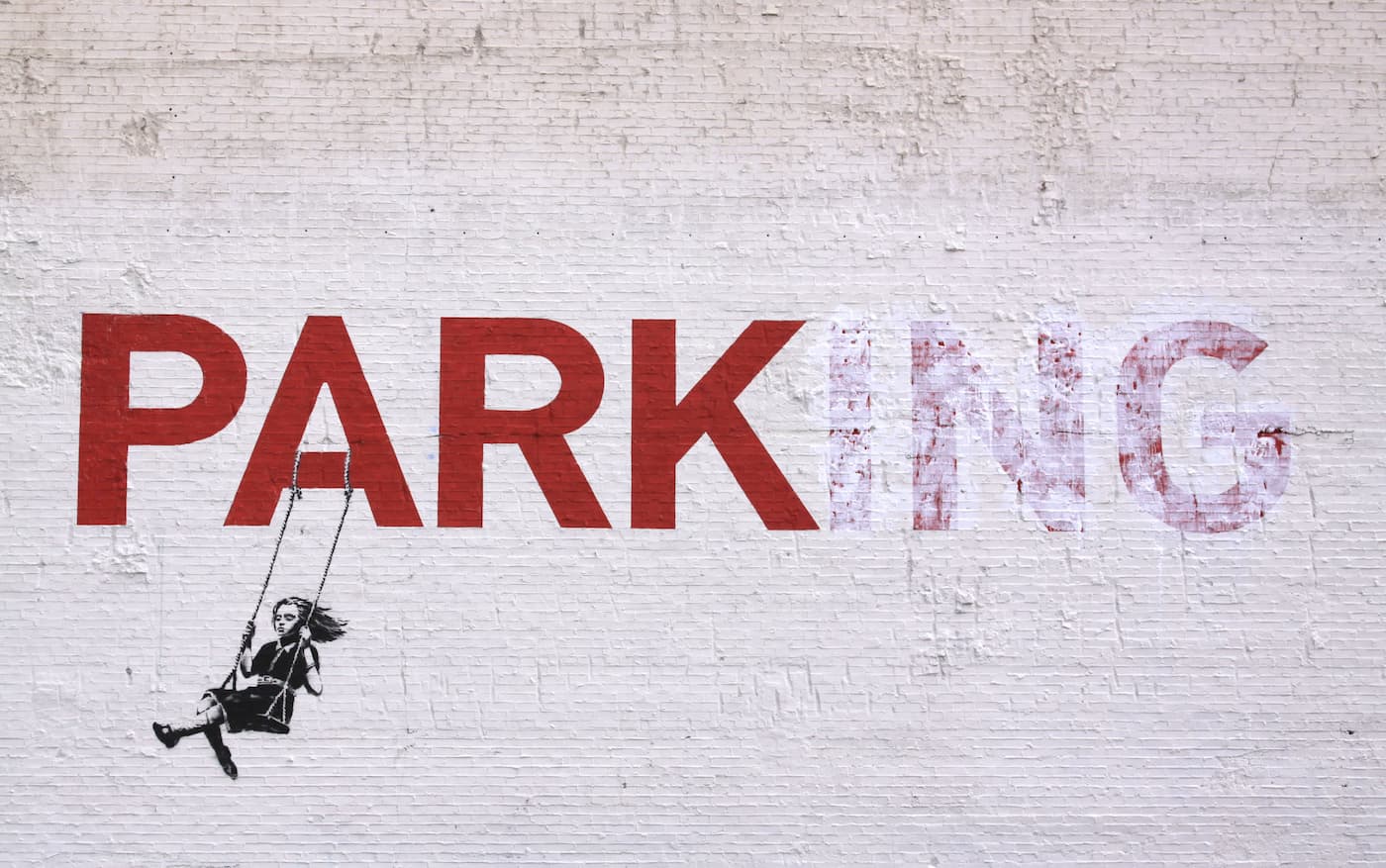
A girl swings from the letter A in a parking sign. Below her is a Los Angeles sidewalk; behind her, a building somebody wants to sell. For a commercial broker, the building is inventory. For an art editor, the girl is a Banksy. The difference between those two descriptions is where Miller Ink gets to work.
The agency had roughly ten weeks to promote the Sparkle Factory auction. Its campaign put the mural and the building’s Hollywood connections up front, then assembled a website, video, press outreach and an event. Miller Ink reports coverage in more than 100 outlets. The useful lesson is in the choice of subject: an unusual wall gave people outside commercial real estate a reason to look at commercial real estate.
Miller Ink sells the work of finding that reason, expressing it clearly and getting it to the right people. Its assignments stretch from publicity and digital marketing to the more anxious business of protecting a reputation. A property auction wants attention. An executive facing a damaging allegation needs to think carefully about what attention will do.
The speechwriter behind the agency
Nathan Miller founded the firm in 2013. Before that, he directed speechwriting for Israel’s Permanent Mission to the United Nations, advising Ambassador Ron Prosor. His earlier work included the Homeland Security Advisory Council and the Transatlantic Institute in Brussels. This is a background in institutions, arguments and consequential audiences.
A speechwriter has to solve an awkward problem: the person saying the words must be able to inhabit them. That is a useful way to understand the agency’s emphasis on message development. The product is a position the client can explain, repeat and defend across interviews, websites, speeches and conversations with its own people.

In a 2022 Shoutout LA interview, Miller described seeing an opening for a small agency that could combine emerging media tools. He also acknowledged how much he had needed to learn about running a business. The original bet was on a changing information environment: organizations would need help coordinating communications that had previously lived in separate departments.
The firm’s principles page opens with a deliberately provocative sentence: “Public relations is dead.” Its service list is full of public relations. The intended target is the separation of press, advertising and marketing. Miller Ink combines earned coverage, channels a client controls, and paid distribution. The practical question is whether these pieces tell the same story.
The bottleneck before the statement
Crisis communications puts that coordination under pressure. The firm’s practice covers litigation, disputes, leaks, hacks and damaged reputations. Its published method begins with conversations about what might go wrong, then develops responses around the organization’s audiences, vulnerabilities and objectives. Nathan Miller is described as directly involved in the crisis practice.
In Axios’s May 2024 reporting on rapid crisis response, Miller pointed to internal processes as a source of delay. The observation is less cinematic than an emergency press conference, and more useful. A company can have plenty of information and still struggle to decide who is allowed to say what.
- 01FactsWhat can we verify?
- 02AuthorityWho can decide?
- 03AudienceWho needs to hear?
- 04MessageWhat can we stand behind?
There is a concrete example in American Jewish University’s 2020 client interview on Clutch. After several crises, the university recognized that it needed more detailed procedures. Miller Ink helped train staff and establish a route for media inquiries. The experience changed the assignment: responding to events exposed a need to improve the machinery behind the response.
The firm also offers attorneys a 90-minute virtual workshop, advertised as approved for California MCLE General Education credit. That audience makes sense. A lawyer and a communications adviser may examine the same sentence for different consequences. Getting their concerns into the same conversation early is part of preparation.
A lullaby with a distribution plan
At the quieter end of the portfolio sits American Friends of the Israel Philharmonic Orchestra. AFIPO wanted more email subscribers, online donations and digital engagement. Miller Ink worked on its website, customer relationship management system, social channels and content capabilities.
One piece was the 2021 Summer Bedtime Series: four episodes pairing a celebrity’s reading of a children’s book with a lullaby performed by a quartet of orchestra musicians. The firm promoted it through Google, Facebook and Instagram advertising, purchased email placements and the nonprofit’s own channels. A cultural institution had found a small, recognizable place in a family’s day.
views of the Summer Bedtime Series
Those figures come from Miller Ink’s case study. They describe attention and participation; they do not establish profitability. Still, the sequence is useful to copy: make something for a specific audience, give it several routes to that audience, and connect the experience to an ongoing relationship.
One company, several reasons to care
The same interpretive work shows up in very different sectors. For Westfield’s Century City and San Diego shopping centers, Miller Ink developed a media kit about a retail model that combined shopping with food, fitness, wellness and everyday errands. The assignment was to explain why a visit could mean more than buying something.
For biotechnology company Pluri, the challenge was almost the reverse. Its cell-based work touched medicine, technology and food. Miller Ink developed messages for different areas of the business and supported announcements, interviews and events. The firm reports nearly 100 unique stories around Pluri’s venture with food company Tnuva.
Read together, these cases suggest where Miller Ink fits in the agency market: organizations whose activities need explanation across several audiences. Its portfolio gives a prospective buyer something specific to inspect - retail positioning, scientific messaging, nonprofit participation - alongside the promised access to senior counsel.
A useful message gives the audience a reason to care and the organization a position it can defend.
The common thread across the work
The work behind the words
Impact reporting adds another requirement: the story needs evidence. Miller Ink’s partnership with Ethos Giving joins communications and design with social impact consulting and measurement. The offering serves businesses and nonprofits that want to explain what their programs achieved. Ethos Tracking, the partner’s software, supports the measurement side.
The attraction is straightforward. A collection of activities becomes easier to understand when the measures, explanation and design are developed together. For a buyer, the relevant test is whether a report distinguishes what an organization did from what changed because of it. Attractive pages cannot settle that question on their own.
The agency is also changing how it produces work. Its published AI position describes dedicated client environments, research and monitoring workflows, message testing and human review. It says AI agents can be made available to clients. These are the firm’s descriptions of its operating approach, rather than independently tested product specifications.
That approach puts a familiar agency question into a new setting: who takes responsibility for the result? Miller Ink says its people retain judgment and ownership. A client can turn that promise into practical questions about how an argument gets checked, how sensitive material is handled and who signs off on the final language.
Its recent publishing keeps returning to human habits. An August 27, 2026 post argues for finding useful stories in existing data and timely events. An August 10 piece examines trust between PR professionals and journalists. Both fit a business in which getting someone to pay attention still requires understanding what makes their work easier.
Buy the work, make time for it
Miller Ink operates as a professional-services firm, selling scoped assignments and ongoing support. Clutch lists a minimum project size of $10,000 and identifies $10,000-$49,999 as the most common band among five cost-reporting reviews. These are buying signals, not a universal campaign price.
Clients also spend time. The university interview contains particularly useful advice: reserve time for the agency and be willing to do the work. A communications team needs access to facts and decision-makers. If those are withheld, drafting faster will only get it to the wrong answer sooner.
For someone considering the firm, the starting point is a concrete problem: explain a complicated offering, prepare for scrutiny, build participation or communicate measurable impact. Bring the audience, the decision that matters and the constraints. Then examine the proposed work against that objective.
The girl on the wall is a memorable illustration of what comes next. The detail was already there. Somebody had to recognize what it meant to a different audience, and build a campaign around that recognition.