A sports card can be worth a great deal of money and still leave its owner with an awkward problem at the bank. Leore Avidar encountered that gap himself. He had built a valuable collection, wanted to borrow against it, and found that a lender did not see the cards quite as he did. For a former derivatives trader, the disagreement was an invitation to build something.
Avidar had already co-founded Lob, the company that lets software order physical mail. Now he was considering another stubbornly physical object: a small rectangle of cardboard whose price depends on condition, scarcity, and how much somebody wants the athlete pictured on it. A letter and a basketball card make unlikely companions. Both, however, become complicated when someone tries to move them through the world.
His new company, Alt, would supply some of the missing machinery: valuations, a marketplace, custody, and lending. That list sounds sober enough to belong in a financial presentation. Its raw material includes Kobe Bryant cards. Avidar's career has an appealing habit of placing the serious and the playful at the same table, then giving them both work to do.
The bank story helps explain the choice. A valuable possession, a usable price, and accessible cash are three different things. Connecting them requires more than a persuasive collector. It requires a system other people can trust. Avidar had found a problem he understood from both sides: as someone who priced difficult assets and someone who liked owning them.
Before the cards, there were numbers
Born in Milwaukee and raised outside Chicago, Avidar grew up with finance and software close at hand. His father traded at Bear Stearns; his mother worked in software at SAP. Basketball occupied another portion of his attention. At the University of Michigan's Ross School of Business, where he studied finance, he also pursued the technical knowledge needed to build things.
One early ambition was wonderfully economical: create a machine that could trade for him, then travel. The route proved less economical. A college grocery-ordering venture exposed gaps in his team's development skills. He learned to program. A subsequent ecommerce effort lasted only months. Those ventures gave him practical experience before the better-known companies arrived.
He worked at Citigroup, trading derivatives, then at Amazon Web Services in technical business development with startups and venture capital. The sequence matters. Finance taught him to examine prices; cloud infrastructure showed a way to package complicated work so somebody else could get on with their job. His later businesses would draw on both experiences.
Wall Street also supplied an example of the workplace he wanted to leave behind. He described it as transactional and uncollaborative, with people watching the clock. When he became an employer, he wanted colleagues to have reasons to stay. Avidar's objection concerned the daily experience of work as much as the work itself. A good career, in his telling, should offer more than a tolerable countdown.
The dining table had a mailing address
In 2013, Avidar and Harry Zhang started Lob. Zhang's experience managing mail campaigns at Microsoft had exposed how much effort even a large technology company devoted to printing and sending things. The founders saw an opening for software that could take over that coordination. Their early names included Printbox and Infraprint, before they settled on Lob.
The domestic arrangements were rather less corporate. In Sunnyvale, they worked side by side at a dining table, with music playing and coding sessions stretching to four in the morning. Early fulfillment involved an inkjet printer and stuffing envelopes by hand. The promise of automation had to pass through a distinctly manual apprenticeship.
Avidar later remembered being the DJ, usually choosing Top 40. Outside the coding, there was tennis, cooking, and NBA Jam on Nintendo 64. After their first employee, Dan, joined, the shared meals continued; so did basketball outings. These details give his company-culture language a specific origin. The founders had enjoyed living and working together and wanted to preserve something of that experience.
By late 2014, Avidar found himself almost jogging through his short commute because he looked forward to seeing his colleagues. He called the feeling “Running to Work.” The phrase is charming precisely because a startup can make running in the opposite direction seem sensible. His aspiration was to make responsibility, mentorship, and friendship part of the reason to arrive.
“It wasn’t collaborative.”
Leore Avidar, on his early Wall Street experience
Two mugs, and a useful embarrassment
The Lob founders also learned how easily a plausible request could become an expensive distraction. A prospective customer said it would order thousands of printed mugs a month. They built a Mugs API. Six months later, the total orders amounted to two: a test order and one for a Y Combinator partner.
The lesson was to seek a spending commitment before committing engineering time. There is something almost merciful about that number. Two mugs are hard to explain away as a promising market waiting for the right season. The episode made a clear distinction between an enthusiastic conversation and a customer willing to pay.
Lob's central business kept developing. In May 2022, the company announced a direct mail automation platform, reporting more than 10,000 customers and almost a billion pieces of mail sent through its service. Those were company figures at that date. The distance from the dining-table printer was considerable.
Avidar's description of the problem stayed concrete: connect the physical with the digital. The computer could specify a letter; someone still had to print it and deliver it. That stubborn last mile gave the company its purpose. The attraction was less about making paper fashionable than making an ordinary task easier to order, track, and repeat.
after six months
Nostalgia with a custody arrangement
Alt was founded in 2020. Its early proposition included portfolio tracking and real-time estimates under the name Alt Value, alongside a vault for the actual cards. A screen could show the collection while the objects stayed in storage. The arrangement addressed the practical distance between a collectible somebody loves and an asset somebody else can transact with.
The emotional side remained visible. Avidar has identified Kobe Bryant as a favorite athlete and a focus of his collecting. His professional biography for Christie's Art+Tech Summit invoked Bryant's approach to preparation and competition. A collector's taste does not disappear when a spreadsheet arrives. Often, the spreadsheet is there to support the taste.
In a 2022 conversation, he discussed nostalgia, deal-making, and the pleasure of learning from other investors. Alt's backers included Kevin Durant, Giannis Antetokounmpo, and Tom Brady. Their participation gave the company recognizable connections to sports, though recognition alone does not explain how a marketplace works. Buyers still need information; sellers still need an offer.
Avidar also emphasized learning what people collect and why. That is a revealing task for a founder who likes numbers. A price records an agreement, but demand begins with people: their tastes, loyalties, memories, and expectations. The market has to accommodate those motives even when its interface looks comfortably mathematical.
Lob and Alt therefore offer an interesting pairing. One coordinates a physical communication; the other coordinates ownership of physical collectibles. This is the connecting thread in his work: software can reduce the administrative burden surrounding an object without removing the object from the story. The envelope still arrives. The card still exists.
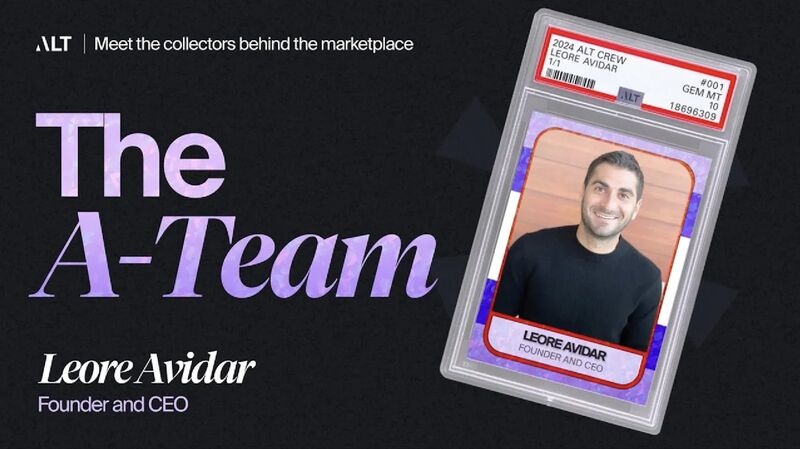
The customer may be twelve
Some of Avidar's customers are young enough to make a conventional executive meeting look faintly absurd. He has described taking calls from children who want to discuss the app, ask about negotiation, or propose a card trade. He treats them as customers with feedback worth hearing. A weekend conversation can become a small bargaining session.
That anecdote is a useful corrective to the language of asset classes. A marketplace is also a place where people learn to ask questions and make offers. The founder cannot assume that a customer will come with a job title, much less a polished deck. A child testing a price has a reason to care whether the product makes sense.
His hiring message has a similar impatience with conventional signals. In a public recruiting post, he said he did not care about candidates' schools, countries, or years of experience, and emphasized engineering ability and a passion for collectibles. His investor profiles also document angel investments, giving him another connection to people building companies beyond his own.
Earlier interviews show a recurring concern with sustainable growth and replacing himself through hiring. In his 20VC appearance, he discussed the changing CEO job and his hope that employees could stay for decades. That ambition asks more of a workplace than a pleasant lunch. People need room to become more capable without immediately needing to leave.
Making the collection usable
On July 18, 2025, Trinity Capital announced a commitment of up to $40 million in an asset-based revolving credit facility for Alt. The announcement described a marketplace available in 76 countries, with auctions, vaulting, cash advances, and collateralized loans. The commitment was financing capacity, with its own structure and purpose; it was not a measure of Avidar's personal wealth.
For Avidar, it meant scope to extend larger loans and more instant advances. He said he wanted to take the financing model beyond trading cards into other collectibles. That ambition returns to the bank encounter at the start of the story. He is working toward a world in which owning a treasured object need not require selling it to access cash.
The hard part sits inside that apparently simple sentence. A lending system needs confidence about value and custody. A collector wants convenience without surrendering everything enjoyable about collecting. Bringing those requirements together is the work; announcing that objects are valuable only gets the conversation started.
Avidar's story remains rooted in particulars: a dining table, envelopes, two mugs, basketball, collectors with questions. They keep his abstractions honest. For all the machinery he builds around things, the things themselves persist. Somewhere beyond the valuation on a screen is a card somebody wanted as a child. He is trying to make the machinery worthy of that attachment.