The card can fit in a shirt pocket. The queue cannot. On September 8, 2026, PSA reported 9.9 million items waiting in its grading backlog. For Collectors, the company behind PSA, that number captures both the appeal of its business and the difficulty of running it: people want an expert opinion on their treasures faster than the experts can deliver one.
Collectors sits between the person who says a collectible is special and the stranger being asked to pay for it. Its brands authenticate objects, assess their condition, seal them in protective holders and attach records that buyers can check. Then come the adjacent services: research prices, store the collection, arrange a sale. A childhood obsession has acquired a rather serious back office.
The proposition is easy to understand. Buying a rare card from an unfamiliar seller involves questions about authenticity, wear and value. Collectors sells help with those questions. Its harder assignment is maintaining confidence while expanding into more of the transaction itself.
The number on the label does the talking
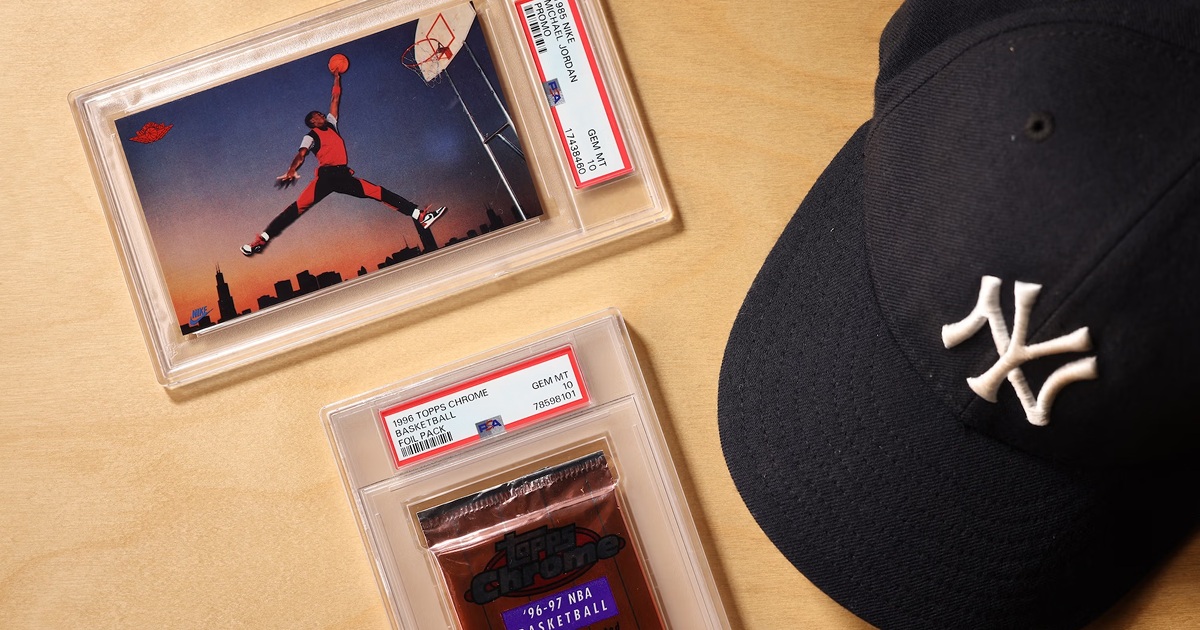
Start with the plastic case, known in the hobby as a slab. PSA authenticates a trading card before assigning a condition grade on its ten-point scale. The label identifies the card, its grade and its certification number. Buyers gain a reference point that travels with the object, rather than depending entirely on the seller’s description.
A slab does not make every card valuable. It makes a judgment about that particular card legible. A collector trying to complete a vintage baseball set and a dealer sorting modern Pokémon submissions may have different motives, but both need other people to recognize what they own. Authentication and condition assessment are the common services underneath the enthusiasm.
That idea predates today’s trading-card boom. Professional Coin Grading Service began serving customers in February 1986. Its founders confronted a maddening problem: two dealers could assign different grades to the same coin. PCGS combined an independent assessment, a guarantee and a protective holder. Its coin grading uses the industry’s 70-point scale. PSA followed in 1991; the Collectors Universe combination was announced in 1999, with David Hall as chairman.
The expertise is unusually specific. Recognizing an altered card surface or interpreting a coin’s condition requires knowledge of the object, its manufacture and its history. An attractive interface can help the customer submit it. The judgment still has to survive scrutiny from someone who knows the hobby.
The first thing to give way was the queue
Nat Turner belongs to the later chapter. The collector and entrepreneur led an investor group with D1 Capital Partners and Cohen Private Ventures that completed the take-private acquisition of Collectors Universe in February 2021. The final deal was valued at about $853 million. Turner is now Collectors’ chairman and chief executive.
Within weeks, the operational constraint became impossible to ignore. On March 30, 2021, PSA announced the suspension of its Value, Regular and Express service levels. The business had demand; it needed enough processing capacity to honor it. Accepting every new order would have made the existing problem worse.
In April, PSA acquired Genamint, whose technology was designed to measure cards, detect alterations and help human graders. Its proposed card fingerprinting could identify individual specimens across resubmissions and condition changes. The purchase showed where management thought software could contribute: supporting repeatable inspection and tracking, while specialists supplied the judgment.

The money followed the ambition. In March 2022, Collectors announced $100 million of new financing from existing investors at a $4.3 billion valuation. Those are historical transaction figures, not a current market quotation. A year later, it secured a $125 million revolving credit facility, co-led by J.P. Morgan and KeyBanc, with California Bank & Trust participating. Access to borrowing is different from money already spent, but it widened the room for expansion.
Nineteen million cards still wasn’t enough
PSA says it graded 2 million cards in 2020 and more than 19 million in 2025. In May 2026, it announced a further $200 million investment over 18 months, directed toward facilities, technology and roughly 1,000 additional staff. The scale of the response matters. Faster websites alone cannot receive, inspect, encapsulate and ship millions of physical objects.
More than nine times the output in five years. Company-reported figures; 2025 bar represents the stated minimum.
Yet growth had again outrun capacity. PSA’s May 28 announcement described a submission surge that added 1.6 million cards to a backlog approaching 10 million. It paused four Value tiers from June 2. This time, it also introduced a public backlog tracker. The company made the queue itself part of the customer conversation.
The tracker reveals why recovery is rarely a straight line. The backlog rose from 11 million in mid-July to 12.4 million on July 28, before declining to 9.9 million on September 8. PSA attributed the July increase partly to higher-tier submissions, convention activity and shipments arriving within an eligibility window. Its latest update said it could evaluate reopening a tier during September if the pace held. That was a conditional outlook, not a reopening announcement.

The auction house went out. The vault came in.
Collectors’ expansion has included a revealing change of shape. It once owned Goldin, the auction business. In May 2024, a set of transactions closed that transferred Goldin to eBay and eBay’s vault to PSA, alongside a commercial partnership. Collectors gained a closer connection between grading, storage and a large marketplace while relinquishing ownership of the auction house.
The companies framed the arrangement around their complementary capabilities. The observable strategic choice was to connect services with eBay’s audience. It would be a stretch to turn that into a story about an executive’s private change of heart. The transaction itself is instructive enough: owning each business in the chain was no longer necessary to connect the customer journey.
Today, customers can route eligible graded cards to the PSA Vault, then choose an eBay auction or a fixed-price listing. PSA handles the listing, photography, customer support, payment and shipping. Its Partner Offers service also lets eligible owners receive offers from a vetted buyer network. Collectors can earn from services surrounding the same object after the grading work is done.
- 01 / GradeEstablish identity and condition.
- 02 / KeepSend home or choose eligible vault storage.
- 03 / SellList on eBay or consider a partner offer.
Distribution extends beyond the browser. GameStop announced an agreement in October 2024 to become an authorized PSA dealer, offering trading-card submissions through selected U.S. stores. For someone unfamiliar with submission forms and packaging rules, a retail counter supplies a recognizable place to begin.
Before the slab, do the arithmetic
The business model mixes per-item authentication and grading fees with memberships, research subscriptions and selling services. Fees depend on the chosen service, the collectible’s value and other conditions. That makes Collectors relevant to occasional hobbyists, professional dealers and owners managing larger collections, but it does not make every service sensible for every item.
On September 9, PSA’s U.S. service page listed Regular card grading at $79.99 per card, with a $1,500 maximum insured value and an estimated 70-80 business days. The four Value tiers remained unavailable. Shipping and other applicable charges belong in the calculation too. A card expected to sell for little more than the grading fee presents an obvious problem, however fondly its owner remembers opening the pack.
Card Ladder supplies part of the research toolkit. It advertises more than 100 million historical sales, spanning sports, trading-card games and other cards, with collection tracking and price alerts. Its research team vets sales used in its analytics. The useful habit is to examine comparable completed transactions for the correct card and grade, rather than treating a hopeful asking price as an established value.
Convenience also has boundaries. The PSA Vault currently accepts cards encapsulated by PSA, SGC, BGS or CGC, rather than loose cards. Withdrawal and shipping fees apply, with an additional charge for early withdrawal. Someone who wants a card available for an in-person trade tomorrow may prefer keeping it at home. Storage solves a custody problem; it changes access to the object.
Different labels, an increasingly shared owner
Collectors’ competitive position comes from recognizable grading brands combined with research, storage and selling tools. PCGS serves the coin market. PSA covers cards and other collectibles. SGC joined the group in 2024, and Collectors announced an agreement to acquire Beckett in December 2025. Its current corporate site lists both SGC and Beckett among its brands.
In the Beckett announcement, Collectors promised to preserve the brand’s separate operations, customer experience and grading standards. That matters because a collector may prefer a particular holder or grading convention. But separate labels under one parent are a different kind of choice from separate owners. Independent alternatives include CGC Cards for cards and NGC for coins. The competitive question is how much buyers value each opinion when the item returns to market.
Trust has to survive the receiving room
Collectors’ published values contain a line more revealing than most corporate mission statements: “Be efficient, but don’t rush.” Elsewhere, it says, “Accuracy and consistency is our product.” These are the company’s stated expectations, not an independent audit of working conditions. They nevertheless describe the tension running through the business with unusual economy.
“Be efficient, but don’t rush.”Collectors’ published company values
Its careers site describes a workforce of more than 2,000 across operations, technology and corporate roles. This is a company where a receiving-room error can matter as much as a software bug. The customer has entrusted it with a particular object, sometimes irreplaceable, and expects that same object back with a credible assessment.
There is a practical lesson here for businesses far from baseball cards: establish a judgment customers trust, then remove the work around using it. There is an equally practical constraint. Every additional transaction brings something that must be handled correctly. For Collectors, the next convincing advertisement may be the simplest one of all: a customer’s card, accurately graded, coming home sooner.
Follow the objects from here
Explore Collectors, PSA services, PCGS and Card Ladder. Follow the company on LinkedIn, X and Facebook.
Read the PSA backlog updates and Collectors technology blog. Watch Nat Turner’s 2022 National interview with Sports Card Investor, or visit PSA’s vault walkthrough.