A customer types eleven angry words into a public box. Inside the company receiving them, the sentence expands. Is it a complaint or a question? Who owns it? Does the person replying need an order number, a manager's approval, or the tact to stop typing and pick up a phone? Leon Chaddock has spent most of his working life inside that expansion: the space between a small message and the large organization expected to answer it.
His career began far from the familiar theatre of founder life. Chaddock worked as a senior engineer at Anite, developing systems used across local and central government. One of those assignments was a major systems-integration project in London. The phrase sounds gray enough to come with its own filing cabinet, but the work taught a durable lesson. Information is only useful when it can cross departmental borders.
He later ran web businesses through Ljfind, then in 2007 founded a company devoted to social-media listening and analytics. Facebook was opening itself beyond universities. Twitter was barely a year old. Brands were discovering that customers could now discuss them in public, at speed, without asking the communications department for permission. Chaddock built tools to help organizations hear the conversation.
01 · The useful pivotListening was only the first half
The early business became Sentiment Metrics. From 2008 to 2014, with Chaddock as managing director, it worked with more than 300 clients in public relations and marketing. The original job was observation: collect the conversation, analyze it, tell a company what people were saying. But a listening tool eventually meets a sentence it cannot merely count. A customer needs a reply.
That was the hinge. Social posts were leaving the marketing dashboard and entering the customer-service queue. A complaint on Twitter might be public, but resolving it could require the same order data, escalation rules and institutional memory as a call to a contact center. The fashionable object was the social network. The enduring problem was coordination.
“Our software allows large enterprises to manage enquiries and complaints on social media outlets such as Facebook and Twitter, from within their contact centres.”Leon Chaddock, describing Sentiment's product
Sentiment followed the work. Its platform evolved from monitoring conversation to organizing the response, bringing social channels into the operational world of service teams. Over time, that world acquired more doors: private messages, chat, email and messaging apps. Every new channel promised convenience to the customer and threatened another browser tab for the agent.
The message, translated into work
The unified inbox is an almost comic phrase: modest furniture for an enormous mess. Yet it captures Chaddock's product instinct. Customers choose the channel that suits them. Companies should absorb the resulting complexity rather than make customers study an org chart before asking for help.
02 · A day in SofiaRemote work, before it had a costume
In 2012, Sentiment needed more development capacity. Hiring experienced engineers near its UK office was expensive and difficult. Chaddock had previously worked with developers in Ukraine and India through conventional outsourcing arrangements, but he was dissatisfied with the balance of cost, quality and flexibility. A longstanding customer introduced the company to Questers, which helped businesses create dedicated teams in Bulgaria.
The decision was compressed into a wonderfully founder-sized itinerary. After a conference call, Chaddock made a 24-hour study visit to Sofia. He saw how the model worked, met teams and returned convinced that the local market had the skills Sentiment needed. Following telephone interviews and a shortlist, he flew back and spent a day interviewing candidates in person. The first two senior Java developers were hired.
“I believe we have achieved a fully integrated development team who all work well together despite being based in different locations.”Leon Chaddock, 2014
The meaningful word is integrated. The Sofia developers attended the same meetings by video, had access to the same internal systems and knew what was happening across the business. UK colleagues visited Bulgaria; Bulgarian colleagues visited the UK. By 2014, the Sofia group had grown to six front- and back-end developers. Distance was treated as a design constraint, not an excuse to ration context.
There is a clean operating lesson in the anecdote. A distributed team is not created by choosing a video-call subscription. It is created by deciding who gets the whole picture. Chaddock's approach was hands-on at the hiring stage and deliberately porous afterward. The people building the product were meant to belong to one team, even when the team did not occupy one room.
03 · Capital and continuityA company grows around the queue
In January 2014, Sentiment, then the trading name of Macranet Ltd, raised £1 million in Series A financing. Elderstreet Investments led the round, with Netcall participating. Michael Jackson, Elderstreet's co-founder and a former chairman of Sage Group, joined as chairman. At that point the platform was used by 200 companies, and the money was intended for product development, sales, marketing and international expansion.
A later £900,000 round supported another push into sales and marketing, particularly in the United States. The company described a market in which contact centers still handled social enquiries separately because the work demanded different technology and skills. Chaddock was by then carrying three titles in the funding announcement: founder, CEO and CTO. The engineer had not disappeared inside the executive.
Systems engineering and cross-department integration work at Anite.
Founded an early social-listening and analytics business.
Began building Sentiment's integrated development team in Sofia.
Raised a £1 million Series A led by Elderstreet Investments.
Sentiment won its category at Talkdesk's Innovations in CX event.
Published on low-code AI, omnichannel service and contact-center assistants.
The timeline is less a sequence of reinventions than a gradual migration toward the moment of action. Listen to the customer. Identify the useful message. Put it in front of the right team. Give that team the context to respond. Automate the repetitive parts. Yield to a human when the situation asks for judgment.
04 · AI meets the contact centerThe handover is the product
Generative AI arrived with a gift for fluent answers and a tendency to make every software company sound newly born. Sentiment had older concerns. A contact center needs more than a sentence generator. It needs classification, channel routing, access to customer records, integrations with order-management systems, approval logic, spam filtering, performance data and a dependable passage to a human agent.
Chaddock's writing has moved with that stack. In 2017 and 2018 he published practical guidance about strategy, response times, staffing, training and unified social-service workflows. In 2025, Sentiment's site listed pieces under his name about low-code AI, omnichannel interactions, cost reduction and assistants for contact centers. The vocabulary changed because the available machinery changed. The operational questions remained recognizable.
This is where accumulated context becomes useful. Someone who has watched customer messages travel through marketing departments, service teams and multiple generations of software is less likely to mistake a persuasive demo for a complete system. The answer matters. So do the route it took, the data it used, the record it leaves and the moment the machine knows to step aside.
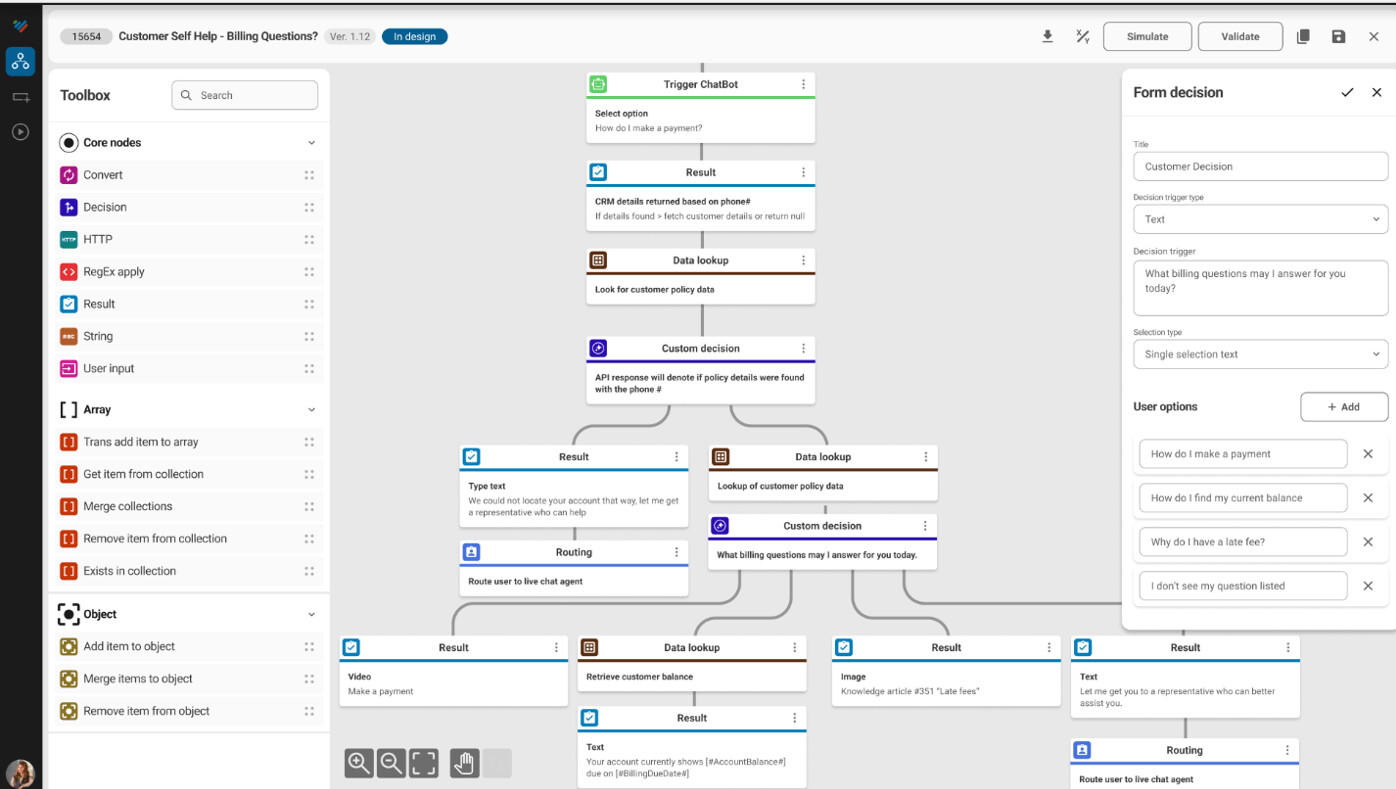
Sentiment's low-code direction also follows the same logic. Contact-center procedures change too often to make every adjustment a formal software project. A visual builder lets operations teams express routing and process without waiting for a release cycle. The product makes the organization's invisible choreography visible: if this message concerns an order, fetch that data; if confidence falls, send it here; if the customer asks for a person, stop being clever.
05 · The founder's durable advantageStay with the awkward middle
Chaddock now presents himself as a SaaS and cloud product leader with more than 20 years of experience. His public profile places him in Salt Lake City, while Sentiment retains its British roots and its engineering history in Sofia. It is a three-city story held together by software, video calls and the stubborn universality of needing an answer.
The attractive lesson is persistence, but persistence alone can become a decorative word. The more useful lesson is what Chaddock persisted with. He stayed close to a unit of work small enough to understand and common enough to build a company around: the inbound customer message. He allowed the product category to move from listening to engagement, from social care to omnichannel service, from rules to AI. He did not require the problem to keep its original name.
In 2020, Sentiment entered Talkdesk's Digital Showdown and won its category at the Innovations in CX event. Around the same competition, the company marked Giving Tuesday with a $1,000 donation to Friends of the Utah Avalanche Center. It is a small Salt Lake City detail in a largely digital biography, and a reminder that companies accumulate local attachments even when their teams and customers cross oceans.
Chaddock's story offers no grand rupture, and that is what makes it instructive. The work is a chain of handoffs: government departments sharing systems, social posts moving into contact centers, UK developers collaborating with Bulgarian colleagues, software passing a difficult conversation to a person. Each handoff can drop context. His career has been spent trying to keep it attached.
The customer, meanwhile, still types into the nearest box. They do not care whether the industry calls what happens next social CRM, omnichannel engagement, workflow automation or an AI assistant. They want the company to understand the message and do something useful. Leon Chaddock has kept following that message. It has led him through nearly two decades of technology, and it is still moving.