The Detroit Startup Betting Your Next Campfire Should Have No Fire At All
A wildfire ban on campfires sent Jarret Schlaff looking for a stove that could not start one. Lectric Boil's answer is an induction cooktop that runs on a battery, boils 36 cups of water on a charge, and never lights a match.
The trip that started Lectric Boil never happened. Jarret Schlaff was planning to camp in an area rated high for wildfire risk, and the rules were blunt: no open flames. That knocks out the campfire, the propane burner, and the little canister stove most backpackers carry. Schlaff went looking for the thing you are actually allowed to use when a spark is illegal, and found that it did not really exist. So the Detroit founder set out to build it.
The result is a company - Lectric Boil, a family-owned operation based in Detroit, Michigan - and a product called the Overlander. It is a portable induction stove that runs on a battery instead of a flame, aimed at campers, overlanders, off-grid cabin dwellers, and, in Schlaff's own framing, people who are simply trying to cook after a disaster. The company debuted the unit at CES 2025 in Las Vegas and has been taking refundable deposits since.
The problemA flame you're not allowed to light
Outdoor cooking has a fuel problem the industry mostly ignores. Propane and butane stoves are cheap and fast, but they burn - and a growing share of the American West spends its summers under fire restrictions that ban exactly that. The standard workaround is clumsy: haul a portable power station like a Jackery or EcoFlow, then plug a countertop induction plate into it and hope the wattage holds. It works, sort of, at the cost of two boxes, a tangle of cables, and a lot of guessing.
Lectric Boil's bet is that the two boxes should be one. Induction cooking heats the pan directly with a magnetic field, so there is no open element and no flame - the same reason it has been quietly taking over home kitchens. Schlaff's pitch is that its advantages travel well.
"There's a lot to love about induction cooking. It blends the instant response of gas with the easier cleanup and environmental benefits of electric." Jarret Schlaff, Founder
The productWhat the Overlander actually is
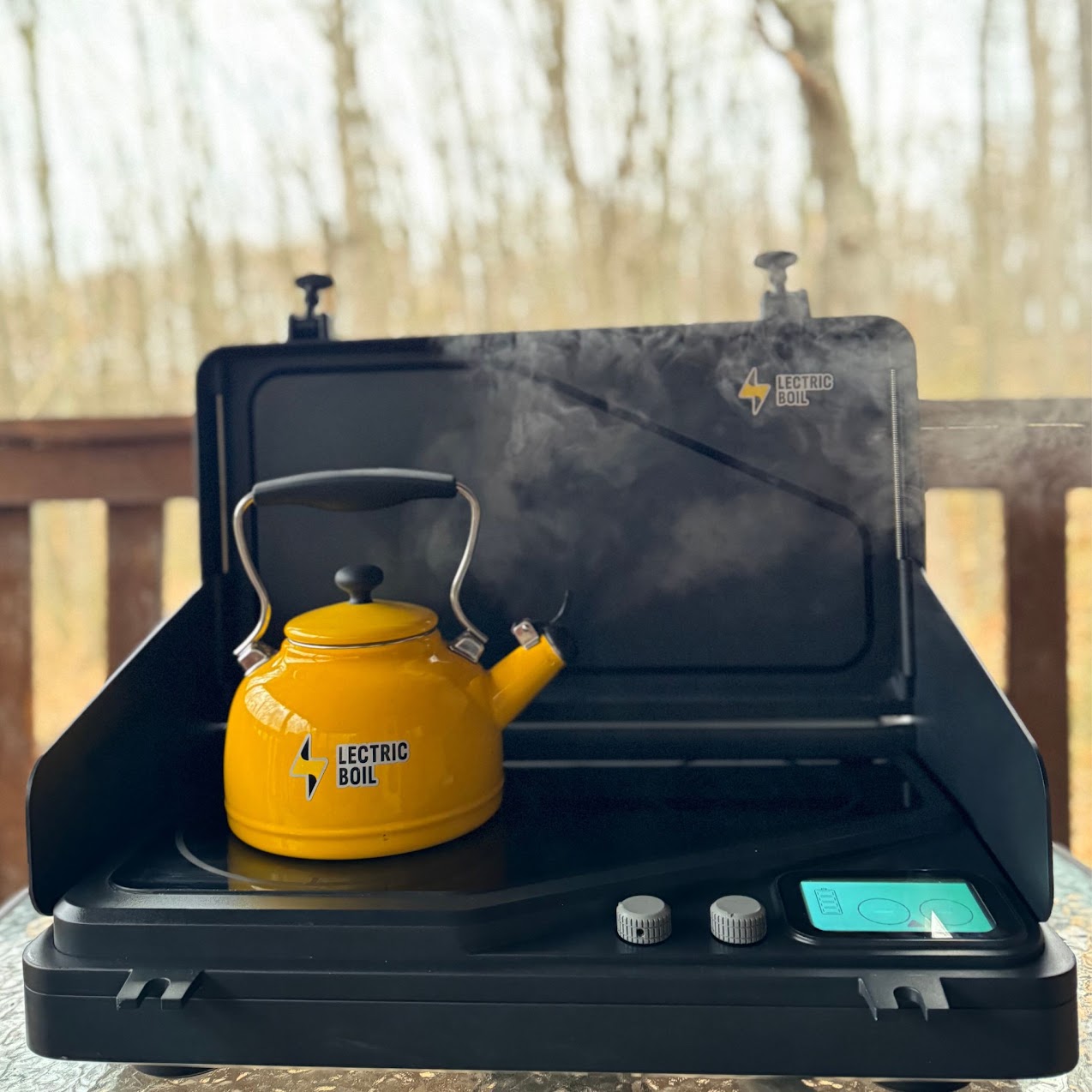
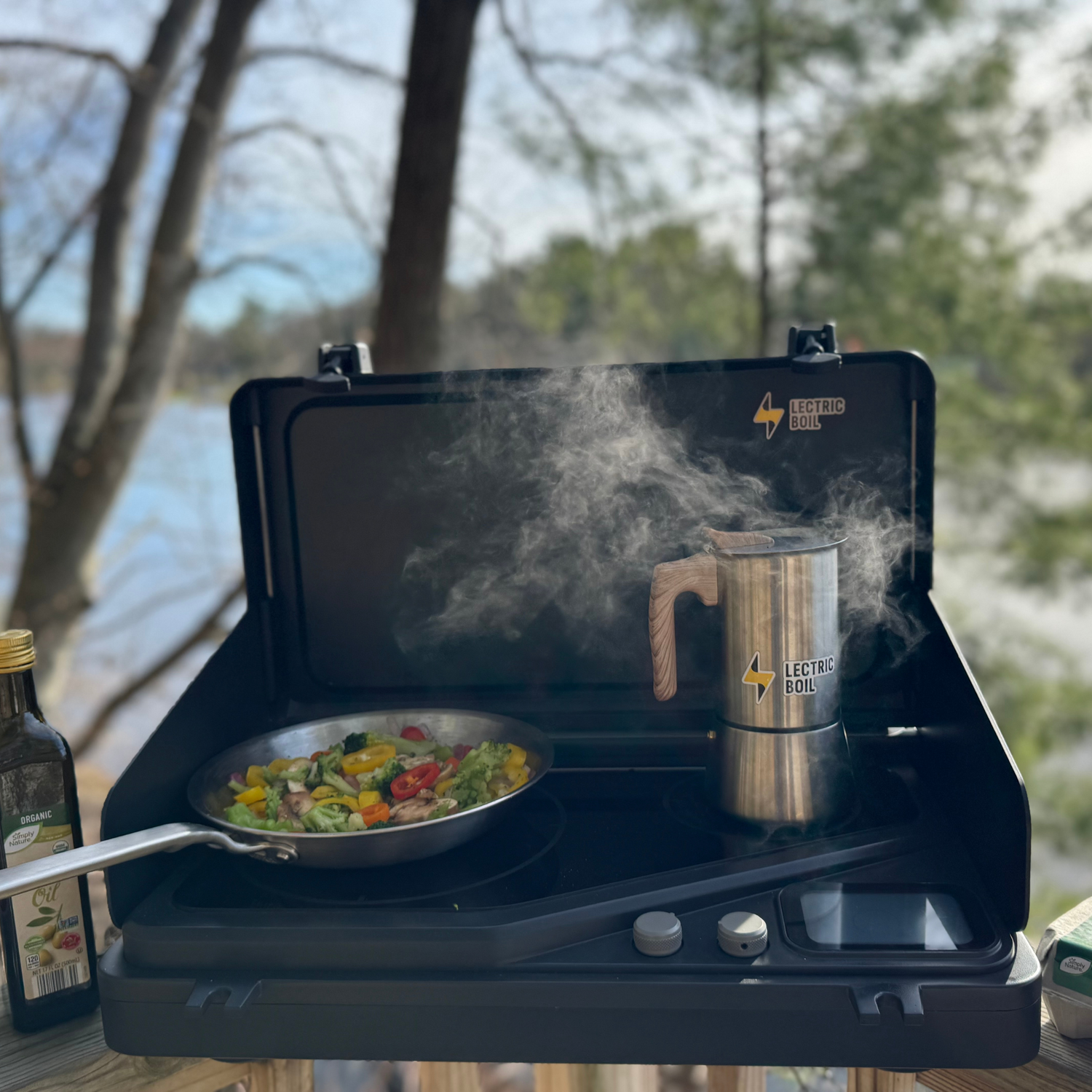
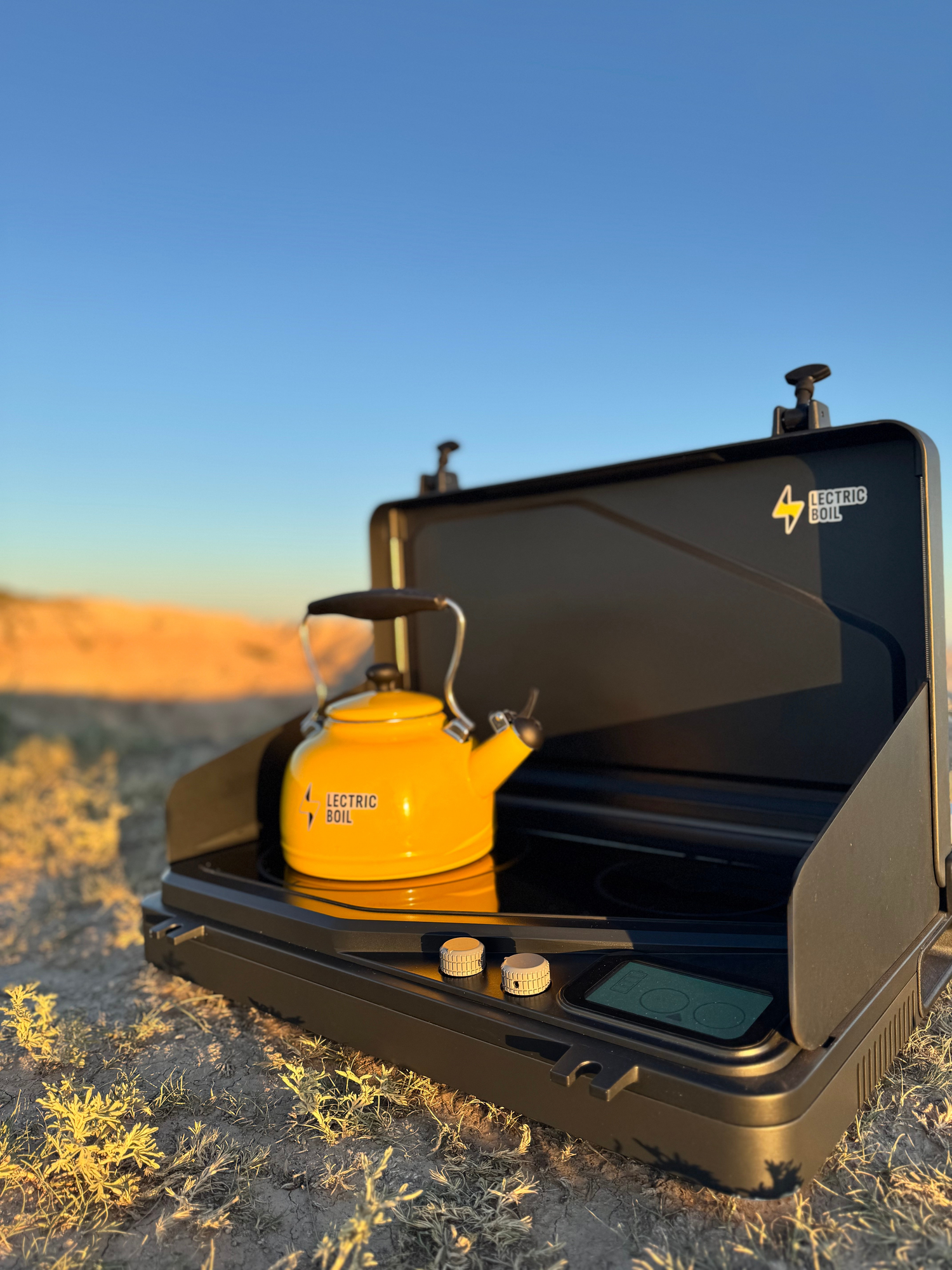
Open the folding case and you get two induction elements - a 10-inch burner and a 6-inch burner - a windshield to keep heat honest in the open air, a 4.3-inch color display for temperature control, and a chopping board tucked into the lid. Underneath sits the part that makes it work: a removable 1kWh lithium iron phosphate (LFP) battery. LFP is the chemistry electric-vehicle and storage makers reach for when they want a cell that runs cool, resists fire, and lasts - Lectric Boil rates the pack for a 10-year service life.
The larger burner puts out 1200W, stretching to 1800W in a boost mode; the smaller one runs at 1200W, or 600W when the big one is boosting. In practice that is roughly 90 minutes of cooking on the large element at medium heat, or about three hours on the small one - enough, the company says, to boil around 36 cups of water before the battery taps out. There are USB-C and 110V outputs on board too, which means the same pack that cooks dinner can top off a phone or run a laptop. It is a stove that moonlights as a power bank.
The catchCharging, weight, and cookware
None of this is free of tradeoffs, and Lectric Boil is fairly straight about them. The unit is heavy - about 35 pounds all in, with the battery alone accounting for 25 of them. This is car-camping and basecamp gear, not something you strap to a backpack. Induction is also picky about pans: it only works with magnetic cookware like cast iron, carbon steel, or magnetic stainless. Your titanium backpacking mug will sit there cold.
Then there is recharging, which is where the off-grid promise gets tested. The Overlander takes three inputs, and they are not equal:
Recharge time by source
A wall outlet fills it in about an hour. A 400W solar array takes roughly five hours of good sun; a 12V car socket or USB-C, closer to ten. That gap matters: the sunniest, most remote version of off-grid - the one the marketing photos love - is also the slowest to refuel. Buyers who plan on solar as their only source will need to think in days, not meals.
Where it fitsNeither a stove nor a power station, exactly
Lectric Boil is squeezing into a gap between two established categories. On one side are camp-stove makers - Coleman, Jetboil, MSR, Camp Chef - who own speed and price but depend on fuel that burns. On the other are portable-power brands like Jackery, EcoFlow, and Goal Zero, who sell the battery but leave the cooking to you. The Overlander's argument is that a single purpose-built box beats a bring-your-own-cooktop kludge.
| Propane stove | Power station + plate | Overlander | |
|---|---|---|---|
| Open flame | Yes | No | No |
| Legal in fire bans | Often no | Yes | Yes |
| Single unit | Yes | No | Yes |
| Doubles as power bank | No | Yes | Yes |
| Solar rechargeable | No | Yes | Yes |
The price reflects the ambition. Lectric Boil is planning to sell the Overlander for around $1,500, with a refundable $99 deposit holding a spot in line ahead of a delivery targeted for 2026. That is real money for a camp stove - but closer to reasonable once you read it as a battery, an inverter, and a cooktop bought together instead of separately.
The companyA five-person bet on Detroit manufacturing
Lectric Boil is small - roughly five people - and family-run, with Schlaff as founder and a team that includes chief marketing officer Aire O. It sells direct to consumers through a Shopify storefront rather than through outdoor retailers, which keeps it close to its early buyers and their feedback. The company frames its mission in broad terms - "to accelerate the shift towards a restorative, localized, equitable economy" - and pairs it with a "Leave No Trace" ethic and a plan to make the removable battery recyclable.
The riskiest line on the whole plan may be the quietest one: the Overlander is being manufactured in the United States. Building hardware domestically is where a lot of promising gadgets stall, and doing it as a tiny startup - with a battery-heavy bill of materials, no disclosed outside funding, and a pre-order model funding the run - is genuinely hard. Whether Lectric Boil ships on time and at price is the open question the deposits are really betting on.
"We aim to serve campers, outdoor workers, victims of natural disasters - anyone, anywhere, cooking or surviving off-grid." Jarret Schlaff, Founder
That last customer - the disaster survivor - is the tell. A stove that works when the power is out, cannot start a fire, and recharges from a solar panel is not only a camping toy; it is emergency infrastructure for a warming, more flammable world. Lectric Boil did not set out to make a statement about climate. It set out to cook dinner in a place where dinner was against the rules. The bigger use case followed.
The takeawayWhat to steal from it
The reusable idea here is not the induction coil. It is the discipline of building for a constraint instead of around it. Schlaff did not try to make a safer campfire; he built the thing you reach for when campfires are banned, and let a real rule define the product. For anyone eyeing off-grid living, disaster prep, or a build in a no-burn zone, the Overlander is a bet worth watching - with clear eyes about the weight, the price, and how long solar really takes to fill it back up.