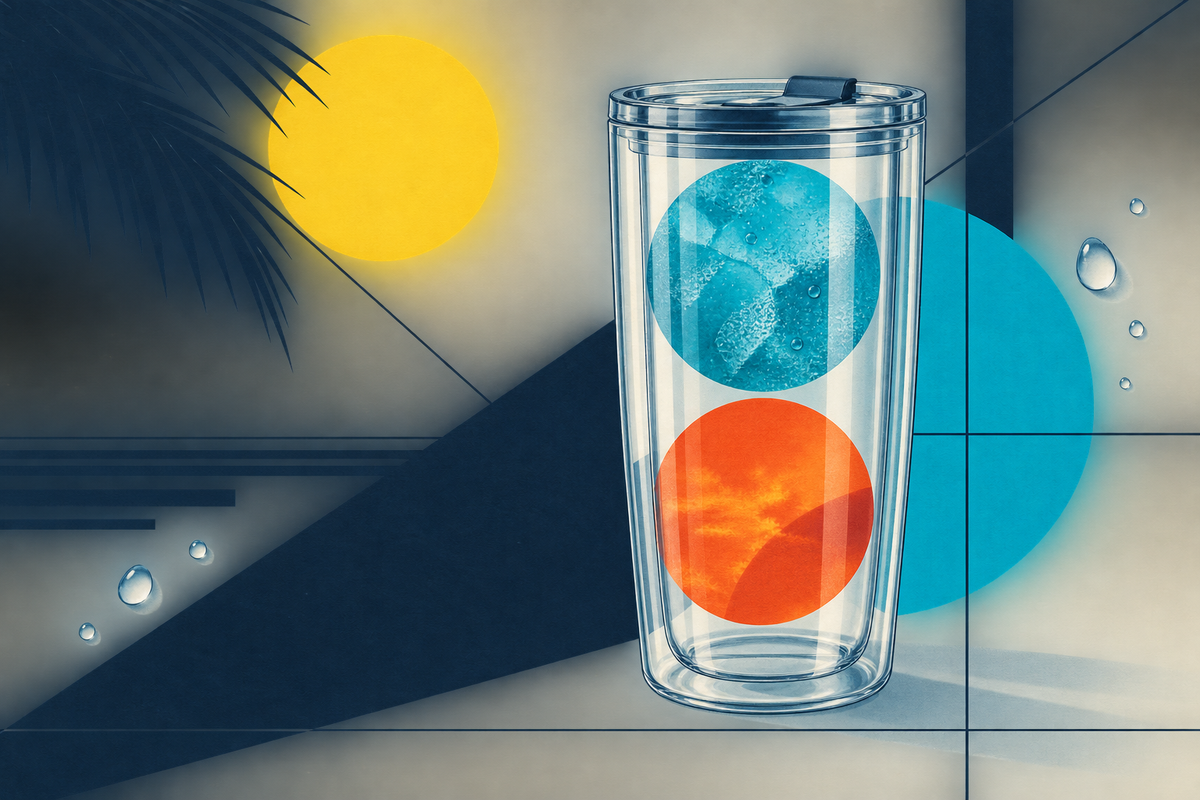
The cleverest part of a Tervis tumbler is the part you cannot hold: the air trapped between two clear walls. That narrow absence slows heat transfer, keeps cold drinks cold longer and stops a sweating glass from leaving a small lake on the patio table. It also gives the company a protected place to put a marlin, a monogram, a college mascot or somebody's wedding photograph. Engineering became canvas. Canvas became commerce.
That trick dates to 1946, when Detroit engineers Frank Cotter and G. Howlett Davis created what Tervis calls the first permanently sealed, double-wall insulated tumbler. The name was a tidy splice of their surnames. John C. "Jake" Winslow, an outdoorsman and sporting-goods entrepreneur, acquired the rights and took the idea south. By 1967 he was making the cups in Florida and selling them dock to dock and fairway to fairway - a distribution strategy that sounds quaint until you recognize it as direct selling to a sharply defined customer.
The customer had a boat, a golf bag or at least a sunny afternoon. The problem was mundane enough to be universal: warm drinks, wet hands and breakable glass. Tervis did not ask people to build an identity around hydration. It offered a cup that behaved itself.
“The most valuable real estate in the original Tervis is not on the cup. It is between the walls.”YesPress observation
A practical object becomes personal
The Classic remains the clearest expression of the idea. Its BPA-free Tritan body is light, impact-resistant and dishwasher safe. The double wall moderates temperature and condensation. On decorated versions, printed artwork sits on a wrap sealed inside the cup, away from fingers and dish racks. Eligible Classic products carry a lifetime guarantee against confirmed defects in material or workmanship. It is not a promise against every scratch or accident, but it gives an inexpensive household object an unusually long relationship with its maker.
Personalization is the second half of the system. On Tervis' online customizer, a buyer can choose a tumbler, mug or bottle, then add photographs, text, stickers and designs. Classic pieces protect that composition between their walls; stainless products print it onto the exterior under a protective coating. This is useful for more than novelty. A cup becomes a name tag at summer camp, a reunion souvenir, a corporate gift, a fan's game-day prop or the one vessel in a crowded cabinet that its owner will not accidentally abandon.
Tervis sells to households, commuters, parents, outdoor hosts, collectors and sports fans. It also sells through a business-to-business storefront to retailers and resellers, and it runs programs for corporate orders. The assortment stretches from 10-ounce wavy cups to 40-ounce stainless Travelers, Venture bottles, mugs, lids and straws. TervisHome pushed the brand onto the table with melamine plates and bowls. In April 2026, Tervis acquired Nashville-born Symglass, whose clear Tritan wine, beer and champagne vessels are designed to resist cracks, chips and shattering.
The fandom shelf
If the double wall is the product moat, licensing is the merchandising machine. Tervis collections have spanned the NFL, MLB, NBA, NHL, colleges and military branches, alongside Disney, Marvel, Harry Potter and Peanuts. That range lets the company sell the same useful form against hundreds of reasons to care. A generic cup competes on price and temperature retention. A Boston Bruins cup bought for a father competes with every other Father's Day gift.
This is where Tervis differs from drinkware companies built mainly around color drops and silhouettes. Stanley made an old work bottle fashionable. Yeti turned rugged performance into a broad outdoor badge. Hydro Flask and Owala developed recognizable shapes and youth followings. Simple Modern paired accessible prices with quick design cycles. Tervis has color and stainless steel too, but its more defensible territory is a clear cup, protected decoration, a deep license library and made-in-Florida production for the Classic line.
Ecommerce
Standard, seasonal and customized products sold through Tervis.com.
Retail and wholesale
Partner shelves, specialty stores and reseller orders widen reach beyond the website.
Licensing
Sports and entertainment artwork converts fandom into functional merchandise.
Custom and corporate
Photos, monograms, logos and bulk programs turn a cup into a gift or promotion.
The business model is correspondingly mixed. Direct ecommerce provides control over the customer experience and customization. Wholesale and retail deliver volume and discovery. Licensed collections make the catalog searchable by passion rather than product type. Corporate and bulk orders turn decoration into a service. Each lane uses the same core expertise: plastics, insulation, decorating, licensing and getting a design from screen to physical object quickly.
When heritage stopped being enough
Tervis' history did not protect it from a punishing cycle. The company had grown from about 20 employees and three outlets under second-generation leader Norbert Donelly to roughly 1,000 workers at its peak. Public reporting put 2022 revenue around $90 million. Then sales reportedly fell by about half over the next two years. Pandemic demand had pulled purchases forward; costs rose; some stores did not pay their way. In September 2024, Tervis entered Chapter 11 with reported liabilities of about $32 million.
The reorganization lasted a little more than five months. Tervis emerged in February 2025 saying its debt was resolved and related litigation dismissed. That August, newly formed JV2 Innovative Products bought a majority interest, ending three generations of family majority control. Rogan Donelly, Jake Winslow's grandson, remained a minority owner. The operating company became Tervis LLC, and Roger Parsons arrived as president and chief revenue officer to oversee the commercial reset.
Not a revenue chart: a scale-of-change sketch
The physical footprint changed with the financial one. The old North Venice headquarters gave way to a smaller Bradenton base near manufacturing partner TMF Plastics. By April 2026, local reporting put the team at about 40 people. A smaller organization can move quickly, but it also has less room for error. Tervis must manage a wide catalog, demanding licensors, custom production, wholesale accounts and a direct storefront while rebuilding relevance against much larger cultural competitors.
Its first disclosed acquisition under the new ownership says something about the plan. Symglass is not another steel bottle. It is an adjacent answer to a familiar Tervis question: what should people drink from around pools, patios, boats and busy hospitality rooms when real glass is a liability? The products look like glass but are built to survive the places where glass behaves badly. Tervis plans to bring production to TMF's Bradenton plant over time, add designs and licenses, and sell the line as Symglass by Tervis.
“I never worked to build the biggest company, just the best.”Norbert Donelly, second-generation Tervis leader
A comeback measured in shelves
The company's market position is now unusually clear. It is neither the prestige outdoor empire that Yeti has become nor the trend engine that pushed Stanley into school hallways and office elevators. Tervis is a heritage consumer manufacturer with real decoration infrastructure, broad licenses and a product still associated with Florida leisure. That can be a durable niche, or the platform for something larger, if distribution catches up.
Management disclosed that new product was headed to more than 1,700 retail stores before Memorial Day 2026. America250 licensing gives the Classic line a timely made-in-America story. Symglass opens hospitality and entertaining occasions. TervisHome tests whether the brand can own more of the outdoor table. The website, meanwhile, can make the customizer less of a side feature and more of a reason to visit.
Protection
Tervis enters Chapter 11 as declining sales, rising costs and its retail footprint squeeze the business.
Exit
The company completes its reorganization with debt resolved and litigation dismissed.
New control
JV2 takes a majority stake; the Donelly family keeps a minority interest.
Expansion
Tervis buys Symglass and prepares a large national retail rollout.
The useful lesson is not that old brands inevitably return. Many do not. It is that Tervis still possesses ingredients a restart cannot easily manufacture: an origin story attached to a functional invention, eight decades of household recognition, a domestic Classic line, licensing relationships and a customization method native to the product's construction. The risk is treating those assets as proof of future demand rather than raw material for earning it.
Back in the 1940s, Cotter and Davis solved heat transfer by sealing empty space inside a cup. The modern company has a different gap to manage - the distance between being remembered and being chosen. It will close one store shelf, one custom order and one unbroken patio glass at a time.