A trade-show floor is an unforgiving classroom. The lights are bright, the carpet is temporary, the coffee has usually surrendered, and the customer can walk away in half a sentence. Before Laurie Morylak was responsible for a global cybersecurity marketing operation, she learned in rooms like these: places where attention is earned in person and a confused message has nowhere to hide.
That education now sits behind one of the cleaner promotion stories in enterprise technology. Morylak joined ReliaQuest in 2019 as director of field marketing. In 2021, she became vice president of field and channel marketing. In March 2023, she stepped up to senior vice president of marketing and joined the executive leadership team. Fifteen months later, ReliaQuest named her chief marketing officer.
Four titles in five years can look like a rapid change of stationery. The substance is more interesting. With each move, the perimeter widened: from the field, to channels, to the whole marketing funnel, to a global brief covering field and partner marketing, demand generation, product marketing, content strategy, analyst relations, creative, social media and technology public relations. The person who once had to make an encounter work now has to make every encounter agree.
The field was the rehearsal room
Morylak graduated from Purdue University with a bachelor of science in retail management. It is a revealing foundation for her later work. Retail is where product, place, timing and human behavior collide without asking permission. Her career moved through field marketing and events at Penton, an information-services company later acquired by Informa, and LogRhythm, a security information and event management software provider. She also earned the Certified in Exhibition Management credential.
Events are sometimes treated as the festive wing of marketing, a place for lanyards, dinners and mysteriously expensive electrical outlets. Done properly, they are operations with an audience. The invitation, the room, the demonstration and the follow-up must feel like parts of the same thought. Morylak's later language about marketing carries that choreography. Every channel, she has said, must be integrated to tell a cohesive story.
She has also resisted the easy funeral speeches for in-person business. Digital optimization gives customers immediate access to answers, she argues, but face-to-face meetings in the field still matter. The position is neither retro nor romantic. Cybersecurity is consequential, complicated and full of claims that sound identical at twenty paces. A dashboard can reveal intent. A conversation can reveal whether anyone understands the problem.
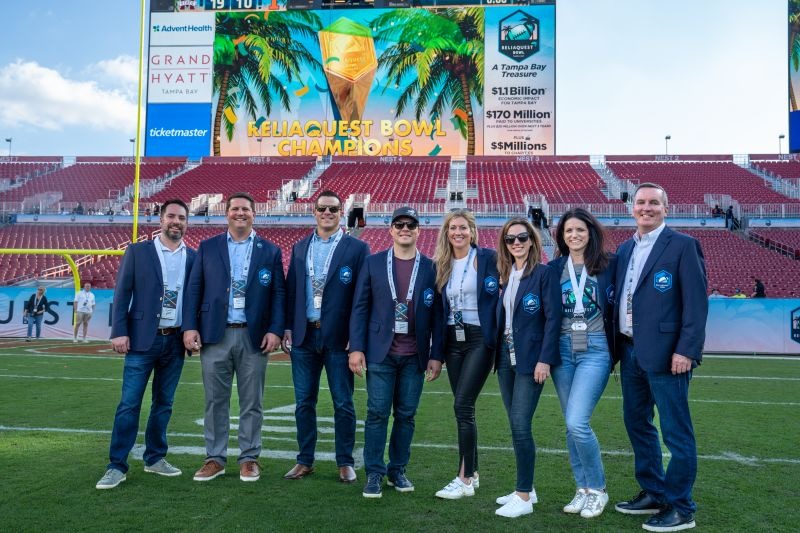
The ReliaQuest Bowl made that combination literal. After the January 2023 game, Morylak wrote about the work of teammates who had started long before her arrival and the chance to bring both the company and cybersecurity onto a public stage. Her gratitude spread outward: the bowl organization, the teams, customers, partners and colleagues. It was an executive's post with an event operator's eye for the people who made the room possible.
“The most important thing in driving qualified leads is to stop thinking only about leads.”Laurie Morylak, 2023
The rebellion against the lonely lead
Morylak's sharpest marketing argument begins with a lonely person raising a digital hand. Many business-to-business funnels celebrate that moment, attach a score and send the name to sales. She considers it only a first step. At ReliaQuest, she explained, the aim is to cultivate a credible account with several people showing interest in the outcomes on offer. The handoff comes when those prospects are educated and prepared for a useful next conversation.
This is less theatrical than counting every form fill as destiny. It is also a more demanding standard. Marketing and sales need constant communication about customer interests, timely themes and what is actually working. Qualification criteria cannot become scripture; they must keep changing. Her verdict is two words long: precision matters.
Look beyond a single lead to a credible buying group with shared interest.
Keep sales and marketing in a live feedback loop, with mutual accountability.
Help prospective buyers learn independently before asking for a conversation.
The approach also changes content's job. Prospective buyers often want to do their own research. They do not need a vendor standing over their shoulder announcing victory over the competition. They need useful material early enough to form a view. Marketing, in this telling, is less a megaphone than a well-lit library with a competent person at the desk.
Technology helps stock that library. Morylak has described using intent data to understand which information matters to target accounts, sometimes before direct engagement. She has also discussed employee-advocacy tools that help colleagues share consistent, role-relevant messages and reveal which content travels. But she adds an important boundary: if behavioral data is not used to improve the customer's experience, outreach can feel like someone lurking behind the curtains.
“While the transaction may be B2B, the partnership is still person-to-person.”Laurie Morylak, 2023
A translator in a room full of acronyms
ReliaQuest gives its CMO a particularly knotty story to tell. The company operates in security operations, where the vocabulary includes SIEM, XDR, detection, investigation, response, orchestration, telemetry and, increasingly, agentic AI. The buyer does not merely want a feature. The buyer wants to know what happens at 2:13 in the morning when a threat moves and the analysts are already carrying too much.
Morylak's public framing returns to outcomes: visibility, reduced complexity, faster work and better management of risk. In 2023, at the RSA Conference, she invited visitors to see how generative AI inside GreyMatter could help security teams work more efficiently. The setting is telling. A developing technology story was delivered through a booth invitation and a demonstration, with the product brought back into the realm of things people can see and discuss.
The ReliaQuest ascent
Her own scope has grown alongside that product narrative. When ReliaQuest promoted her to senior vice president in 2023, the company credited the marketing organization with contributing to customer growth and retention. Morylak received the Arena Award, which ReliaQuest describes as its highest honor. The announcement placed her on the executive leadership team and gave her responsibility from awareness through consideration and selection. Marketing was being measured not only by the size of its audience, but by its role in company outcomes and revenue.
The CMO promotion in June 2024 made the arrangement explicit. Morylak would lead the full global team as ReliaQuest pursued more enterprise security organizations. The company promoted two other customer-facing leaders at the same time, linking marketing, sales and customer success under a broader go-to-market structure. It was an organizational version of the alignment she had been advocating.
There is a useful connection between that structure and her earlier event work. At an event, the customer does not experience departments. A registration problem, a vague demonstration or an awkward follow-up all belong to the same brand, no matter which budget paid for them. The same is true across a long enterprise sale. A buyer who reads an intelligent report, attends a polished demonstration and then receives an irrelevant message does not grade each team separately. Coherence is the product before the product.
That helps explain why Morylak talks about marketing as an extension of the broader go-to-market organization. Her remit may contain many specialties, but the specialties are not the story. Their handoffs are. Field observations need to reach content. Product changes need to reach sales. Account signals need to improve the next interaction without making the buyer feel watched. The work resembles security operations in one respect: scattered information becomes valuable only when someone can connect it, prioritize it and act with judgment.
More is not more
There is an appealing plainness to Morylak's critique of modern B2B marketing. More pipeline is not automatically better pipeline. Speed to lead matters, but a quick response without relevance can lose the customer later. Technology can increase efficiency while remaining difficult for practitioners to use consistently. Buyers need room to learn. Relationships continue after the transaction.
None of these ideas requires a new acronym. Together, they amount to an operating discipline: simplify where possible, connect the teams, use data with restraint, and keep the customer's outcome visible. In a category prone to urgent language, that restraint has practical value. Fear can produce a click. It is a poor basis for a durable partnership.
Morylak has said her career has always focused on customer experiences that feel high-touch and intentional for an individual client while remaining scalable. That is the enduring tension in her work. A field marketer knows every room is particular. A CMO knows the story must travel without her. The craft is to build a system large enough for global growth without making the person on the other side feel processed.
Her rise at ReliaQuest suggests that proximity to customers can be a route to broader authority. The field was not merely where campaigns landed. It was where she learned what a campaign owes the people who encounter it. Now, with machines moving faster through both marketing and security, that old lesson has acquired fresh force: scale the message, certainly, but do not misplace the human being it was meant to help.