Long before Laura Beussman was responsible for both marketing and revenue at a software company, she was learning what an audience costs. Her early career unfolded behind the curtain at opera companies and theaters, in jobs that ran from accounting and finance to development and marketing. The scenery was theatrical; the underlying problem was severe and practical. An arts organization has a mission, a finite number of seats and no magical exemption from arithmetic.
That tension between meaning and measurement became the quiet through-line of her career. Today, Beussman is Chief Marketing Officer and Chief Revenue Officer at CallRail, the Atlanta-based platform that helps businesses connect calls, texts, forms and chats to the marketing that produced them. Her remit covers marketing, sales, partnerships and strategic project management. In blunt terms, she sits where the promise meets the receipt.
The route there was productively crooked. She grew up in Bryan, Texas, started dance at four and piano at seven, and was always singing. At Texas A&M, psychology and sociology pulled her attention. This was not entirely accidental: she is the daughter of two sociologists. Human behavior became a fascination before it became a job.
The useful detour
After several years in nonprofit arts, Beussman realized she wanted to help set strategy rather than merely execute around it. She went north to the University of Wisconsin-Madison for an MBA at the Bolz Center for Arts Administration. The degree preserved the mission-minded part of her experience while adding the language of markets, operations and price.
It also supplied the sort of detail no executive biography should omit: she sang in a cover band made up of MBA students. They called themselves Statistically Irrelevant, a name so pleasingly dry it could have been workshopped by a room of analysts after two drinks.
“Listen to the market and your customers to understand a pain point.”Laura Beussman on building technology products
The phrase sounds obvious. Beussman says she has watched teams skip it. A product can be clever and still fail the only commercial test that matters: does it solve a problem someone is willing to pay to fix? Her version of product marketing begins before positioning decks and launch calendars. It begins with the nuisance, cost or anxiety on the other side of the screen.
Dell gave that instinct numerical rigor. After the MBA, she spent two years as lead pricing manager for consumer desktops. Pricing is psychology with a spreadsheet and consequences. It forces a company to declare what it thinks customers value, then allows the market to mark the answer in red.
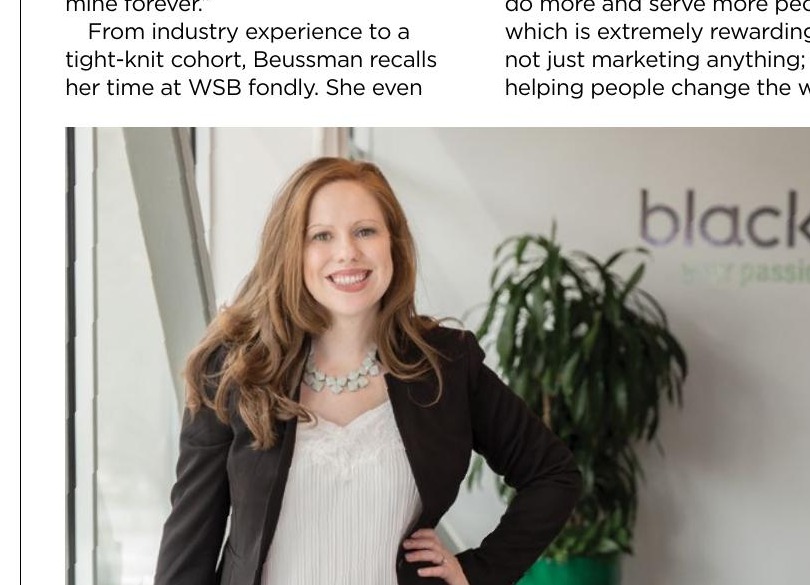
A career conducted in movements
In 2013, Beussman joined Blackbaud, which makes software for nonprofits and mission-driven institutions. Her first brief covered arts and cultural organizations. It was an elegant reunion: she understood the buyer because she had lived with the buyer's constraints. She later led product marketing for fundraising and CRM solutions and marketing for faith solutions. The work turned experience into an unfairly useful kind of empathy.
She moved on to become Vice President of Marketing at Social Solutions, then joined CallRail in 2021 as Senior Director of Product Marketing. The promotions came in quick, legible steps: Vice President of Market Strategy and Pricing in 2022, Senior Vice President of Marketing in 2023, Chief Marketing Officer in 2025, then the combined CMO and CRO remit.
The sequence is less a reinvention than a widening aperture. Pricing asks what a customer values. Product marketing asks how to explain it. Marketing asks how to find the people who need it. Revenue asks whether any of this produced a business. By 2025, Beussman was accountable for the whole sentence.
The data hidden in hello
CallRail's world begins with a familiar irritation: marketing generates a lead, a phone rings, and the data trail becomes foggy. Clicks are tidy. Conversations are not. A customer explains a leaking roof, asks whether a lawyer handles a certain case, objects to a price, reveals urgency, changes their mind and books an appointment. The call contains intent that a traffic report cannot see.
Beussman's case for conversational AI is rooted in this messiness. Software can summarize calls, detect sentiment, tag and qualify leads, and surface recurring objections across hours of speech no marketing team could review manually. That gives smaller teams access to evidence once trapped in individual conversations.
Her most vivid examples stay close to ordinary businesses. A home-services prospect may call several providers in order and hire the first one who responds. A missed call is not merely a support failure; it can be an advertising expense walking into a competitor's calendar. Voice tools can answer after hours, collect the basics and help a human follow up with context.
“AI can't build a relationship for you - but it can make it a lot easier.”Laura Beussman on lead follow-up
That boundary matters. Beussman describes generative AI as a content accelerator: useful for keyword research, outlines, early drafts, tone checks and clarity. Humans still own the brand. Her governance argument is equally direct. The more capable the system, the more deliberately a team must decide where it belongs, how output is reviewed and who answers when it goes sideways.
The beautiful-chart problem
In 2026, Beussman pushed back on the fashionable claim that attribution is dead. Her complaint is with oversimplification. A last-touch model can reward branded search because it happens near conversion, even when several earlier encounters created the demand. The chart may be immaculate while the recommendation quietly starves the top of the funnel.
AI search makes the puzzle stranger. A customer may discover a brand inside a generated answer and never produce a conventional site visit. Beussman has argued that marketers need broader signals, including self-reported attribution and connected conversation data, to understand influence that click paths miss. In August 2026, she announced that CallRail could measure ChatGPT ad leads alongside campaigns from Google, Meta and Microsoft. The channels changed; the need to follow the customer did not.
The temptation is to solve every new measurement problem with another instrument. Beussman's career offers a more disciplined order of operations. First, name the business question. Next, collect signals across the journey. Then ask customers what brought them in and compare their answers with the machine's account. A model can distribute credit, but it cannot rescue a company that never agreed on what a valuable lead looks like. This is the old pricing lesson in modern clothing: precision is useful only after the organization has defined value. Without that agreement, a finer decimal simply makes the disagreement look official.
A combined CMO/CRO role makes this philosophical dispute operational. Marketing cannot celebrate volume if sales sees poor leads. Sales cannot dismiss awareness merely because its contribution arrives before the CRM can conveniently count it. Both teams have to agree on value, evidence and the point at which a prospect becomes a customer.
People are the scaling system
Beussman's leadership language is more communal than heroic. As her roles expanded, she learned to hire people with complementary expertise, especially those willing to move toward difficult problems and operate in ambiguity. She has said that leadership impact scales through people rather than personal output. The executive's work is to assemble judgment, then create conditions in which it can travel.
Mentorship sits at the center of that philosophy. She credits mentors with changing the trajectory of her own career and makes a sharper distinction for women moving into AI-era leadership: find an advocate as well as a mentor. Advice helps. An advocate says your name in a room you have not entered and connects it to an opportunity.
Her prescription for AI literacy follows the same social pattern. Leaders should use the tools themselves, share wins and failures, offer frequent training and make experimentation ordinary. Fear recedes when automation is framed concretely: let it handle repetitive work so people can spend more attention on strategy, customers and relationships. Curiosity becomes part of the job description.
There is a satisfying symmetry here. The child who studied dance, piano and the social science of why people behave as they do became an executive working with machines that parse conversation. Yet her central idea remains stubbornly human. Markets speak through numbers, but customers speak in sentences. A useful leader learns to hear both, keeps them in time and notices when the orchestra has started following the dashboard instead of the score.