At DigitalOcean, Edward and Kevin Chiu had a problem that sounded almost too ordinary to become a company. Customer information was everywhere. A note lived in one tab, an email campaign in another, product activity somewhere else. The people responsible for helping customers succeed had to assemble a picture of each account by hand, usually while the clock toward renewal kept running. It is difficult to be thoughtful about a customer when half your day goes to finding out who they are.
The short version
- Founded in New York in 2017 by brothers Edward and Kevin Chiu after their work in customer success at DigitalOcean.
- Joined product usage, CRM, support and financial data so teams could see risk and act on expansion opportunities.
- Raised venture capital, including a $25 million Series B in 2020 and a reported $20 million strategic round in 2022.
- Merged with Totango in February 2024; Catalyst remains a product for customer growth teams.
The Chius built Catalyst for precisely this gap. A customer success manager could look at one account and see product use, open support issues, commercial context and the work already done. Managers could scan a portfolio instead of opening every record. Rules and playbooks could turn a signal into a task. The proposition was less glamorous than an acquisition funnel, but in a subscription business the sale is merely the first installment of a relationship.

The first thing that broke was the view
Edward has described the original frustration with unusual specificity: meeting notes, email campaigns, activity data, customer priorities, and too many windows to hold together. That was an operational failure, not a failure of goodwill. A customer might be using a product less, while the CRM still showed a healthy account and the support desk knew about an unresolved issue. Each team held a true fragment. Nobody held the useful whole.
Catalyst’s answer was a customer 360 view. It pulled data from tools that companies already used, then organized it around accounts, people, goals and lifecycle stages. The platform’s current documentation still names the pieces: portfolio management, automations, organization settings, and integrations for financial information, product usage, support tickets and feedback. A CSM can watch customer health, a manager can assign work, and a sales colleague can see an expansion signal without having to ask for a report.
The distinction matters. Many businesses already have a CRM; many have a support desk; most have product analytics of some sort. Catalyst occupied the space between them. Its competitors include Gainsight, ChurnZero, Vitally and Planhat. Its everyday rival, though, was the spreadsheet and the heroic employee who kept a whole account history in their head. That approach is cheap until the employee leaves, the customer base grows, or renewal season arrives all at once.
A first hire with a point of view
Edward says Catalyst’s first hire was a designer. For an enterprise software startup, that is an editorial decision about the product: the user should understand the page before reading a manual. True Ventures, an early investor, described the launch in 2018 as a deliberately intuitive platform focused on essential customer success features. Accel later backed the company’s mix of native integrations, automation and approachable software. The test was whether a busy team would actually open it.
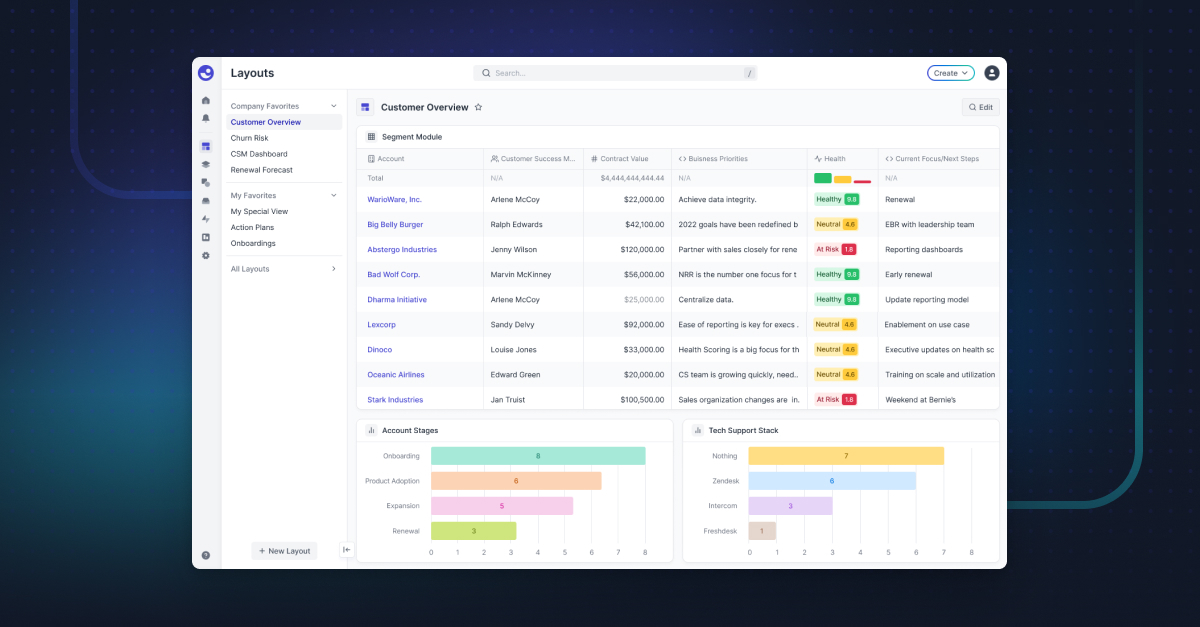
Braze offers a useful, if company-reported, example. In a Catalyst case study, the customer engagement company said engagement with its customer success platform rose by more than 220% after the switch. Its team pointed to quick onboarding, Salesforce integration and a clean interface. That is a measure of software adoption, not proof that Catalyst alone increased Braze’s revenue. It does show why interface quality was part of the business case. A health score that nobody checks has excellent manners and no practical effect.
“The simplicity and speed of onboarding, the Salesforce integration, and the clean UI/UX allowed team members to intuitively understand how to use Catalyst.”Braze customer story
Catalyst sold subscription software to businesses, primarily teams responsible for customers after the sale. Its published product page now sits inside Totango’s portfolio. The Catalyst Growth package includes customer goal tracking, a playbook designer, expansion signals, integrations and a stated allowance of 2,500 customer accounts. The price is a sales conversation; Totango does not publish a fixed monthly fee. For a buyer, the useful questions are what data must be connected, who will maintain the workflows, and which commercial decision the team expects to improve.
Then success had to explain itself in dollars
The market changed while Catalyst was growing. Customer success teams had long argued that good relationships protected renewals. As budgets tightened, buyers wanted to see the financial result more clearly: which accounts were likely to stay, which were expanding, and which needed intervention now. Catalyst’s own language moved toward customer growth and revenue. The product gained expansion signals and a stronger emphasis on customer goals. This was a change in emphasis rather than an abandonment of the original idea. The same connected account view could answer a harder question: what revenue is at stake?
The funding path shows how much attention that question drew. A $2.4 million seed round arrived in 2018, a $15 million Accel-led Series A in 2019, and a $25 million Spark Capital-led Series B in 2020. A later strategic round of roughly $20 million brought in StepStone and several customer-side executives, according to contemporary reporting. Early accounts that list $40 million raised stop before that later financing; they are a snapshot, not the full story.
In February 2024, Catalyst merged with Totango. The companies said their platforms together served nearly 600 organizations worldwide. Totango brought an established enterprise customer success platform; Catalyst brought its modern customer growth approach. Forrester read the combination in the context of a market under pressure to connect customer success with profitable growth. The combined company later standardized its identity under Totango, while Catalyst continued as a named product. A merger is not proof that one design or strategy won; it is evidence that the customer problem remained large enough for two approaches to join forces.
The part worth copying
Catalyst’s most transferable move costs less than enterprise software. Start with a specific customer decision: whether an account is adopting, drifting, renewing or ready to expand. Gather the few signals that can change that decision. Name the person who will act, and define the action before building a dashboard. The Chius found a product by doing this work from the inside. Braze’s adoption story suggests the other half: make the resulting workflow easy enough to use routinely.
There are limits. A small team with a handful of customers may keep a reliable shared view in its CRM. A company that cannot agree on what customer progress means will only automate its disagreement. And a health score built from stale or inconsistent inputs can lend false authority to an old guess. Catalyst makes most sense where customers generate enough signals, and enough recurring revenue, to justify turning scattered evidence into a repeatable operating habit.
The company began with a mundane discovery: someone was already sitting on the answer, but the answer was in five tabs. Its later chapter under Totango gives that discovery a commercial edge. The customer was already there. So, eventually, was the growth opportunity.