It is a Tuesday morning at a software company you have never heard of, and a customer success manager is staring at a list of accounts. One of them renews in 41 days. The relationship feels fine. It is not fine. Somewhere in the usage data, the logins have thinned, the power user left, and a competitor sent a deck. ChurnZero is the software that says so out loud - before the renewal call goes quiet.
This is the unglamorous middle of the subscription economy. Everybody romanticizes the sale. Nobody throws a party for the renewal. And yet the renewal is where the money actually lives. ChurnZero, a customer success platform born in downtown Washington, D.C., exists for that exact moment - the long, quiet stretch after the contract is signed and before someone decides whether to sign again.
The Problem They SawSelling is loud. Keeping is silent.
Here is the inconvenient arithmetic of SaaS: it costs a fortune to acquire a customer, and a single cancellation can erase the profit from several new ones. Sales teams get the dashboards, the quotas, the kickoffs. Retention - the thing that compounds - gets a spreadsheet and a hunch.
When ChurnZero's founders started building, churn was treated as weather. Something that happened to you. You noticed it at renewal, which is roughly like noticing a leak when the ceiling is already on the floor. The data to predict it existed - product usage, support tickets, survey scores, the rhythm of a relationship - but it lived in eight different tools and zero of them talked.
Two founders had built SaaS products before. They had watched churn quietly drain healthy businesses. So they built the instrument that would have warned them.
- The origin, in one sentenceA four-time founder moves east
You Mon Tsang had spent two decades building and exiting companies in the Bay Area. A four-time founder, he did the unfashionable thing and set up in Washington, D.C. - a city better known for lobbyists than for Series B SaaS. With co-founder and CTO Mark Heys, he started ChurnZero in 2015 around a stubborn idea: customer success deserved its own system of record, the way sales had Salesforce.
The bet was that retention would stop being a soft, relationship-y afterthought and become a measurable revenue function - with its own software, its own metrics, and its own seat at the table. In 2015 that was a contrarian read. By the 2020s it was conventional wisdom. ChurnZero helped make it so.
The goal isn't in a tagline. It's in the name. Drive churn to zero - and admit out loud that you'll never quite get there.
- On the nameA cockpit instead of a guess
ChurnZero pulls a customer's data into one place and turns it into something a human can act on. Health scores estimate how likely an account is to renew. Segmentation groups customers so a team of ten can attend to thousands. Automation playbooks fire off the right nudge at the right moment - an onboarding sequence here, a check-in there - without a person remembering to.
The Renewal Hub turns the dreaded renewal from a surprise into a forecast. Surveys (NPS, CSAT) and Success Plans put numbers and goals against the relationship. And in-app messaging lets the software talk to the customer inside the product they already pay for, which is the only place anyone is really paying attention.
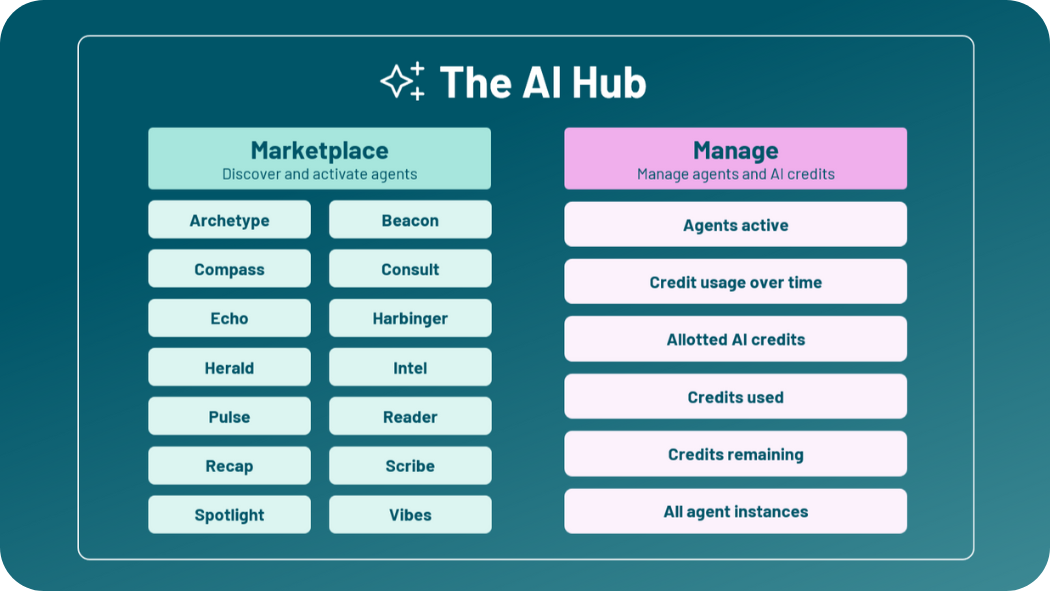
Then, predictably and on schedule, came the AI. ChurnZero launched Customer Success AI - agents built for the specific job of a customer team. They read sentiment across an account, draft an executive-ready snapshot of outcomes and risks, surface trending topics, and slot into the workflows a CSM already uses. In 2025 the company added Engagement AI and a Synthesia integration that builds lifelike AI video avatars of real team members for onboarding and renewal nudges. The ambition is plain: let a small team behave like a large, attentive one.
The short, busy life of ChurnZero
The reviews did the talking
ChurnZero's clearest evidence isn't a billboard - it's a pile of receipts on G2, the software review site where buyers are notoriously hard to please. The company became the first purpose-built customer success platform to cross 1,000 reviews, and has repeatedly landed at or near the top of G2's customer success rankings, collecting Leader and Best Relationship badges quarter after quarter.
That last one - "Best Relationship" - is a quietly funny award for a company whose whole product is about relationships. It suggests they take their own medicine.
Funding, one round at a time
"Best Relationship," from the reviewers, to the company built on relationships. They appear to take their own medicine.
- On the G2 recordMake keeping as serious as winning
Strip away the dashboards and ChurnZero is arguing for a cultural shift inside software companies: that the customer success manager should be as equipped, as data-rich, and as accountable as the salesperson who closed the deal. The platform unifies customer data, team expertise, and AI into one system so that adoption, retention, and expansion stop being vibes and start being a pipeline.
It is a mission with a built-in irony - the better ChurnZero works, the more invisible it becomes. A churn that never happens is a non-event. There's no alert, no save, no story. Just a customer who quietly renews and never knew how close they came to leaving.
Why It Matters TomorrowThe renewal is the new sale
As software budgets tighten and buyers scrutinize every subscription, the companies that win won't necessarily be the ones with the flashiest acquisition funnel. They'll be the ones whose customers don't leave. AI is about to make this both easier and more competitive - every CS team will soon have agents reading their accounts. ChurnZero's wager is that it has been doing the unglamorous work long enough to do it best.
Back to that Tuesday morning. The account that renews in 41 days. In the old world, the CSM finds out it's in trouble on day 41, on a call that has already gone cold. In ChurnZero's world, the health score dipped on day 12, a playbook fired, a human reached out, and the renewal - the silent, unglamorous, profit-bearing renewal - happens without drama. Nobody throws a party. That's the point.