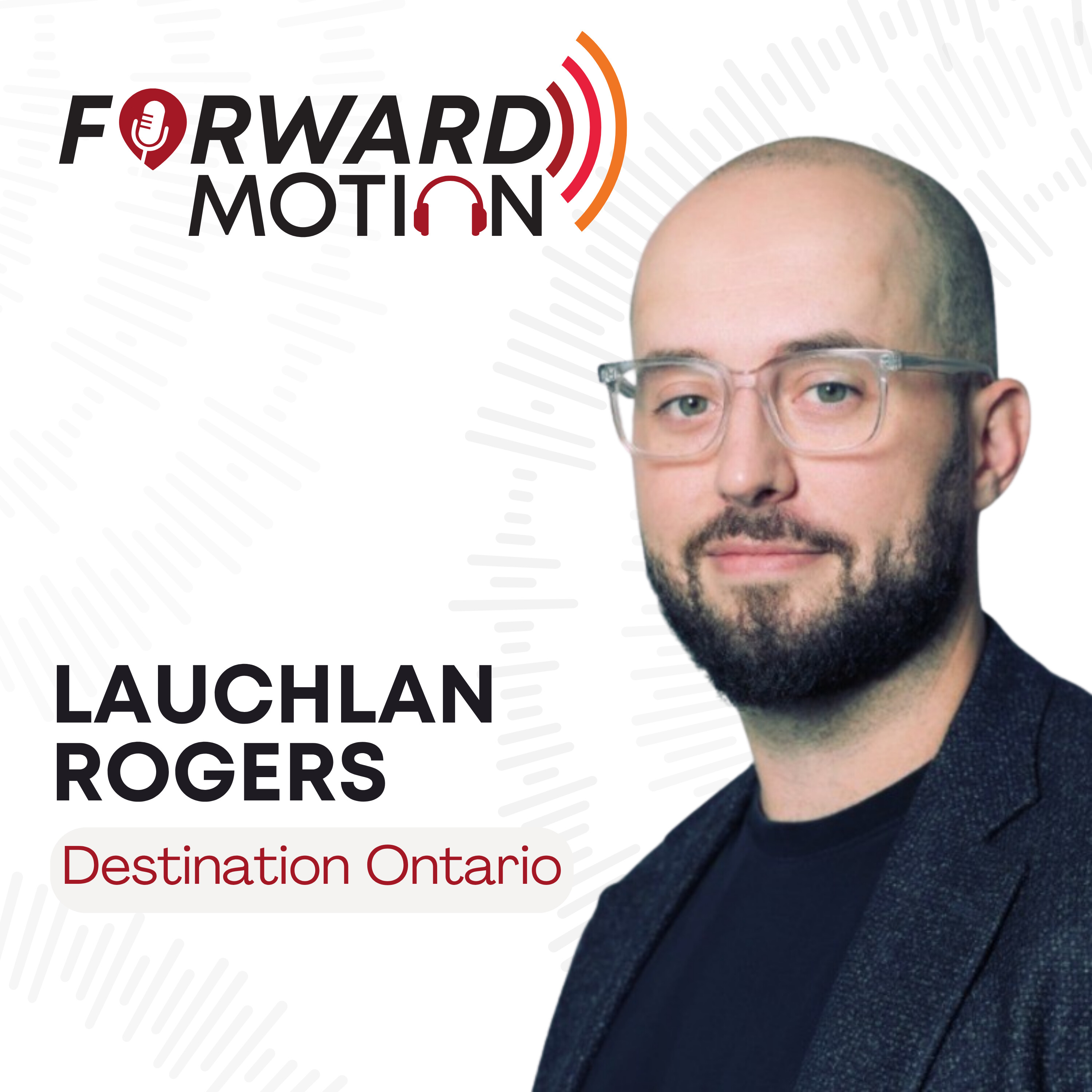
Long before Lauchlan Rogers marketed a province, he learned to read one. He studied people, places and maps at York University, mixing anthropology, human geography and geographic information systems into an honours double major and a certificate. The combination looks almost designed for destination marketing: who moves, where they go, what a place means, how a route becomes visible. Rogers says the fit appeared only later. At university, he felt more like a “lost soul,” taking classes widely and trying to locate a passion.
His childhood had already given him two distinct ideas of home. He grew up in downtown Toronto and kept roots on Nova Scotia's South Shore, where his father worked as a fisherman for two decades. Both parents were university professors. Education mattered in the family, but Rogers did not inherit a tidy professional lane. He built one from subjects that made him curious.
After graduating from York in 2014 on the Dean's List, he fell into advertising. He began on the accounts side and evolved into digital strategy. Agency life trained him to shift between clients, stakeholders and unfamiliar problems. It also taught him what he wanted: a home team. Rogers had worked with arts and tourism clients and found himself drawn to work where his commitment to a place did not reset when a contract ended.
The route was not straight. The thread was curiosity.
- York
social sciences - Agency
accounts - Digital
strategy - Destination
Ontario - VP +
CMO
Chapter oneLearning the tools, one program at a time
One moment at the agency stayed with him. Rogers watched designers use Illustrator and InDesign and asked where they had learned those skills. The answer surprised him: much of the practical craft was self-taught. Formal education supplied theory, but the tools were available to anyone willing to work through them. Rogers set himself a challenge to learn Adobe's creative programs. Design led to video, photography and a broader literacy in how ideas become things people can see.
He describes the process as a kind of gamification. Each new skill made the next unfamiliar task less alienating. That remains his advice for people entering marketing: start small, acquire a skill, then acquire another. Channels change. The useful unit is not the name of the software but the function beneath it. Storytelling, visual impact and the ability to make something survive the next platform.
“It's less the program, and it's more the function.”Lauchlan Rogers on durable creative skills
Rogers eventually persuaded the agency that he could work freelance. The arrangement let him travel, a long-running passion, while continuing digital strategy work. He backpacked and tried the digital-nomad version of a career before the glamour wore thin. In his own telling, backpacking produced travel debt and desperation along with experience. That practical pressure helped lead him to interviews at the Ontario Tourism Marketing Partnership Corporation, the organization that was becoming Destination Ontario.
He joined as a social media advisor. Then came digital marketing, including ad buying and creative production. He moved into global content, overseeing work with Destination Canada and international markets including China and Germany. As the pandemic swept across the travel industry, he joined recovery planning and stepped into the director of marketing role. He held it for about four years before becoming Vice President and Chief Marketing Officer around 2024.
Chapter twoCampaigns are the visible layer
Destination Ontario is a government agency with a public mandate to market the province at home and internationally. Rogers' job sits where creative ambition meets that institutional responsibility. The advertisements are easy to see. Less obvious is the shared machinery underneath: research, content production, media buying, reporting, measurement and dozens of partnerships that help regional organizations reach audiences they could not efficiently reach alone.
Rogers said Destination Ontario supported more than 50 dedicated partner campaigns in 2024. Its annual partner survey returned a 96 percent satisfaction and approval rating. In 2025, he described 26 co-marketing campaigns within Ontario, 21 aimed at the United States and additional partnership work in Quebec. These are matched-investment programs, with Destination Ontario taking on much of the production and reporting work. The province becomes a platform, not just a brand.
The “We Stand” campaign made that operating model visible. Destination Ontario and agency Broken Heart Love Affair developed it quickly in response to a changing cross-border climate and new interest in domestic travel. From early thinking through production, Rogers put the timeline at roughly six weeks. The creative device let the word “stand” rotate through different meanings: standing together, standing for something, standing small against Ontario's wilderness, standing and exploring.
The strategic problem was familiar to anyone marketing close to home. Research found a “been there, done that” feeling among Ontarians. The task was to renew curiosity without turning the province into a generic sequence of smiling faces. During creative reviews, Rogers pushed back on the idea that pride had to look cheerful in every frame.
“Pride is not a smile.”Lauchlan Rogers on giving provincial pride some grit
For Rogers, pride could carry fierceness, work and attachment. It could spotlight makers, operators and communities rather than treating them as scenery. Still, emotion had to lead somewhere concrete. The campaign invited tourism partners to submit businesses, articles and destinations for its content system. “Seeing Ontario is supporting Ontario” gave the audience a small piece of agency: a trip could become money spent with people close to home.
Chapter threeWhen the answer replaces the click
The next disruption is arriving through the search box. Rogers has been candid about the possibility that travellers will ask an AI tool for an itinerary and never visit a destination website. In a 2026 strategic presentation, Destination Ontario reported a 27 percent decline in total sessions and a 19 percent decline in outbound clicks. The presentation's blunt conclusion was more useful than a reassurance: a decline in traffic does not automatically mean a decline in influence.
The old dashboard is getting quieter
If an AI summary cites Ontario, recommends an operator or places a town in an itinerary, the content has shaped a decision even when analytics never record a conventional session. The measurement system has to catch up. Rogers has described a practical testing habit: ask the same question across several tools, compare whether a destination appears and repeat. The systems are opaque, so the early work resembles user research more than optimization by formula.
His academic background reappears here. In a generated answer, a destination is trying to become a credible citation. Authority depends on clear, reliable underlying information. Rogers worries that generic tools may keep sending everyone to the same bucket-list places. His counterweight is specialist curation: strong local databases, distinctive recommendations and tourism organizations that know how to surface the overlooked option.
Rogers also draws a boundary around creative AI. It can throw the ball against the wall, helping a team explore copy or concepts. It cannot own the final judgment. Image alteration raises particular concerns for a destination organization whose product is a real place. His phrase for the division of labour is concise: “We're always the last pen on everything that we do.”
Chapter fourThe personal map
The clearest picture of Rogers may be a map made for no client at all. For several birthdays, he planned brewery tours with GIS, creating a route friends could download to their phones and join along the way. The project joins his interests in one small artifact: maps, craft beer, digital utility, movement and the pleasure of showing people a place.
When friends visited Toronto more recently, he challenged himself to make a “no sign” tour through speakeasies, secret restaurants and pop-ups. He loves the nooks and crannies of the city and the feeling of revealing something a guest would not otherwise access. In his travels, he has often offered new acquaintances his number and an invitation to be shown around if they come to Ontario.
That instinct explains his resistance to bucket-list sameness. He wants more attention for local culture, small businesses and travel that leaves something useful behind. He has spoken about the potential for more wellness experiences across Ontario and about the unresolved tension between international visitation and sustainability. He does not package the tension into an easy claim. He asks the industry to identify which part of the problem it is actually discussing, then improve what operators and destinations can change together.
The through line is less a campaign slogan than a working method. Look closely at people and place. Learn enough tools to make the idea real. Build systems partners can use. Measure what happens after the message. Then keep testing because the route will change. Rogers once needed several disciplines to find his direction. Now the mixture is the direction.