Justin Cordero left Zip with a small sporting disappointment. He had hoped to finish first in the company’s Gong listening rankings. Cameron Hunter got there instead. In the screenshot Cordero shared, the two names sit at the top of a chart devoted to calls listened to. It is an unexpectedly good exhibit for a sales career: a contest over how often someone chose to hear another conversation.
The farewell came on March 27, 2026. Seventeen days later, Cordero announced his start as Ramp’s Founding Inbound SDR for Canada. Between those two dates sits the hinge of his current professional story. He was moving from procurement into a broader finance conversation, carrying a work history that already included an internship, a full-time return, and a fair amount of listening.
A small contest with a long replay
A listening leaderboard has an appealing absurdity. Sales is a speaking profession, yet here was a chart making a competition out of the other half of the exchange. The screenshot is pleasantly unceremonious. Pale bars stretch across a software dashboard. The two leading colleagues’ names remain visible. It has the visual drama of an office spreadsheet and the narrative advantage of an actual close finish.
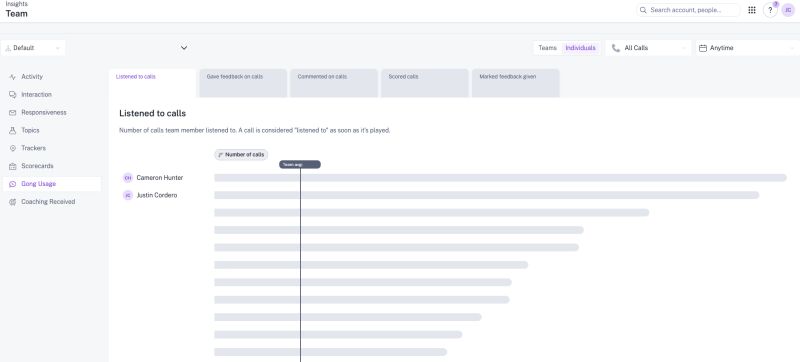
The attraction of this detail is its modest scale. There is no need to turn a dashboard into a theory of success. A call has to be heard before it can be considered. A question can be replayed. A reply can be compared with the question that prompted it. Listening gives the listener material to work with, even when a chart can count only the act of opening the call.
The most useful distinction here is between activity and understanding. A bar on a screen measures an activity. The understanding belongs to the person doing it. That makes this a good starting point for a profile rather than a verdict on performance: an ordinary piece of work, with two people close enough in the rankings to give it a little suspense.
His farewell included the other familiar sound of a sales office: a quota bell. Cordero said he had rung it one last time before leaving. He also planned two weeks away from quota before the next chapter. The announcement therefore had a definite ending, a short pause, and something still to be announced. Even an employment update can benefit from leaving the next scene until later.
Hunter supplied a useful detail in his reply: he had a fourteen-month head start in the listening contest. “Well played, Cam” was Cordero’s acknowledgement of the outcome. The exchange has the tone of colleagues enjoying a close result. A farewell can make room for that kind of competition without becoming a victory speech.
A second work term, a different scale
Cordero’s interest in startups appears earlier in the sequence. In August 2021, as his time at BMO Financial Group was ending, he announced an autumn placement at MarketBox. It would be his second work term. He looked forward to working with the team and Diana Goodwin, and framed the choice around his interest in learning inside a growing startup.
He described himself plainly: “As someone who loves the world of startups”. The phrase makes the work term feel like a choice with a particular attraction, beyond the requirement to find another placement. He was interested in the setting as well as the position. Goodwin welcomed him in the replies, giving the announcement a small, direct response from the team he was about to join.
Work terms have a peculiar place in a career story. They can occupy only a line on a résumé while taking up an entire season of a student’s life. The word “second” does useful work here. It places MarketBox inside a sequence of experiences, with a previous workplace behind it and further decisions still ahead. A career can begin to acquire shape before it acquires a settled title.
There is also a difference between being interested in startups and having a job inside one. The first is an enthusiasm. The second gives that enthusiasm a timetable, colleagues, and work to complete. Cordero’s announcement records the moment when the two met. It is a smaller event than an international launch, but belongs in the same account of how he arrived at his present role.
Four months away, then a return
Other student chapters took him through Infinite Investment Systems and a Sezzle sales-development internship. He credited Mike Zegers with helping him learn outreach. He also received DECA Ryerson’s Most Improved Delegate 20/21 award. In late 2022, he spent four months on exchange at Nanyang Technological University in Singapore, an experience he said had changed his previously sceptical view of exchange semesters.
His next announced placement was an Analyst role in Deloitte’s National Sales Office in 2023. His education profile lists Toronto Metropolitan University. These experiences put several different settings into the years before his full-time Zip role. They also keep the account of his career properly chronological: the current employer is a chapter, with earlier work and study on either side of the page.
work term
exchange
full-time BDR
Canada inbound
The exchange chapter introduces a useful change of scene. A career chronology can make each entry look like a direct preparation for the next. Study abroad has a wider shape. There are months spent in another university setting, followed by a return to the next work term. The chronology records both, without requiring every experience to become an explanation for the present job.
The rookie comes back
On May 22, 2024, Cordero announced that he was joining Zip full-time as a BDR, a business development representative. He had completed his final internship there the previous year, supporting the BDR team. The return gave his announcement a simple structure: he had worked alongside the team as an intern and was now coming back to do the role himself.
He called the new chapter his rookie year. It is a nicely proportioned phrase for an early full-time role, allowing excitement without pretending that the learning is complete. A rookie has a place on the team and plenty still to do. The sports language also gives a conventional employment announcement a little movement. There is a season ahead, rather than a finished career to unveil.
Cordero named Amanda Corea and Janae Guy for their part in recruitment, and Murtuza Hussain and Sarah Newman for the opportunity. Newman replied with a welcome. The names make the return specific. There was an existing team to rejoin and a recruitment process to complete, with people on the other side of both. Familiarity and a new responsibility could occupy the same moment.
An internship followed by a full-time return is an unusually clear transition to describe. The workplace stays the same while the position changes. That makes it possible to see a career move without a change of company. Cordero’s later move to Ramp would change the setting as well, but the earlier return deserves its own place in the story.
A Canadian chapter, one conversation at a time
Cordero’s April 13, 2026 announcement put the next role in precise terms: Ramp’s Founding Inbound SDR for Canada. SDR stands for sales development representative. He explained that, after procurement, he wanted to engage with finance more broadly. His description of the new work centred on businesses spending less time on expense reports and more time on their other priorities.
“Might be me on the other side of the phone.”Justin Cordero, announcing his Ramp role
That closing invitation is the human-sized version of a launch. A market can be described in currencies, product categories, and office locations. The first exchange with a prospective customer is a conversation between people. Cordero’s line puts him inside that exchange. It leaves room for the everyday practical question that follows any announcement about a new product: who will answer when someone asks about it?
Ramp’s Canadian offering brings corporate cards, expense management, bill payments, and accounting automation together. It supports CAD and USD cards and Canadian tax coding. Those features give the finance conversation a concrete vocabulary. Cards, receipts, invoices, and accounting entries are things a business has to handle. They are also more useful subjects for a call than a vague promise that software will make everything easier.
Four connected parts of Ramp’s Canadian offering.
The attraction of Cordero’s career story lies in these changes of scale. A student moves between work terms. An intern returns to a familiar team. A sales representative joins a Canadian launch effort. Each transition can be given its date and its setting without asking it to bear the weight of an entire philosophy of ambition.
The listening chart remains a fitting opening image. It shows a small piece of the work before the next role, with enough detail to make the transition memorable. His Ramp announcement introduces a new company and a wider finance conversation. Somewhere between the chart and the invitation to call is Justin Cordero’s place in the story: a person preparing to take the next question.