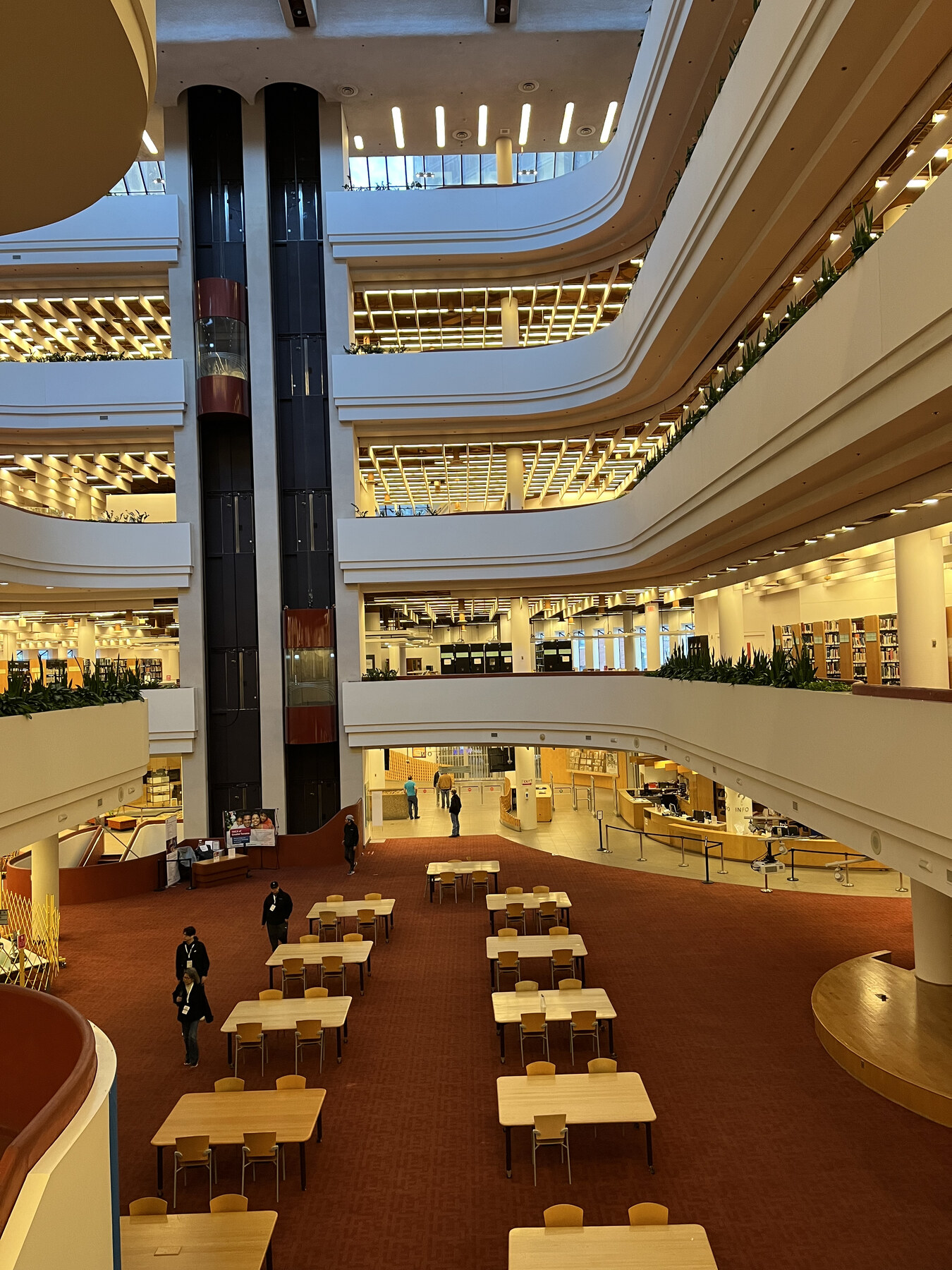
At 789 Yonge Street, the Toronto Reference Library rises around a broad, many-storeyed atrium. People lean over curved balconies, ride the glass elevators, disappear into stacks and settle at tables with the purposeful sprawl of those staying awhile. It looks like a building organized around books. Spend a day there and the books begin to look like the cover story.
Across Toronto Public Library's 100 branches, someone can borrow an ebook, use Wi-Fi, print a résumé, get basic math tutoring, record audio, reserve a pass to a museum, ask a settlement worker about life in Canada or talk to a crisis worker without an appointment. No latte is required to keep the chair. The system's real product is access, bundled so densely that the humble library card starts to resemble a civic membership.
That bundle reaches nearly 45 million visits to branches and online in a year. In 2025 benchmarking, TPL reported 13.4 million branch visits, 31.5 million electronic visits and 28.1 million total circulation. Those figures make it tempting to call the library a content platform. But that description misses its decisive advantage: a physical distribution network embedded in neighbourhoods, staffed by people whose job is to help.
01 / The offerBooks are the wedge, not the whole business
Toronto's first free public library opened in 1884, after voters approved a bylaw and turned a Mechanics' Institute into a public institution. The present network took shape in 1998, when municipal amalgamation combined seven library systems. That history matters because TPL did not begin with a clean product roadmap. It inherited buildings, collections, staff expertise and local habits, then kept attaching new capabilities to them.
One card, many doors
The thirteen Digital Innovation Hubs are the clearest example. A cardholder can use professional software, 3D printers and audio-video equipment, with staff nearby to help troubleshoot. The space and classes are free, aside from small printing-material charges. The same logic powers tpl:map, which turns a card into reservable admission at participating cultural attractions. Adult literacy offers one-on-one tutoring. Newcomer services route people to settlement agencies. Job seekers find databases, training and interview rooms.
This is differentiation by combination. Google can answer a question faster. Amazon can deliver a title. Netflix has more polished recommendations, and a coworking desk may have better coffee. None of them combines trusted human help, local rooms, cultural access and a lending collection at no point-of-use charge. TPL competes with each in slices and with none in full.
The library is urban middleware: it connects people to knowledge, tools, rooms, culture and other people.The product is the routing layer
02 / The economicsA public budget with a portfolio manager’s logic
TPL is not a venture-backed company and has no meaningful valuation. Its business model is municipal: in 2025, city funding accounted for 93 percent of a CAD $273.3 million gross budget. Staffing consumed CAD $197.1 million; materials, CAD $23.1 million; operations and administration, CAD $53.1 million. In commercial terms, it is labour-heavy and deliberately terrible at extracting revenue from users.
Where CAD $273.3M went in 2025
Private philanthropy, channelled through Toronto Public Library Foundation, helps test or enlarge services before the city assumes longer-term costs. The arrangement resembles a portfolio of public experiments. A donor can fund the risky early phase; the branch network supplies distribution; municipal funding supplies durability. The Gerstein Crisis Centre partnership followed this pattern: an 18-month pilot served more than 4,200 people, then expanded to 12 branches with donor support.
The service works because the library already sees people who might never enter a clinic or agency office. Crisis workers can offer short-term counselling and referrals for housing, addiction, primary care, finances or employment in a familiar setting. This is not librarians playing therapist. It is sharper service design: put the specialist beside an existing stream of trust and foot traffic.
03 / The reversalThe fee that failed its own job
For decades, late fines rested on a plausible theory: a small penalty would return books to shelves faster. Then COVID-19 suspended the mechanism. TPL had already eliminated children's fines in 2021; by June 2022 it ended late fines for everyone. The pandemic pause became an accidental trial, while research from other library systems challenged the old assumption. Fines were not reliably improving returns. They were reliably giving people with small debts a reason not to come back.
The direct transition was modest beside the whole budget but not imaginary. The Foundation raised CAD $300,000 to help eliminate fines in 2022, and the board wrote off CAD $448,748 in outstanding teen and adult overdue fines. Borrowers still owe replacement costs for items that are lost, damaged or never returned. The mechanism changed from punishment by the day to reminders, renewal rules and eventual replacement liability.
The copyable principle is narrower than “make everything free.” Ask whether a fee improves the behaviour it is supposed to improve. If it does not, and if it disproportionately ejects the people the service exists to reach, it is friction wearing an accountability costume.
04 / The failureWhen the digital library vanished
On October 28, 2023, a cyberattack split TPL into two versions of itself. The physical branches stayed open. The website, online catalogue, public computers, printing and holds did not. Staff lost normal systems and used manual workarounds. Returns accumulated while a network spanning a data centre, 100 branches and thousands of public and staff computers had to be examined, rebuilt or restored.
The first failure users felt was not the disappearance of books but the coordination layer around them. A book could sit on a shelf while the system that located it, reserved it, checked it out and moved it across the city was unavailable. The incident also exposed employee information. Ontario's privacy regulator later found that intruders had gone undetected in the environment from early August until late October, and noted vulnerabilities in the library's security posture.
TPL recovered affected systems using secure backups where possible and rebuilt components where necessary. It re-architected the affected public-printing service with newer technology. What failed first was connectivity; what proved durable was place. Yet “the branches stayed open” is comfort, not absolution. For residents who depend on public computers, printing or accessible digital collections, the network is not an accessory to the library. It is the library.
A shelf can survive an outage. Access cannot.The cyber lesson
05 / The playbookWhat a builder can steal
The strongest lesson is not to imitate a library's feature list. It is to notice the sequence. TPL begins with a frequent, legible use case - borrow something. That earns repeat visits and trust. It then adds adjacent services, often through expert partners, without asking users to learn a new institution each time. The branch is both product and channel.
The five-part civic bundle
- Lead with a simple ritual. Borrowing is easy to explain and frequent enough to build a habit.
- Bundle around the user's day. Wi-Fi, study space, job help and cultural access sit beside reading because real lives are not departmental.
- Borrow expertise, not identity. Crisis workers and settlement agencies bring specialist skill while the library remains the trusted door.
- Remove punitive friction. Test whether a penalty creates the desired behaviour before treating it as sacred.
- Design the fallback. If the digital layer fails, staff need rehearsed, bounded ways to keep essential service moving.
Hours are product design, too. When TPL extended hours at participating branches in 2024, visits rose sharply. All 100 branches gained Sunday service in October 2025; from mid-October through December, Sunday visits ran 50 percent above the same period a year earlier, while Sunday borrowing rose 54 percent. By July 2026, the system had moved to seven-day, year-round service, excluding public holidays. Availability created demand because availability was part of the value.
The next distribution bet is physical. TPL has announced a new district branch for 2028 and secured a future home at Quayside, its first waterfront location and planned 102nd branch. New library branches can take five to ten years to deliver, so the Quayside space is being reserved while the neighbourhood itself is built. That is the slow, unfashionable version of platform strategy: arrive with the housing, then stay for generations.
Where this playbook breaks
Bundling fails when there is no trusted core use, stable public funding, secure operating layer, adequate staffing or partner capacity. A sparsely used branch cannot distribute everything; an overloaded employee cannot become every specialist. The model also weakens when services are added for publicity rather than measured local need.
Toronto Public Library's expertise is curation in the broadest sense. It selects books, yes, but also software, equipment, programs, partners and public uses for scarce rooms and money. Its culture is constrained by public accountability and unionized operations, while its stated values make room for intellectual freedom, equity, experimentation and responsive service. That mix creates friction. It also keeps novelty tied to a mandate rather than to novelty itself.
A city library will never move like a startup, and should not pretend to. Its advantages compound slowly: a familiar sign, a branch within reach, an employee who knows where to look, a card carried for years. Toronto's experiment suggests that the modern library belongs neither to the media market nor the social-services sector. It sits between them, catching needs that specialized systems route away.
The amusing part is that one of the city's most useful networks still presents itself as a place for books. Perhaps that is the trick. Books are generous camouflage for a public institution that has learned to do many jobs without making every visit feel like an intake appointment. When the computers went dark, Toronto saw the cost of turning that institution into infrastructure. When the doors stayed open, it saw why the infrastructure was worth repairing.