The most revealing detail in Lando’s pitch is a short walk. At White Oaks Elementary, a fall 2026 robotics listing sends first- through third-graders into a two-hour class after dismissal. The price is $40. The classroom is on campus. Somewhere in that unremarkable arrangement, an entire parental errand disappears.
Usually, enrichment comes attached to a second job: transporting the child. Someone must leave work, collect a backpack, cross town, and wait. Lando places the activity where the backpack already is. Its business begins with robotics and game design, then reaches into the ordinary machinery of a school afternoon.
- For children: projects in robotics, coding, clay, math, and piano.
- For families: on-campus classes, usually $15-$20 an hour, with local variations.
- For schools: instructors, materials, registration, billing, and parent communication supplied by Lando.
01 / The trip that disappears
There are three people to please here. A child wants something absorbing to do. A parent wants a useful afternoon and a manageable pickup. A school wants the program to run without turning its front office into an activity-booking desk. A clever lesson alone cannot settle all three accounts.
Lando’s answer is to operate the whole class. It typically pays to rent a school classroom, brings the instructor and equipment, and collects tuition from parents. Some arrangements use PTA or district funding instead, making classes free to families. The company says it reserves at least two scholarship places in every class.
George Hall Elementary’s PTA supplies a concrete example: its fall 2026 hub lists Lando at $16 an hour, with robotics on Tuesday, coding on Thursday, and math on Friday. Parents enroll directly with the provider. The school’s existing campus becomes the distribution network.
At the website’s typical rate, a two-hour session works out to $30-$40. One weekly session over four teaching weeks would cost $120-$160. That is a calculation, rather than a universal monthly price. Families comparing programs still need to check actual class dates, local tuition, and the hours of supervision they require.
02 / A robot has to earn its keep
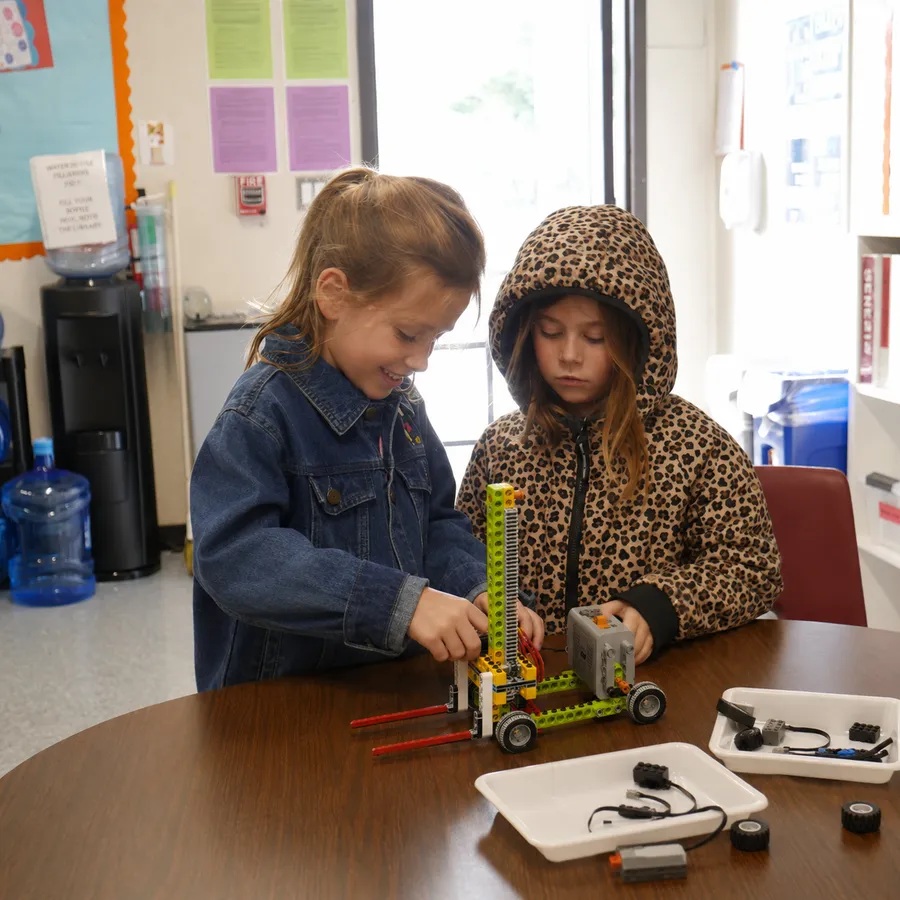
The robotics curriculum asks children to make things that do something. Younger builders explore structures and movement. Later challenges introduce mechanisms, motors, and sensors. A crane must lift; a robot must respond. Success becomes visible, and so does the next problem. Children can compare what they intended with what actually happens.
That structure carries across subjects. Coding students build playable games. Clay students make characters and miniature worlds. Math Tycoon uses an imagined business to give numbers a job: pricing, measuring, budgeting, interpreting results. Piano adds rhythm, reading, and performance. The catalog spans five subjects, with different entry points for different ages.
“The best learning happens at the edge.”
Lando’s teaching philosophy
A project offers a useful kind of resistance. The mechanism sticks. The game behaves oddly. The sculpture tips over. Lando describes teachers trained to hold back from rescuing children too quickly. The judgment lies in deciding when a student needs another clue and when another attempt would be more valuable.
Technology has a practical role in this. Foster City’s coding listing describes Lando’s Scratch-based iPad app, games playtested with friends, and links children can use afterward. The screen is present; so are classmates and a teacher. Parents should expect different mixes of digital and physical work across subjects.
03 / The founders stay close to the classroom
Lando dates its first robotics class to 2021, taught by co-founders Blake Kavanaugh and Felix Hu. By 2023, its timeline records hiring teachers and building the surrounding systems. The sequence matters: teaching came before the larger delivery operation. The founders had to learn what would bring children back.

Co-founder · CEO

Co-founder · CTO
An archived teacher vacancy makes that feedback loop explicit. Teachers were expected to work alongside the founders, notice what happened in class, and give the product team actionable observations. An engineering vacancy asked for Unity and hardware experience, with school visits for playtesting. The classroom was a place to develop the product.
The hiring brief connects two kinds of expertise: making a game work and making a group of children want to play it. A technically sound activity can still confuse its audience. Watching a class supplies information that a finished lesson plan cannot provide on its own.
That history helps explain Lando’s position in education technology. Software supports lessons and operations, while the thing families buy happens in person. Reach Capital and Maveron publicly identify Lando as a portfolio company. Their involvement puts venture backing behind a business whose delivery still depends on adults arriving at school.
04 / Reliability has a payroll
Those adults need preparation. Lando’s teaching page advertises a progression from $30 to $60 an hour, with pay bands varying by region. It describes classroom coaching, written debriefs after lessons, and quarterly promotion reviews. Paying for teaching ability, then helping it improve, is part of what tuition must support.
There is a second cost: backup. On its school page, Lando says it deliberately overstaffs regions so a trained substitute can cover a delayed teacher. It also promises to handle parent questions and restore the classroom after use. A school buys confidence in all the small events around the lesson.
For any operator copying this approach, the economics would turn on how many children enroll and how efficiently teachers and supplies move between schools. A spare instructor protects a class but adds an expense. A full room spreads delivery costs across more families. Opening another campus therefore creates another local scheduling problem, alongside the opportunity to reach more children.
- 01School endsChildren stay on campus.
- 02Class beginsAttendance triggers a parent text.
- 03Pickup arrivesCheckout and a class update close the loop.
05 / A week can hold several specialists
Lando reports more than 300 schools and 300 teachers, serving campuses in California, Washington, and Colorado. School listings show the competitive neighborhood. Arbor Heights pairs Lando offerings with Coding with Kids and Bricks 4 Kidz/BEAM. George Hall combines it with theater and sports vendors. A school can build variety through several providers.
The choice for families is therefore specific: which subject, which day, which price, which pickup time? A scheduled enrichment class may cover only part of the care a parent needs. The model depends on available classrooms, workable transitions, enough trained local teachers, and somebody funding the places. Convenience has operating conditions.
The idea other businesses can borrow is to examine the journey around a service. Count the trips and handoffs a customer has to arrange. Remove one, then take responsibility for what remains. Lando’s bet is that a more interesting afternoon becomes easier to choose when it starts a short walk away.