There is a pleasing complication in Oren Fuerst’s résumé: the instruction manual arrived before the company for which many people know him. He and Uri Geiger co-wrote From Concept to Wall Street, a guide to entrepreneurship and venture capital published by Financial Times Prentice Hall. Years later, Fuerst co-founded LabStyle Innovations, the company behind Dario, and became its chairman and chief executive. By April 2013, its shares were trading under the symbol DRIO. The title had acquired a rather literal sequel.
The book’s contents offer a useful introduction to its co-author. They include establishing a venture, assembling a team, financing a business, raising public capital and selling companies. They also include restructuring and bankruptcy. A business book that leaves room for dissolution has at least remembered that the reader may eventually meet an accountant. Fuerst’s subject was the whole journey, including the turns that rarely make it into a founder’s celebratory announcement.
That breadth gives his career its shape. He has taught executives and MBA students, advised technology ventures, helped establish an angel investment club and held the operating responsibilities of a founder. More recently, his public work has included conversations about artificial intelligence and investment. Read across those activities and a recurring question emerges: how does a technical possibility become something an investor, a team and a market can understand? The connections are visible in the jobs themselves: classroom teacher, network organizer and company founder.
Putting a price on a possibility
Fuerst studied accounting and economics at Tel Aviv University before earning master’s and doctoral degrees at Columbia Business School. His academic background placed him close to a particularly awkward business problem: assigning a value to something whose future matters more than its present. A young technology company can have an idea, intellectual property and ambition while offering very little of the trading history that makes comparison comfortable.
At Columbia, he co-directed an executive program concerned with technology valuation and strategy and lectured in executive and MBA programs. He also served on the faculty of Yale’s School of Management. Those appointments put him in a position to discuss the same business from different angles: the entrepreneur explaining its promise, the investor considering its price and the manager expected to make the numbers mean something.
An online Columbia seminar carried the title Introduction to the Art of Venture Valuation. Its premise distinguished the relative convenience of comparing publicly traded companies from the difficulty of valuing private technology ventures. The word “art” does some useful work there. A calculation may be precise while the assumptions beneath it remain debatable. Teaching that distinction asks for more than fluency with a spreadsheet; it asks for an explanation that survives somebody else’s questions.
Two Orens, one meeting room
In 2007, Fuerst and attorney Oren Heiman created Tevel, an angel investment group connecting Israeli entrepreneurs with American investors. The matching first names are a small gift to anyone trying to remember the founders. The undertaking itself dealt with a less charming problem. An entrepreneur could have a promising business and still struggle to reach the people capable of financing it. A potential investor could be interested in Israeli technology and lack the time to sort through it.
Tevel proposed meetings every two months, with screened companies seeking between $250,000 and $2.5 million. Its first meeting was scheduled for September 6 at the Harvard Club in New York. There is something agreeably concrete about that arrangement. Capital formation, an expression capable of emptying a dinner table, becomes a date, a room and a short list of people expected to turn up.
Fuerst explained the ambition in a few words: “The more Israeli companies we can help, the happier we will be.” The statement gives the network a purpose beyond merely expanding a contact list. In this part of his career, the work was to make useful encounters happen. A venture needs people willing to examine it, and those people need a reason to spend their attention. Tevel supplied a recurring occasion for both.
“The more Israeli companies we can help, the happier we will be.”Oren Fuerst, on Tevel
The work before the handshake
By early 2008, Tevel had recruited 28 members. A 17-member executive committee reviewed business plans and selected four companies to present at a meeting. The group connected founders with individual investors; Tevel itself did not supply the financing. That distinction mattered. The organization could arrange an introduction and a process, while the decision to invest stayed with the people whose money was involved.
The mechanics tell a more interesting story than the familiar photograph of people shaking hands. Screening, selecting and preparing information all happened before a founder stood up to speak. A pitch occupies a few minutes. Deciding whether the pitch deserves the room takes rather longer. Fuerst’s involvement placed him in that less visible stretch between a company’s desire to be heard and an investor’s willingness to listen.
It also gave a practical setting to the concerns of his teaching and writing. Valuation needs information; information needs to reach someone who can act on it. In Tevel, the business plan was read, the meeting was organized and the introduction was made. The lesson is modest enough to be useful: a network becomes valuable through the work people perform inside it. The membership list alone cannot do the reading.
From the classroom to the chair
Dario brought Fuerst into a different position. LabStyle was founded in 2011, and he served as chairman and CEO during its early development. His co-founders included Shilo Ben Zeev. Public trading followed in 2013, initially on the over-the-counter market. That sequence is worth keeping straight: the company’s later Nasdaq identity should not turn an earlier trading milestone into a different event.
In August 2013, Fuerst moved to executive chairman and Erez Raphael became president and CEO. The responsibilities allocated to Fuerst included acting as a liaison to the investment community and advising management on intellectual property and business strategy. The change made the division of work explicit. A growing business had to distribute responsibilities among people, even when a founder’s name remained closely associated with it.
At the time, Fuerst described a company that had grown from two employees to more than 20 professionals in two years. The numbers are small enough to picture. Two people can keep much of a venture in conversation. More than 20 need decisions, responsibilities and coordination that survive beyond any one conversation. Here was the subject of his book taking organizational form: a company changing shape as it moved through successive stages.
His founding role is therefore best understood with its dates attached. The early CEO became executive chairman, and the business continued under a new chief executive. That handover is part of the story of building a company, as much as the first incorporation or the appearance of a ticker symbol.
A new question across the desk
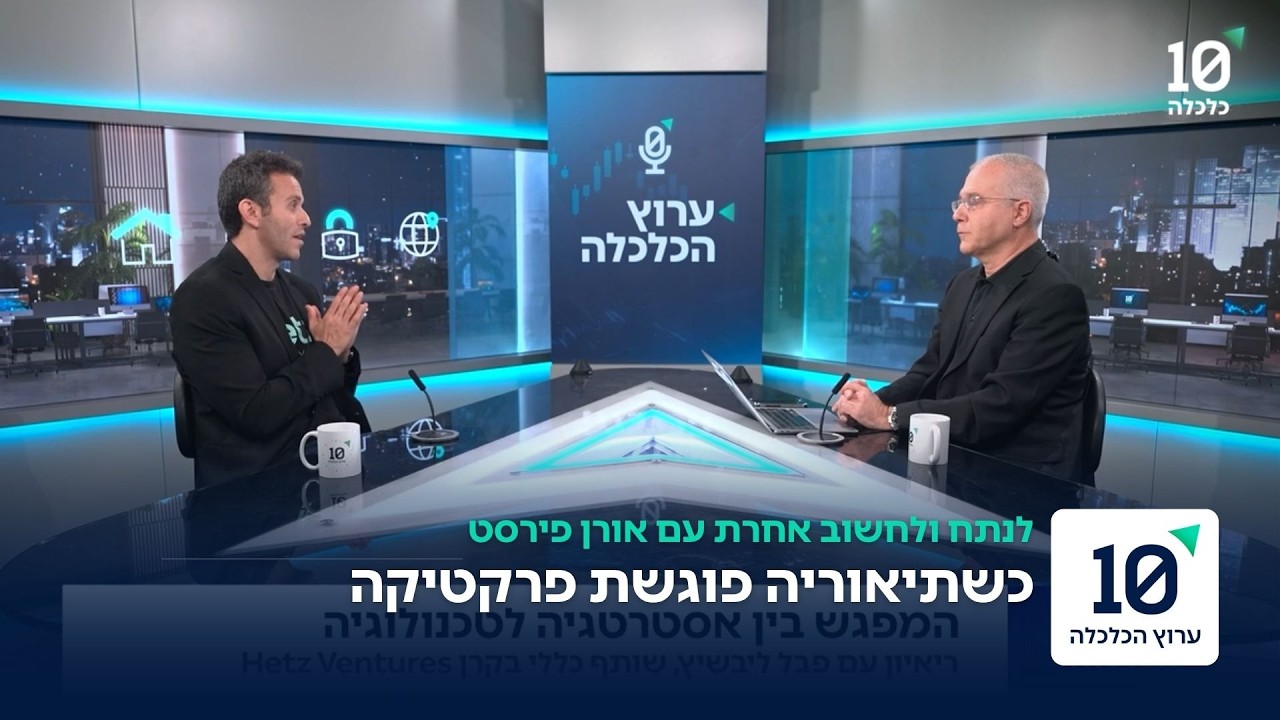
The setting changes again in a Channel 10 conversation with Pavel Livshiz, discussed publicly in March 2026. Fuerst sits across a television desk from the investor, with a laptop open in front of him. The subject is how artificial intelligence changes the companies people might build and finance. The familiar meeting between a technology argument and an investment argument now has studio lighting.
Livshiz discusses the security problems created by software agents inside organizations, changes in data infrastructure and the business opportunities surrounding new regulation. Those are Livshiz’s observations in the conversation, rather than views to attribute automatically to Fuerst. Fuerst’s role is the interviewer’s: he provides the setting in which someone else’s investment reasoning can be examined. A useful conversation leaves room for that distinction.
Fuerst’s own writing offers a separate view of his thinking. In February 2026, he published A Balanced Perspective on the 2028 Future, responding to a widely discussed hypothetical scenario about AI and the economy. He treated the scenario as a thought exercise and discussed both disruption and opportunity. The interest lies in his choice to work through the implications rather than simply repeat the scenario’s alarming premise.
That approach sits comfortably beside the older valuation work. A scenario makes assumptions visible. An investment decision requires a judgment about those assumptions. The technologies have changed substantially since his Columbia seminar, but the reader still has to ask what the argument depends on and which parts remain uncertain.
The distance between an idea and a business
Today Fuerst presents his work through Fuerstech, advising founders, investors and organizations on strategy and venture development. His interests include AI, fintech and robotics. He is also a co-founder of the Israeli Intelligent Robotics Center and hosts a podcast on global strategy, investment and technology. The formats have multiplied: a course, a book, a meeting, a company, a broadcast conversation.
Each format has a different audience. A student needs a concept explained. A founder needs a business examined. An investor needs a reason to commit time or capital. An interview guest needs space to make an argument. Looking across Fuerst’s career suggests that explaining the connection between those audiences has been a substantial part of the work. The connection must be rebuilt whenever the technology or the audience changes.
The title From Concept to Wall Street remains a convenient way into the story, provided the middle receives its due. There are people to recruit, claims to test, introductions to arrange and responsibilities to hand over. Fuerst has occupied several of those positions himself. The interesting distance in his career is measured in the work between them: enough detail to fill a book, and enough uncertainty to keep the next conversation worthwhile.