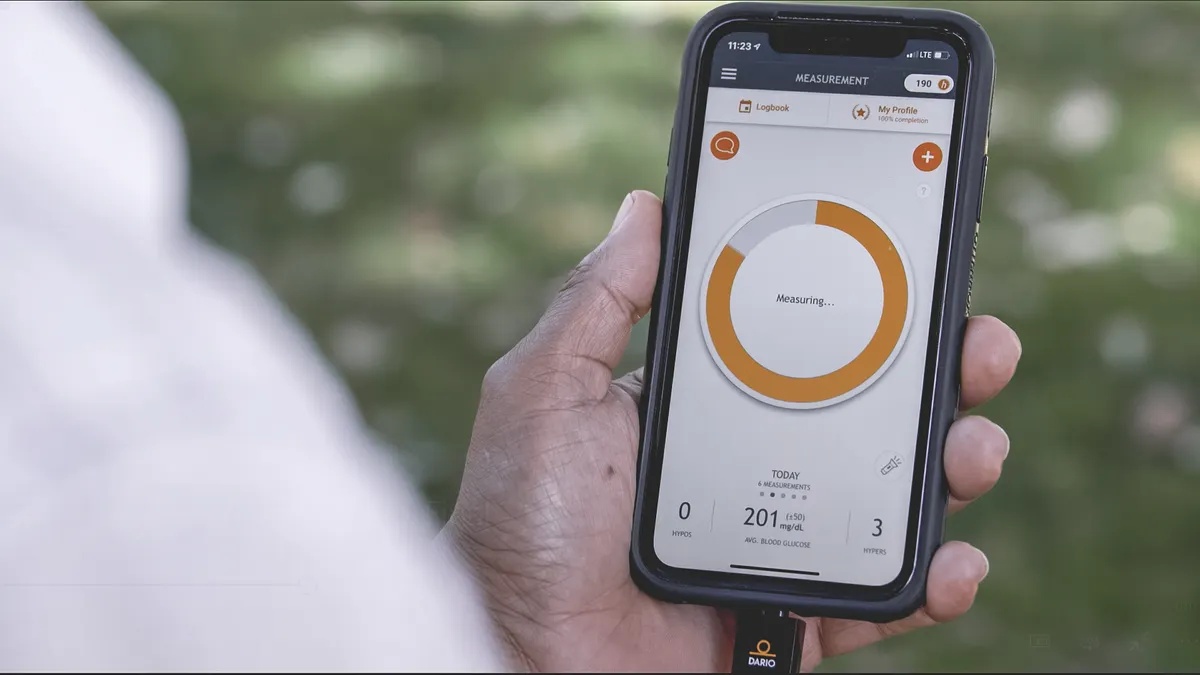
A blood glucose reading takes six seconds on Dario’s smart meter. The device plugs into a phone, which supplies the power and displays the result. There is something pleasingly economical about this arrangement: the screen, battery and connection are already in your pocket. Why carry them twice?
But the interesting part begins after the number appears. A measurement can tell you something about your body. It cannot, by itself, arrange dinner, change a routine or make tomorrow’s test easier to remember. Dario’s evolution is an attempt to build a business in that awkward interval between knowing and doing.
- Connected devices make health measurements easier to record.
- Apps and coaches help turn those readings into daily routines.
- Employers and health plans buy recurring access; consumers can buy directly.
The missing hours
Erez Raphael, Dario’s chief executive, describes a personal reason for joining the company: “I joined Dario five months after my father passed away from diabetes”. He recalls care organized around appointments, with too little support between them. It is a useful starting point for understanding the company. The gap in his account was day-to-day help.
The screen, battery and connection are already in your pocket. Why carry them twice?
The company began in 2011 as LabStyle Innovations. Its early founders included Oren Fuerst, David Weintraub and Shilo Ben Zeev. The glucose system received FDA clearance in 2015; the US diabetes solution followed in 2016. The proposition was tangible: a meter, lancing device and strip storage in one compact object, connected to something people already used constantly.
A pocket-sized argument
The meter automatically records readings in the app. Users can add meals, medication, activity and notes, then share information with their doctor. That removes a small, persistent nuisance: copying a number from one place to another. The finger-stick meter still needs strips and a compatible phone. It takes individual readings rather than continuously measuring glucose.
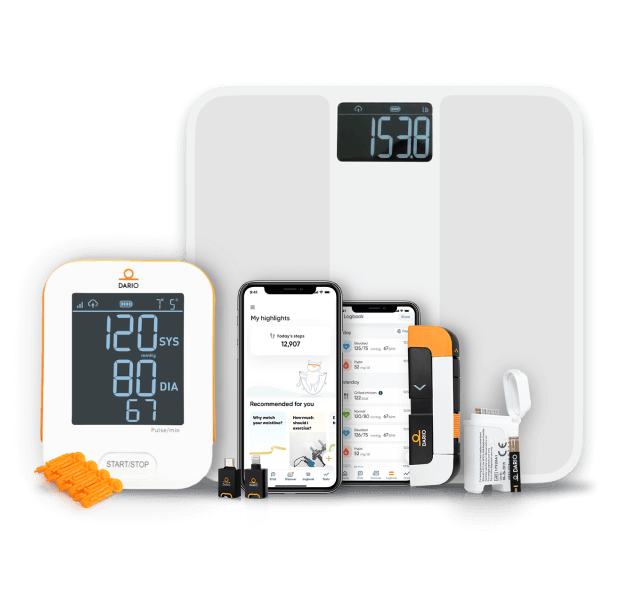
For a product designer, there is a lesson here. Start with a task people repeat. Remove a step. Make the resulting information easier to use. Dario’s larger platform extends that reasoning: connected blood pressure monitors and scales feed tracking tools, while educational material and coaching help members interpret patterns and work on habits.
Repeat. Adjust. Keep the next step within reach.
For someone enrolled through a participating employer or health plan, the appeal is having tools and support available at home. A blood pressure reading can become part of a record to discuss with a coach or clinician. An exercise session can fit around the day. The service is trying to reduce the work of organizing care as well as the work of recording it.
One person, several problems
Dario widened its scope to hypertension, weight management, musculoskeletal care and behavioral health. These categories make tidy menu labels. A person’s life is less tidy. Pain, sleep, mood and daily activity can compete for the same limited attention. The commercial argument is that support should be easier to navigate when several needs overlap.
Dario Move offers exercise plans and coaching, with sensor-based feedback for movement and posture. Dario Mind combines self-guided activities with coaching, peer support and expert content. Its cardiometabolic offering addresses diabetes, prediabetes, weight and blood pressure. Together, these put Dario in the market for ongoing condition management, alongside companies such as Omada, Teladoc, Vida and Virta.
Selling through the people who pay
Dario’s direct consumer roots remain part of the business. Its enterprise model adds another customer: the organization paying for care. Employers and health plans purchase subscriptions priced per member or per engaged member each month. Some arrangements include performance guarantees. The distinction matters: eligibility, enrollment and sustained use are different things.
Partnerships help reach those buyers. A 2022 Sanofi agreement covered promotion, development and research, with payments of up to $30 million subject to conditions. Amwell provides another route into insurers. In September 2026, Dario announced a New Jersey health-plan contract representing roughly 1.5 million covered lives, with launch expected in early 2027. That is potential reach, rather than a count of people already using Dario.
The expensive part of putting it together
Acquisitions supplied some of the breadth. Upright and wayForward joined in 2021; Twill followed in 2024. Twill’s deal included $10 million in cash plus equity-related consideration. Buying capabilities and customer relationships can shorten a development timetable. Keeping the acquired customers remains another job.
A legacy Twill client’s scope change and nonrenewal contributed to Dario’s 2025 revenue decline, from $27.0 million to $22.4 million. The company has since emphasized recurring enterprise business and moved away from certain pharmaceutical-related work. It reported a $7.9 million net loss in the second quarter of 2026. A July equity financing raised approximately $23.5 million gross. The wider platform still has to support a viable business.
Reported full-year revenue, rounded. Product breadth grew; revenue did not follow in a straight line.
A savings estimate with small print
The evidence deserves the same care as the accounting. In October 2026, Dario announced an Aon review supporting estimated annual healthcare-cost reductions of 2.5% to 7.2% across a covered population. The review considered 17 studies identified by Dario, including company-sponsored and independently conducted work.
Aon did not independently verify the underlying data, audit the studies or review every available piece of evidence. Its conclusions describe associations and estimates, with outcomes depending on the population and its use of the services. Buyers need to examine their own enrollment, disease burden and realized costs before treating that range as a budget assumption.
Make the next useful action easier
Dario is now extending toward clinical delivery. Its Beluga Health collaboration underpins an Integrated GLP-1 Program announced in July 2026, bringing licensed-provider evaluation, appropriate prescribing and oversight alongside coaching and monitoring. Commercial availability was expected in fall 2026.
The practical idea to borrow is modest: connect a measurement to a useful next action, then make that action easier to repeat. It depends on people having suitable technology, participating and receiving appropriate clinical care. A device in a drawer contributes very little. Dario’s opportunity lives in what happens after someone picks it up.