In 2011, Tomáš Bella was trying to sell a rather awkward product: news that people had grown accustomed to getting free. The proposed price was €2.90 a month. The more difficult figure was nine - the number of Slovak media organisations persuaded to join the same payment system. Getting a reader to open a wallet was one problem. Getting competing publishers to agree on anything was quite another.
The venture was Piano Media. Its proposition borrowed from cable television: pay once, sign in once, read across a collection of publications. Publishers would still choose which material to charge for. The reader would be spared the small bureaucratic adventure of buying a different subscription at every stop.
Bella’s argument was that paying should be convenient. It sounds modest beside the grand theories routinely offered about journalism’s future. It also gives us a useful way into his career. He has spent years working on the space between wanting good reporting to exist and making the arrangements that allow someone to produce it.
A school newspaper came first
Before any of this, he wanted to be a policeman. Watching police beat demonstrators during the Velvet Revolution changed his idea of where justice might be found. He was ten. Journalism became the alternative. Later, he chose a business academy partly because its school newspaper was better than the one at the grammar school. His priorities were already reasonably clear.
He studied journalism at Comenius University in Bratislava and began working on the internet beat in 1997. His early employer was the computer magazine CD Tip. When SME’s publisher acquired it, the magazine became a newspaper supplement and Bella came along with it. He joined SME in 2000, eventually editing its computer supplement, leading Sme.sk and returning later as deputy editor-in-chief.
The technology was a way into stories about people. His work at Sme.sk ranged across services, usability and information architecture, including the newspaper’s blogging platform. An editor’s job could involve deciding how a reader navigated a website as well as deciding what belonged on it. Bella was getting an education in both.
There is a pleasingly unvarnished record of this period in his old blog. A June 2008 entry acknowledges that the launch of new discussions on Sme.sk had gone wrong. Other posts introduce a news map, profile Slovak website makers or explain new services. Here was someone helping construct the machinery while leaving the workshop door open.
Nine publishers, one checkout
Piano emerged from a conversation with Etarget’s Marcel Vašš. Bella had been planning a media consultancy with Miloš Čermák and Adam Javůrek; the subscription idea took over. His official biography dates his founding and first-CEO period to 2010-2013. The shared Slovak service began charging in May 2011. The company’s beginning and the product’s launch are different moments.
The early negotiations took a year. Bella initially approached twelve publishers and expected perhaps half to participate; nine agreed. Piano handled billing, software and support, keeping a portion of the subscription income and distributing the rest. Readers could move between competing publications without confronting another checkout. For publishers, sharing the infrastructure required sharing the proceeds.
“I think people will pay when it’s convenient.”
Tomáš Bella, 2011
The experiment addressed a habit as much as a budget. A small payment made the idea of paying less forbidding. In February 2012, Piano announced that the Slovak monthly price would rise from €2.90 to €3.90 the following month. The introductory price had helped establish the practice; it was never intended to last indefinitely.
One payment. One login. Nine participating media organisations.
Expansion introduced new decisions. Slovenia required research about what readers would actually pay. The Polish launch brought a much larger market. In April 2012, Piano announced a €2 million investment from 3TS Capital Partners through its Cisco-backed growth fund. A Slovak experiment now had investors, international customers and the obligations that accompanied them.
Bella handed over the chief executive role in 2013 and went back to SME. His announced editorial brief included longer, more analytical writing and new genres. The return makes sense alongside everything else: the person building a system to sell journalism still wanted to make journalism.
A newspaper becomes the test
In 2014, the argument about who should pay for a newspaper acquired another dimension: who should own it. After Penta’s announced entry into SME’s publisher, a group of journalists left to create a new outlet. Bella was among the founders of Denník N. Its development would put his subscription experience inside a newsroom built around the model.
Early on, he described an editorial interest in two ends of the spectrum: substantial analysis and very fast updates. The long articles offered depth; the minute-by-minute service answered the recurring question of what had just happened. Those are different reader needs, and a newspaper could serve both without filling every available space between them.
He also continued reporting. His article about spending a week with refugees in Sicily won the Slovak Journalism Award for best reportage for 2015. The award matters here because it supplies a concrete answer to a question his job titles can obscure. Yes, the subscription specialist went out and did the reporting himself.
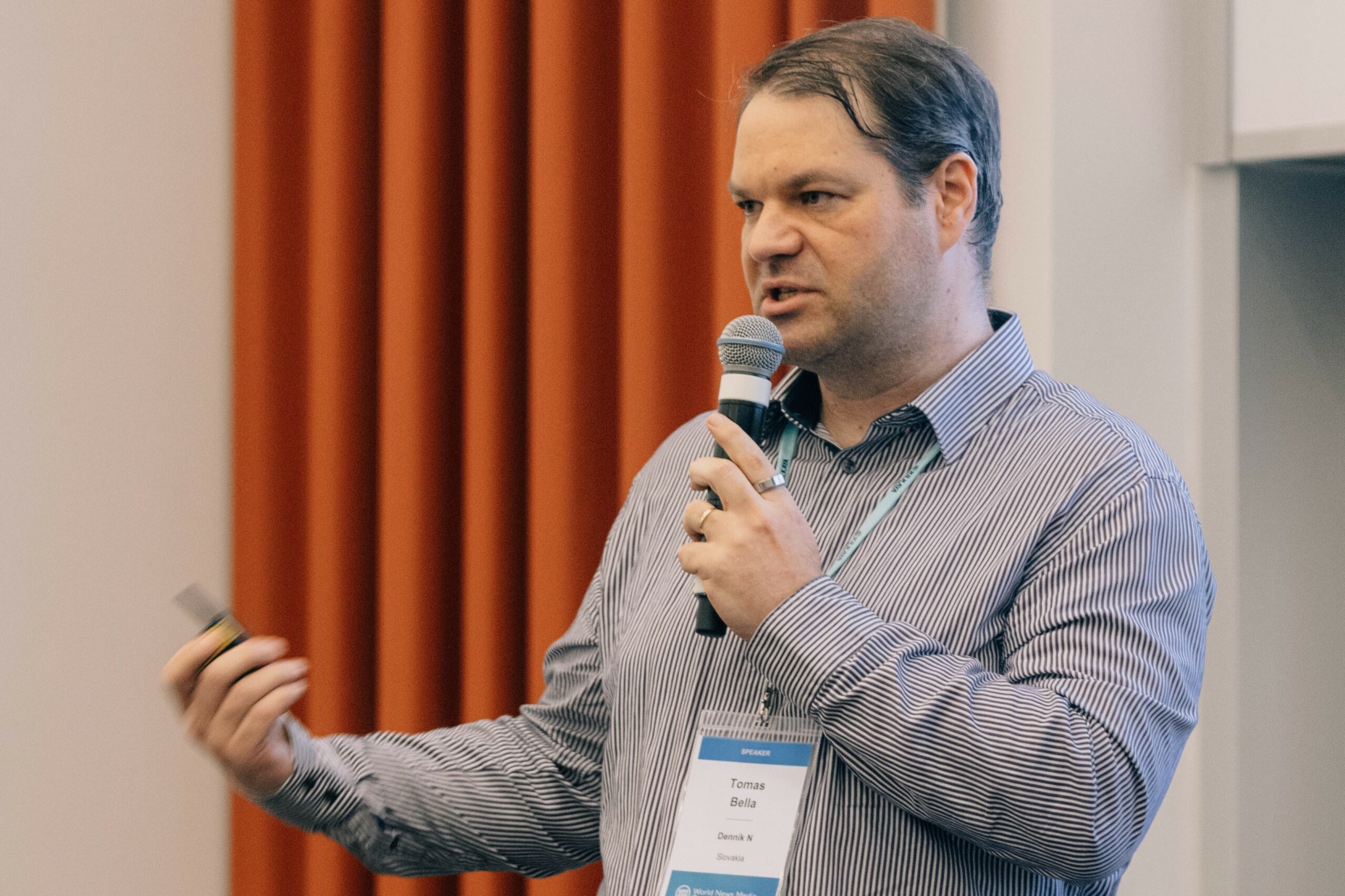
By the time of his 2024 Copenhagen presentation, Denník N had 72,000 subscribers. The scale belonged to the work of a newsroom and its readers, rather than to a solitary founder’s trick. Bella’s account of it included people contributing to special projects and helping fund magazines for schools. A subscription could become a continuing relationship with something the reader wanted to support.
The newsroom builds its own tools
A reader-funded newspaper needs rather particular plumbing. It must know whether someone has paid, what access they bought, when that access expires and which messages might be useful. Denník N developed REMP, the Readers’ Engagement and Monetisation Platform, with support from Google’s journalism funding programmes. Developers worked alongside the editorial operation.
During REMP’s development, Bella asked editors which tools would make their work easier. The resulting dashboard showed which stories persuaded visitors to subscribe. Reporters could see the consequences of their work in something other than a pageview count. Editors also continued commissioning important coverage that was unlikely to sell subscriptions.
The tools became open source. Other publishers could use them, including competitors. The system connects customer records, payments, behavioural analytics and communications, and has been adopted by dozens of publishers. Sharing software allowed newsrooms to spend less effort duplicating the same technical work.
There is a consistent thread from the Piano negotiations to this decision. Competing publications have reasons to cooperate on the things a reader never came to admire. Nobody buys a newspaper because its renewal database is unusually elegant. They may leave when the database gets their subscription wrong. The unglamorous work has editorial consequences.
A paywall with an access problem
By 2025, Bella was discussing a complication that the paywall’s inventors could hardly dismiss: even paying subscribers disliked the fact that their friends or relatives could not read an important article. Their objection did not necessarily mean they wanted to stop paying. They wanted the information to travel further.
Denník N’s spring campaign connected subscriber recruitment to ten public promises. Bella described gathering readers’ feedback before deciding what those promises should be. An initial goal of 10,000 new subscribers produced 24,000 trial subscribers. The word “trial” matters: the result describes an acquisition campaign, rather than 24,000 proven long-term customers.
That distinction is part of what makes the story interesting. A paywall can finance reporting while also limiting who encounters it. Recruitment, free-access initiatives and reader support become ways of negotiating the tension. After years of arguing that people should pay, Bella was listening carefully to the people who already did.
Bratislava’s experience arrives in Brussels
In February 2026, Denník N became the owner of EUobserver, and Bella joined as CEO. This was the group’s first expansion into English-language journalism. The arrangement brought subscription technology, financial backing and publishing experience to the Brussels outlet. Editor-in-chief Elena Sánchez Nicolás retained responsibility for editorial decisions.
By July, Bella reported that EUobserver’s readership had nearly doubled since February and that four new team members had joined since the beginning of the year. Readership growth is its own measure; it does not tell us how many people became paying subscribers. It does show that the new job had moved beyond an acquisition announcement.
Brussels also gave him fresh material. In a May podcast conversation with Čermák, he discussed the move, his surprise at the city’s relative affordability and the people there who sincerely wanted to improve things. He also mentioned an unfinished book about what it means to be rich. The executive had acquired another newsroom to worry about; the reporter still had questions he wanted to pursue.
His old reporting award and his current corporate titles belong in the same story. So do a €2.90 offer, a subscription database and a newspaper willing to share its software. Each makes journalism possible in a different way. Bella’s career keeps bringing the payment question back to an everyday consequence: whether a reporter gets the time, the support and the freedom to go and find something out.