Before the quarry trucks, before Google, before the courtrooms, Anthony Levandowski built a motorcycle with nobody on it. There were practical reasons for choosing two wheels: a small dirt bike was relatively cheap, could fit in a pickup and could be lifted when it fell over. Falling over would become a substantial part of the development process. An autonomous motorcycle has to solve a problem an autonomous car can generally take for granted: remaining upright.
Ghostrider emerged from a group of Berkeley engineers called the Blue Team. Levandowski worked on obstacle-avoidance software; other members brought skills in stability, electronics and mechanical design. Their machine entered the DARPA Grand Challenges of 2004 and 2005. It did not win. In 2007, it entered the Smithsonian’s National Museum of American History instead. A place in a museum is an unusual consolation prize for failing to get very far in a race.
The bike offers a useful place to begin a life that is often told from the middle, with the lawsuit. Levandowski’s career runs through the creation of Google’s self-driving program, a trucking startup sold to Uber, a criminal conviction, a presidential pardon and another company. Across those episodes sits a persistent engineering question: where can a machine actually do useful work? His current answer involves limestone.
Back to where the road ends
- 2004–05Ghostrider
DARPA desert courses - 2009Project Chauffeur
Google’s self-driving program - 2016Otto → Uber
Autonomous trucking - 2019 →Pronto’s off-road turn
Mining and quarry haulage
A banker for Monopoly money
Born in Brussels in 1980, Levandowski grew up between Belgium and California before studying industrial engineering and operations research at the University of California, Berkeley. His early businesses had less glamorous customers than a robot taxi might. As a teenager, he built websites, then developed a database business called La Raison. By graduate school, he was working with Randy Miller on a portable blueprint system for construction sites. Dust and revised drawings were already business opportunities.
That student-era picture includes a revealing domestic arrangement: he chose housemates partly for programming skills that could help his work. He also took computer manuals on holiday. The appetite for learning came with a practical streak. For the blueprint project, he and Miller visited building sites and asked foremen what they needed. The proposed machine, Worktop, was built around getting updated plans into the hands of people who had to build from them.
In 2001, another project gave that instinct a less expensive proving ground. BillSortBot, assembled from 300 Lego pieces, sorted Monopoly banknotes by color. A light sensor read reflected light from each bill; the robot directed the paper into different bins. Purple antennae and large eyes supplied personality. The machine won a Sun-sponsored university contest, earning prizes that included Java-branded leather jackets and computerized golf putters. Even robotics competitions occasionally lose their grip on restraint.
“We wanted to solve a real problem,” he said of the project. Sorting pretend currency was a playful version of sorting parts on a production line. It also required handling actual objects, which could slip, jam or arrive in the wrong order. Long before Pronto, his student work was already rubbing software against the inconvenient texture of the physical world.
The map becomes a vehicle
Levandowski joined Google in 2007 to work on mapping. His startup 510 Systems, founded with Andrew Schultz and Pierre-Yves Droz, developed equipment that brought together camera images and precise location information. Its technology helped enable early Street View. The relationship had layers: Topcon manufactured and sold equipment to Google, while 510 supplied underlying technology. The familiar street photograph depended on a less familiar collection of sensors, timing and positioning systems.
A television commission then offered a different use for that knowledge. In 2008, a team built PriBot, a modified Toyota Prius, to deliver pizza for the program Prototype This! The trip across the Bay Bridge took place with police clearing and escorting the route. It was a staged demonstration with substantial assistance, rather than an ordinary delivery service. Still, a machine carrying dinner made an engineering argument that a presentation could only describe.
In 2009, he became a founding member of Google’s self-driving project, Project Chauffeur, which later became Waymo. Google acquired 510 Systems and its sister company, Anthony’s Robots, in 2011. Levandowski’s work put him among the engineers turning autonomous driving from a research contest into a corporate program. Sebastian Thrun, Chris Urmson and other collaborators belong in that history too; the car had considerably more creators than seats.
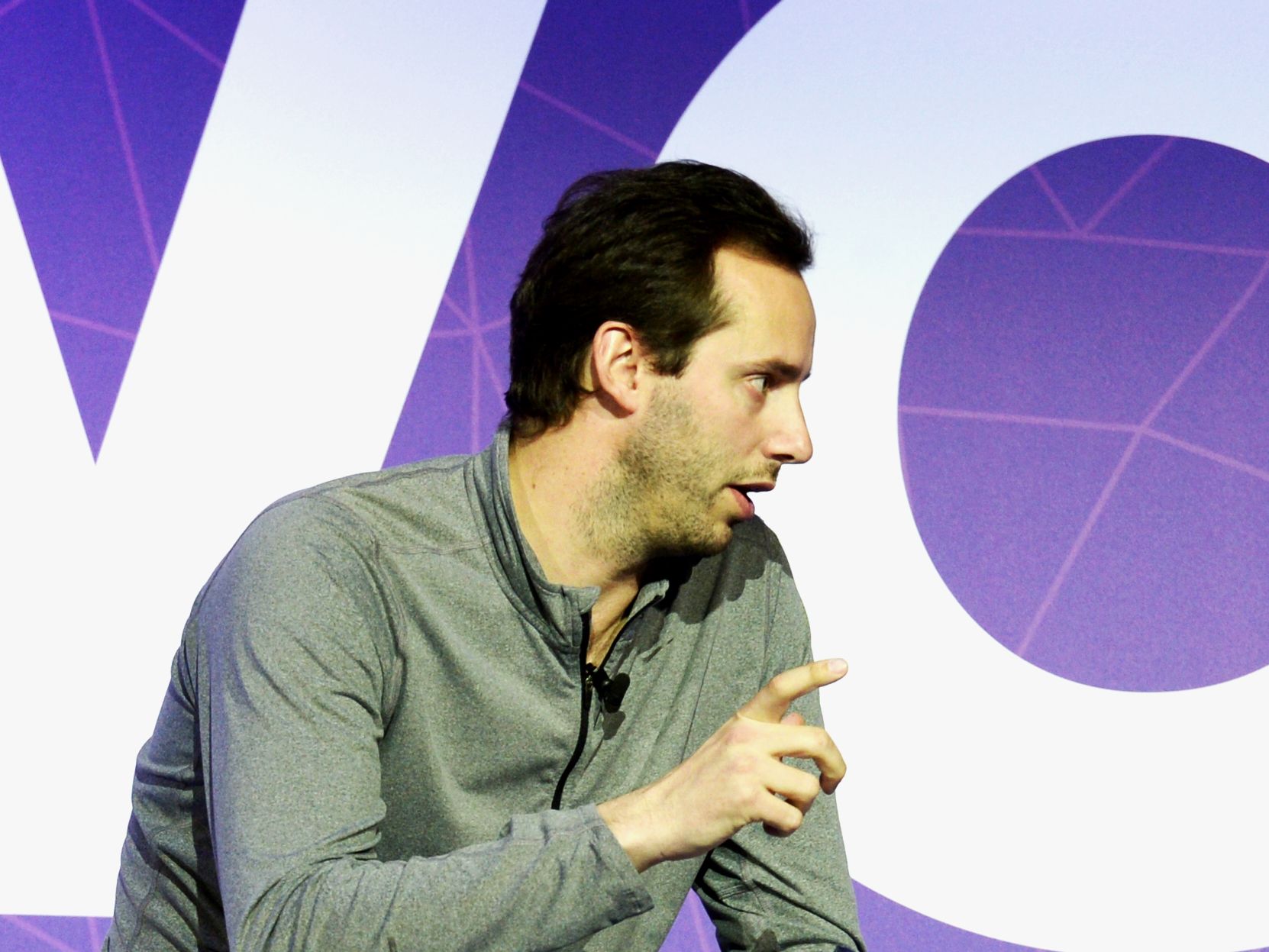
Levandowski speaking at a technology event. The machines have changed; there is still plenty to explain.Photo: picture alliance/Getty Images, via WIRED
The files that followed him
In 2016, Levandowski left Google and co-founded Otto, which developed self-driving technology for trucks. Uber acquired the company that year, and he took charge of its autonomous-vehicle program. The move appeared to offer a direct route from research into a transport business. It also produced the dispute that would come to dominate his public identity.
Waymo sued Uber over alleged misuse of trade secrets in 2017. Uber fired Levandowski that May. The companies settled their civil dispute in 2018. A separate criminal prosecution followed. In 2020, Levandowski pleaded guilty to one count of trade-secret theft related to Google’s self-driving program. He received an 18-month prison sentence and was ordered to pay a fine and restitution. He had admitted taking confidential information despite knowing his obligation to protect it.
Donald Trump granted him a full and unconditional pardon in January 2021. The pardon is part of the record, as is the guilty plea. Any account that treats the engineering accomplishments as an answer to the theft leaves out the central problem. Any account that stops at the prosecution leaves out the work that followed. Both belong in the same biography, without requiring one to excuse the other.
A smaller patch of the world
Pronto, co-founded in 2018 with Ognen Stojanovski, initially pursued driver assistance for highway trucks. Its Copilot system retained a human driver and used cameras and software to help handle steering, acceleration and braking. Levandowski put particular emphasis on monitoring the driver’s attention. The driver remained part of the system, with responsibilities the technology did not remove.
The company also publicized an October 2018 journey from San Francisco to New York in a Toyota Prius. Levandowski said the system handled 3,099 miles without driving interventions, apart from stopping and refueling. He was in the vehicle. The distinction matters: a supervised cross-country demonstration and a service operating without a driver answer different questions. Distance alone cannot tell the whole story of an autonomous system.
Pronto shifted toward off-road autonomy in 2019. Levandowski returned as CEO in 2021. On a quarry site, the operating area is bounded and the people around the vehicles can be trained to work with them. The environment still changes, and heavy equipment gives mistakes serious consequences. But a business can define the routes, the tasks and the interactions more tightly than it can on a public street.
For Levandowski, that choice also brought the work back toward its beginnings. DARPA’s desert courses had been off-road. His early blueprint project had addressed construction work. A quarry combined a familiar setting with a specific customer need: move material from one place to another, again and again, through a working shift. The task has little room for theatrical novelty. Nobody buying limestone needs the truck to be charming.
“We wanted to solve a real problem.”
Anthony Levandowski, on BillSortBot, 2001
Two million tons, with the receipts in rock
The commercial sequence became more concrete at Heidelberg Materials. A 2023 pilot at Bridgeport, Texas, led to deployment at Lake Bridgeport. In February 2025, Pronto announced an agreement to equip more than 100 Heidelberg trucks worldwide over three years. That was a rollout commitment, not a claim that all those trucks were already operating. The distinction separates a sales announcement from a completed fleet.
In January 2026, Pronto reported that the Lake Bridgeport operation had autonomously moved more than two million tons of limestone in under eight months. The fleet combined Caterpillar and Komatsu trucks. That combination matters to a quarry owner: buying autonomy need not require replacing every vehicle with equipment from one manufacturer. Existing machinery can remain an asset rather than become an obstacle to the next software purchase.
Levandowski’s language has become correspondingly industrial. “True scalability in the aggregates industry requires the ability to automate the iron you already own,” he said. Iron is doing useful work in that sentence. It directs attention toward the customer’s fleet, rather than the elegance of the software. At Lake Bridgeport, Pronto described a camera-based option, with transponders helping coordinate autonomous trucks and other equipment.
The product range also widened. Pronto acquired SafeAI in July 2025, adding multi-sensor capabilities alongside its camera-based approach. In August, a collaboration with Komatsu introduced Smart Quarry Autonomous, powered by Pronto, for the North American quarry market. The arrangement included access through Komatsu’s dealer network. An autonomy system needs people who can install, maintain and support it; distribution is part of the engineering’s route to a customer.
Tons of limestone hauled at Lake Bridgeport
Heidelberg trucks planned over three years
A completed operating milestone and a rollout commitment measure different things.
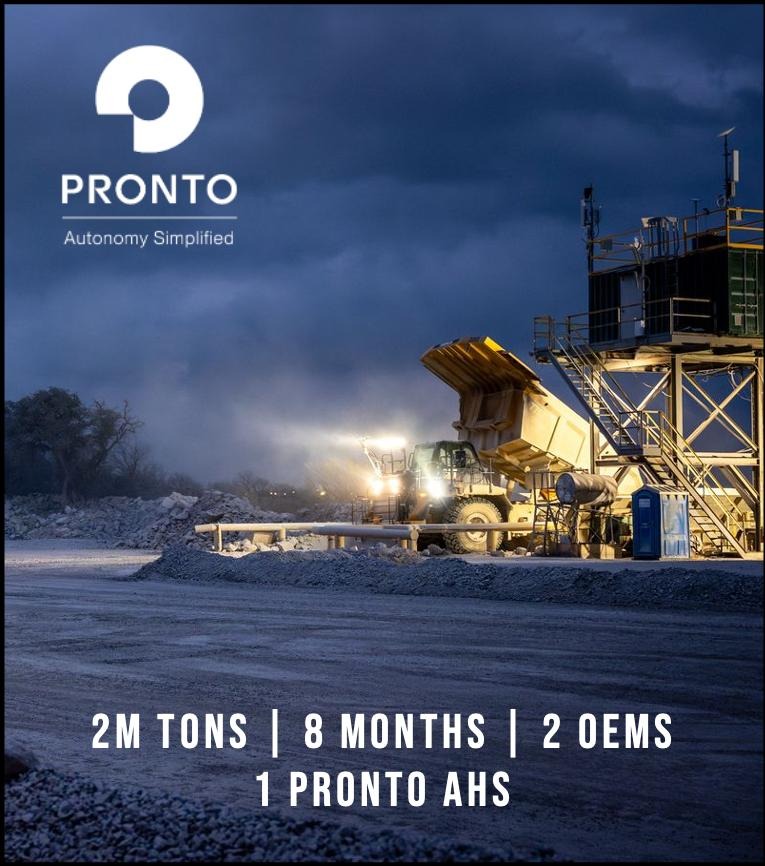
Pronto’s Lake Bridgeport milestone image. A mixed fleet, a working quarry and a rather large pile of evidence.Image: Pronto
An old connection, a new company
In April 2026, Pronto confirmed its acquisition by Atoms, the physical AI company founded by Travis Kalanick. It became the core technology engine of Atoms Mining. The deal reunited Levandowski with the former Uber chief executive in a different industrial setting. Their earlier connection had helped shape the race for autonomous vehicles; the new one put quarry and mining machinery inside a broader robotics business.
Later that month, Pronto announced plans to expand its Heidelberg deployments to Mitchell, Indiana, and the Servtex quarry in Texas during 2026. The announcement identified Levandowski as Head of Atoms Mining and Transport. Pronto’s leadership page and its July announcement also identify him as Pronto’s CEO. His work now sits within a larger organization while keeping the quarry business at its center.
In July 2026, Pronto and Hitachi Construction Machinery signed a memorandum of understanding aimed at open mine automation. The proposed collaboration emphasized working with existing equipment from different manufacturers. An agreement to cooperate leaves implementation ahead of it, but the direction fits the same customer argument: owners want options for the fleets they have already paid for.
Levandowski’s stated ambition remains broad. In 2025, he described Pronto’s vision as automating everything with wheels while pursuing profitability. That is a large destination for a company whose practical case begins with repeating a haul route. The interesting question is how many of those ordinary, paid tasks it can perform reliably. Ghostrider earned a place in a museum. The quarry trucks have a less ceremonial appointment: another load.
Keep following the wheels
- Pronto
- X / Twitter
- Personal website
- Pronto on YouTube · company channel
- 2019 interview · Electrek
- Ghostrider’s history · IEEE Spectrum
- The Smithsonian’s Ghostrider collection record
- The 2020 conviction · Department of Justice
- The presidential pardon · official document
- Pronto joins Atoms · April 2026
- Hitachi partnership · July 2026
- 2025 television interview · Fox Business