By February 2026, Lance Tucker was talking about parking-lot stripes. A year earlier, he had returned to Jack in the Box as chief financial officer. Weeks later, he was its interim chief executive. Now, with a turnaround underway, he was explaining to analysts why fresh paint, tidier landscaping and a sealed parking lot deserved attention. The numbers were smaller than a corporate acquisition. The customer would actually see them.
There is something pleasingly unglamorous about that progression. A restaurant executive can spend years moving between financial models, ownership structures and boardrooms, only to arrive at the question of whether the entrance looks inviting. Tucker’s career has covered pizza, burgers, hotels and real estate. At Jack in the Box, those experiences converged around an awkward assignment: make a familiar business simpler while asking it to perform better.
His permanent CEO tenure lasted from March 2025 to May 2026. It included the sale of Del Taco, a debt repayment and plans to close underperforming restaurants. It also ended before the company had restored same-store sales growth. That combination makes his story more useful than an uncomplicated promotion narrative. Here was a finance executive given the whole enterprise, with all the competing clocks that come with it.
A Kentucky education, followed by several kinds of business
Tucker graduated from Transylvania University in Lexington, Kentucky, in 1991. His degree was in accounting. Before the restaurant leadership jobs, he worked as a senior accountant at Ernst & Young. In 1994, he joined Papa John’s as director of finance, staying until 1999. The beginning was recognizably an accountant’s route into corporate life: learn how the numbers are assembled before taking responsibility for what they mean.
The next stretch was less linear. Between 1999 and 2003, he held finance leadership positions across businesses involved in education, technology consulting, online retail and real estate development. He then spent six years as CFO of Evergreen Real Estate in Louisville. Restaurants would become the recurring setting of his career, but he had already worked beyond them. A building, an online retailer and a pizza chain put different demands on the same dollar.
In 2009, he returned to Papa John’s. He held chief-of-staff and strategic-planning responsibilities before becoming CFO and treasurer in 2011, later adding chief administrative officer. By the time Jack in the Box recruited him in 2018, his remit included finance, accounting, legal, human resources, investor relations, planning and risk management. The title contained “financial”; the work had spread across much of the organization.
Transylvania also remained part of the family story. His wife, Jill, graduated in 1990. Their daughter attended the same university after her parents encouraged a campus visit. In its summer 2024 giving recognition, the university listed Jill and Lance together in the President’s Circle. Across changing employers, that connection to a small Kentucky campus persisted.
The second return came with a different job
Tucker first joined Jack in the Box as executive vice president and CFO in March 2018. That stint ran into 2020. When the company later recruited him back, it credited him with helping implement its securitization, a financing structure that became a significant part of the company’s capital arrangements. He would return with experience of the machinery behind the balance sheet.
Between those appointments, he became CFO of CKE Restaurants, parent of Carl’s Jr. and Hardee’s, and then CFO of Davidson Hospitality Group in 2022. At Davidson, his assignment included budgeting, cost management, analytical tools and work with board committees. The setting expanded to hotels and resorts as well as restaurants. He reported to CEO and president Thom Geshay, carrying a restaurant finance background into hospitality management.
Jack in the Box announced his return in November 2024, with a January 13, 2025 start date. Tucker emphasized working more closely with franchisees and listening to their particular challenges. That mattered in a business where the corporate office and the restaurant operator share a brand while carrying different responsibilities. A financial plan has to make sense on both sides of that relationship.
Then the timetable changed. Following Darin Harris’s resignation, Tucker became interim principal executive officer effective February 24. On March 31, the board made him permanent CEO and a director. A return to a familiar finance job had become responsibility for the entire company in less than three months. Dawn Hooper continued as interim principal financial officer; the two jobs had already separated.
A smaller company was part of the plan
The board’s choice put financial experience near the center of the assignment. Tucker’s initial priorities included capital allocation, faster free cash flow and a return to an asset-light model. In ordinary language, that meant reconsidering where the company kept its money, which assets it needed to own and how much complexity the business could afford. The plan soon acquired a name: JACK on Track.
Announced on April 23, 2025, it combined selected property sales, an end to the dividend and a program targeting 150 to 200 underperforming restaurant closures. It also opened a review of alternatives for Del Taco, including a sale. These were planned actions, with closures spread over time, rather than a single afternoon of locked doors. The scale was substantial enough to make the direction unmistakable.
Shrinking a restaurant system is a peculiar way to prepare for growth. The argument depends on the economics of the restaurants that remain: fewer weak locations, less capital tied up and a clearer operating focus. Yet closures also involve franchise agreements, leases and local trade. A corporate target can be expressed in one line. Carrying it out requires separate decisions about individual places.
Tucker also made a consequential appointment in finance. In May 2025, Jack in the Box named Hooper permanent CFO after 25 years with the company. He described her institutional knowledge and recalled their earlier work together during his first CFO tenure. Bringing a returning executive into the CEO role did not eliminate the value of someone who had stayed. Their partnership joined familiarity regained with familiarity maintained.
The sale, the repayment and the cost of simplicity
In October 2025, Jack in the Box agreed to sell Del Taco to Yadav Enterprises for $115 million in cash, subject to adjustments. The announcement translated the turnaround’s language into a specific transaction. A company that had been managing two restaurant brands would focus on one. The expected use of net cash proceeds was debt repayment, making the connection between selling a business and changing the balance sheet explicit.
The sale closed on December 22. The reported consideration was approximately $119 million, subject to post-closing adjustments: roughly $109 million in cash and a $10 million short-term promissory note. Those figures describe the closing terms; they should not be confused with the earlier agreement’s headline price. Even a strategy built around simplicity has footnotes. Accounting is remarkably good at keeping them employed.
On January 9, 2026, Jack in the Box announced that it had repaid $105 million of an existing series of senior secured notes. Tucker presented the repayment as progress toward a stronger balance sheet, alongside continued investment in the business. The announcement supplied a measurable result for the financial side of his plan. Money had moved, an obligation had fallen and the company’s scope had narrowed.
December 2025
January 2026
The parking lot gets a hearing
The operational side produced a different kind of detail. On the February 2026 earnings call, Tucker described a modest refresh ahead of a larger restaurant reimage program. Paint, parking-lot sealing and striping, landscaping and the drive path were all on the list. He put the cost below $20,000 and suggested franchisees could often do it for less than $10,000. The proposal was deliberately cosmetic and economical.
An analyst asked whether corporate assistance would accompany the eventual wider reimage effort. Tucker answered emphatically, then caught the possible misunderstanding. “100%, there will be assistance from corporate. Corporate will not pay for it 100%.” It was a small, revealing moment of verbal bookkeeping. Enthusiasm had briefly outrun the conditions, and the former CFO brought the sentence back within budget.
The exchange offers a glimpse of his public manner without requiring a grand theory of his personality. He could discuss inexpensive fixes, acknowledge franchisees’ ability to get work done cheaply and correct himself with a joke at his own expense. It also showed what the job demanded: switch from the financing of a restaurant system to the paint on one restaurant, then explain who might pay.
“100%, there will be assistance from corporate. Corporate will not pay for it 100%.”Lance Tucker · February 2026 earnings call
The plan continued after its author left
The commercial results remained difficult. In the second quarter of fiscal 2026, Jack in the Box’s same-store sales fell 3.8%, driven primarily by fewer transactions, partly offset by higher prices. Company-owned restaurant-level margin was 16.4%, down from 19.6% a year earlier. Reducing debt and selling assets could address one set of problems while the restaurant business continued to face another.
Tucker ceased serving as CEO effective May 8, 2026. On May 13, the company announced Mark King as executive chairman and interim CEO. King said the company would accelerate JACK on Track, crediting Tucker with establishing a clearer path toward a simpler business. Tucker resigned from the board effective May 27 in connection with his separation and consulting arrangements. His executive tenure had ended; the strategy remained in use.
There was also one brief appearance far from an earnings call: a ceremonial Padres pitch in September 2025.
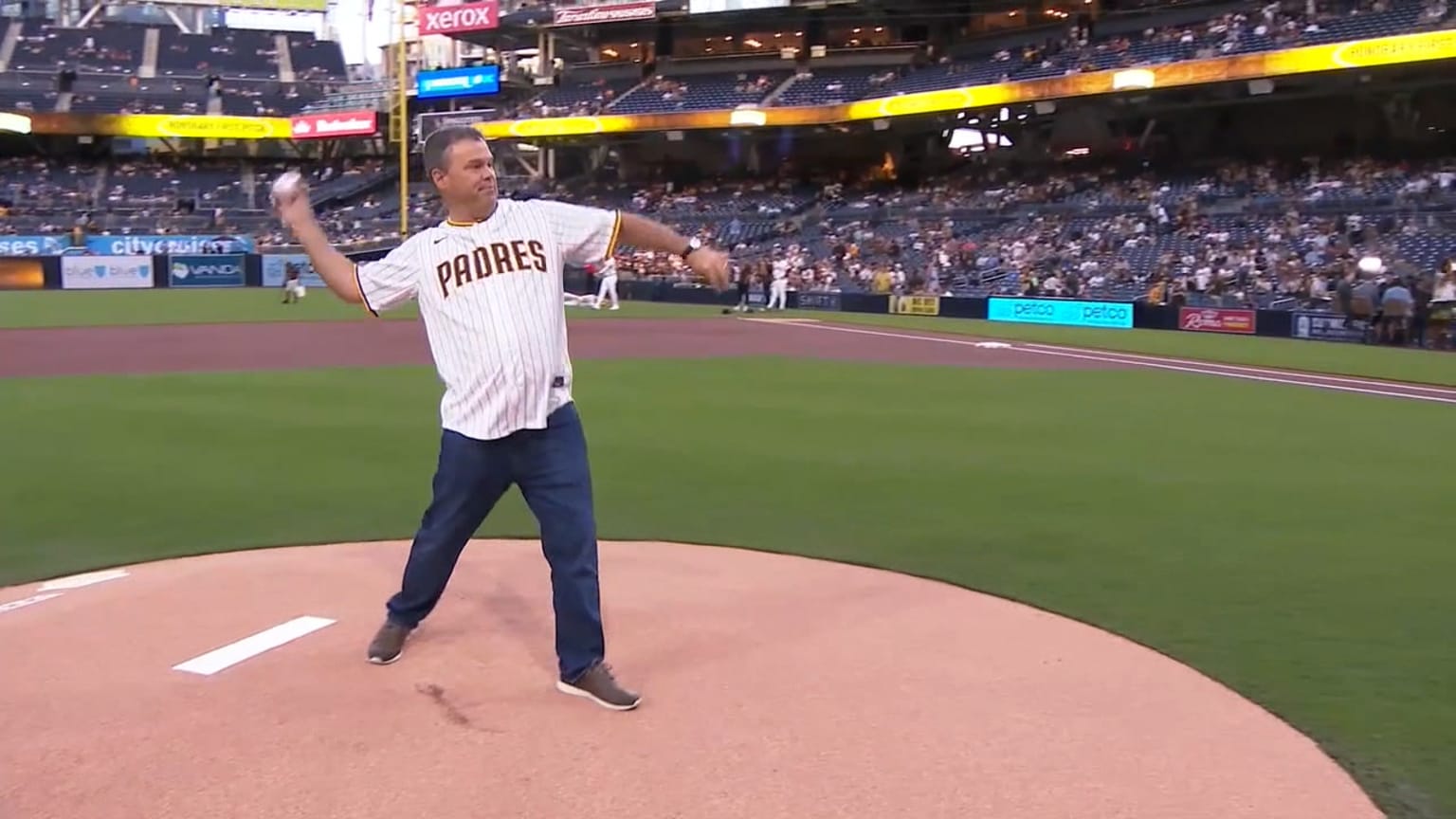
The record leaves a mixed, concrete account of his time in charge. He moved from finance to the chief executive’s office, oversaw a brand divestiture and a debt repayment, and argued for practical improvements that a guest could notice from a car. Sales were still declining when he left. His successor inherited both the unresolved operating challenge and the plan intended to address it.
Tucker’s route through these businesses helps explain the recurring concern with what a company owns, what it owes and what it can afford to improve next. The interesting part is how ordinary the last question can become. After the transaction closes and the financing discussion ends, someone still has to look at the entrance. Sometimes the next decision begins with a can of paint.