Three weeks is a sensible length for a temporary accounting assignment. It is long enough to learn where the files live, short enough to keep the rest of your life provisional. In 1992, Danny Prosky took one at American Health Properties in Denver. The assignment became a permanent job. The job became the beginning of a career that would eventually reach the opening bell of the New York Stock Exchange.
There is a pleasing lack of ceremony in that beginning. Prosky had studied finance at the University of Colorado and management at Boston University. His entry into property investment came through the accounts. Decades later, he described it in a sentence that required no polishing: “A three-week temp assignment turned into a permanent job.”
By July 2026, when he retired as president and chief executive of American Healthcare REIT, he had helped build investment businesses, combine portfolios and take a company onto a national exchange. He remained a director and adviser to management. Between the temporary desk and the board seat sits the more interesting part: years spent learning what buildings earn, what they cost and how to put them together.
The accountant learns the buildings
From 1992 to 1999, Prosky worked in financial operations at American Health Properties. HCP acquired the company in 1999, and his responsibilities moved through asset management into acquisitions and dispositions. These are adjacent jobs with different questions. Financial operations tracks the numbers. Asset management asks how a property performs. Acquisitions asks whether the next property belongs in the portfolio at all.
The sequence gave his career an unusually legible progression. Before the company leadership roles came the work inside the properties and their finances. In 2006, he moved into the business that became part of Grubb & Ellis. He later oversaw more than $1.5 billion in acquisitions for its first property REIT in the sector.
In 2009, he became president and chief operating officer of the vehicle later called Griffin-American Healthcare REIT II. It merged with NorthStar Realty Finance in December 2014 in a transaction valued at approximately $4 billion. A portfolio assembled through individual purchases had become something another company wanted to acquire as a whole.
That was central to the proposition he described at American Healthcare Investors, the investment manager he co-founded with Jeff Hanson and Mathieu Streiff in 2011: “Build portfolios with a value greater than the sum of the individual assets.” A building had its own accounts and obligations. The portfolio also needed a purpose.
“Build portfolios with a value greater than the sum of the individual assets.”
Danny Prosky, 2017
He also spent periods carrying the interim chief financial officer title at the predecessor REITs in 2015 and 2016. The earlier accounting work had an echo in his executive responsibilities. Across the different entities, his record includes financial oversight as well as operating leadership, a combination that becomes easier to follow once the company names are set beside the dates.
The three founders’ working history preceded AHI. Their connection continued through the Griffin-American businesses and into American Healthcare REIT. Following Prosky’s career means keeping those collaborators in view. Corporate names change rather more easily than the people who know how the machinery works.
Three businesses become one
In October 2021, two of those businesses, Griffin-American Healthcare REIT III and Griffin-American Healthcare REIT IV, combined. The transaction also brought American Healthcare Investors into the resulting company. American Healthcare REIT emerged with approximately $4.2 billion in assets measured by gross investment value. Prosky became its CEO and a director.
The third piece of the transaction mattered. Acquiring an investment manager changes who employs the people doing the buying, accounting and portfolio management. More than 100 AHI employees, including the three founders, joined the combined company. The business became self-managed, bringing those functions inside the same organization as the assets.
REIT III+Griffin-American
REIT IV+American Healthcare
Investors
The announced structure connected acquisitions, asset management, finance, accounting and tax. It also established a business intended to pursue a future stock-exchange listing. The merger announcement in June 2021 had already described that ambition. Becoming a combined company and becoming a listed company would be separate jobs, with separate deadlines.
For Prosky, the CEO title therefore arrived at a particular point in the construction. There was an existing portfolio, an experienced management group and a route toward public markets. His task was to lead that assembled business into its next form. The corporate diagram looked tidy; completing the next step would take longer than drawing it.
What the bell could not tell you
AHR filed for an initial public offering in September 2022. Difficult financial-market conditions slowed the process. It began trading on the New York Stock Exchange on February 7, 2024. The offering closed two days later. Including the underwriters’ option, it involved 64.4 million shares at $12 each, producing $772.8 million in gross proceeds.
The listing also created a route to liquidity for existing shareholders. For a business assembled from non-traded REITs, that was a distinct part of the proposition. Raising new money and giving existing investors an exchange on which to trade their shares were connected benefits, serving different needs.
Those details give the listing some useful texture. The trading debut, the closing date and the final proceeds describe different parts of one transaction. A photograph can compress them into a single triumphant morning. A company still has to account for each of them separately.
In its first-quarter 2024 results, AHR reported paying down approximately $721.5 million of outstanding debt obligations carrying a weighted average interest rate of about 7.5%. The offering gave the company room to reduce borrowing and improve financial flexibility. Here was a consequence of the listing that could be measured without reference to the ceremony.
Two different measures: capital raised and debt repaid. Gross proceeds precede offering expenses.
Prosky’s public conversations that summer returned to performance inside the existing portfolio. At the June 2024 investor conference in New York, he discussed same-store growth and the balance between demand and available property supply. “Same-store” is a useful discipline: it asks how a comparable set of properties performs, so buying more buildings cannot supply the whole explanation.
That distinction suited the business AHR had become. Access to capital could support acquisitions. Existing properties still had to produce results. Investors wanted to understand whether the operating improvement could continue. The questions were less photogenic than a stock-exchange bell and considerably harder to dismiss.
The other 24 percent
In September 2024, AHR completed another consequential piece of assembly. It acquired its joint-venture partner’s remaining 24% interest in Trilogy REIT Holdings. The approximately $258 million cash purchase made AHR the sole owner of Trilogy Holdings. The price included a $247 million base amount and roughly $11 million in distributions owed to the partner through closing.
The acquisition used proceeds from a separate equity offering that closed on September 20. Remaining net proceeds went toward repaying approximately $194 million outstanding on credit lines. Ownership and funding moved together: AHR bought the remaining interest while also reducing existing borrowing.
The remaining 24% cost approximately $258 million in cash.
The transaction offers a compact view of the work surrounding a large property investment. There is the asset, the partner’s interest, the distribution calculation, the equity raised and the debt remaining afterward. Each has its own arithmetic. The purchase price is only the number most likely to fit in a headline.
By late 2025, Prosky was describing regional operating relationships as a central part of AHR’s acquisition process. Operating partners could be identified before properties were pursued. Their local knowledge helped with finding opportunities and evaluating them. The sequence put a practical question ahead of the deal: who would run the properties?
In that interview, published in January 2026, he expected more competition for senior housing assets and more properties to become available. These were expectations expressed at the time. They show what he was weighing as an executive: the available capital, the opportunity set and the people needed to turn ownership into operating performance.
A passport, an award and a different seat
There was a life outside those calculations. Prosky and his wife, Zoe, enjoyed international travel. In February 2025, a possible trip to Australia with their three adult children was on the horizon. The long effort to get AHR listed had left limited time for extended escapes. Even an itinerary, apparently, had to wait for the capital markets.
That month, he received Healthcare Real Estate Insights’ 2024 Executive of the Year recognition. It followed an earlier industry acknowledgment in October 2013, when Real Estate Forum included him among 16 pioneers in the field. The two awards frame different stages: an investment business taking shape, then a company completing its first year on the exchange.
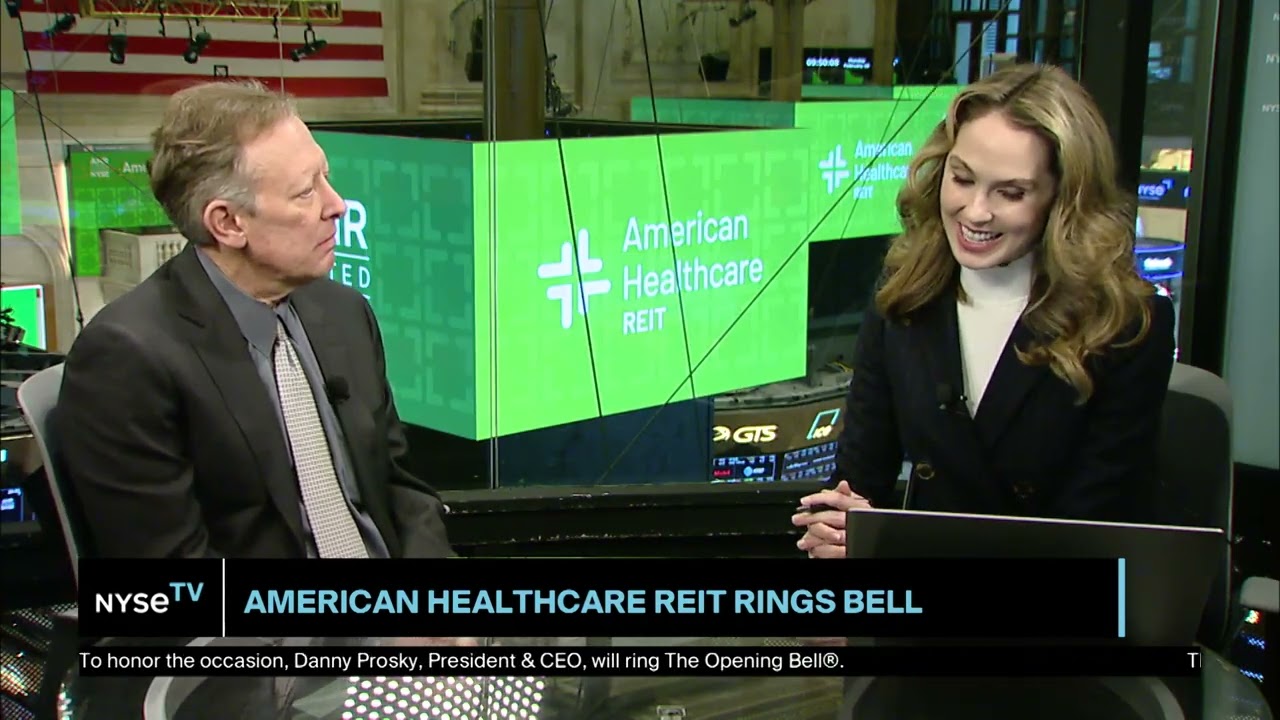
AHR marked that listing anniversary with an opening-bell visit on February 10, 2025. A year earlier, its ticker had been new. Now there was a year of public-company decisions to discuss: capital raised, borrowing reduced and ownership consolidated. The milestone belonged to a team whose work stretched well before the first trade.
Effective July 21, 2026, Prosky retired as president and CEO. Hanson became CEO, continuing as chairman; Gabe Willhite became president alongside his COO responsibilities. Prosky stayed on the board and became an adviser to management. The executive handover kept the founding relationships inside the business while changing who handled its daily leadership.
His career can be read as a succession of expanding responsibilities, beginning with accounts and ending with oversight of the company itself. The temporary assignment supplied the first opening. What followed required years of work, colleagues who kept working together and transactions that changed the shape of their business. Three weeks proved a remarkably poor estimate of the time involved.