David R. Emery had to wait twenty years to ring the bell. When Healthcare Realty went public on May 27, 1993, three other companies also joined the New York Stock Exchange. Another newcomer had already secured the opening ceremony. Emery and his colleagues would have to enjoy becoming a public company without the soundtrack.
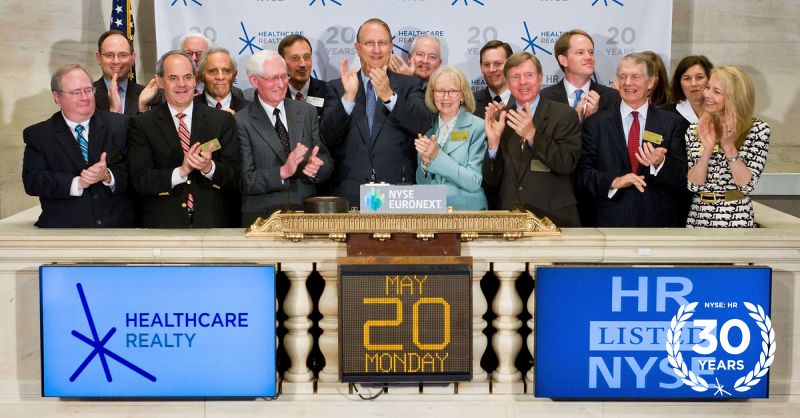
On May 20, 2013, they returned. There was breakfast in the exchange’s boardroom, a certificate, commemorative medallions, and a tour. At 9:30, Emery rang the opening bell. In the photograph, the balcony is crowded with colleagues applauding. A company anniversary had become an outing for the people who helped make it possible.
The twenty-year interval suits a career whose interesting parts often happened between the ceremonial dates. Emery founded Healthcare Realty in 1992 and remained its chief executive until 2016. Before that, he developed commercial property in Nashville. Alongside it, he found time for sailing and for building projects in Maine. The recurring attraction was work with something tangible at the other end.
A developer before there was a ticker symbol
His early working life began with land. After graduating from Tennessee Technological University in 1967, Emery joined Nashville’s R.A. McDowell, buying and selling parcels along interstate highways. In 1973 he began the high-rise Rokeby Apartments on West End Avenue. More office projects followed along the same corridor. His business education acquired a skyline.
Downtown brought a different sort of negotiation. Third National Bank wanted a Church Street parcel he owned for its headquarters project. Emery resisted an attempt to condemn the property. Nashville’s newspapers took opposing positions, and the dispute reached the Metro Council. On February 15, 1983, the condemnation proposal lost, with 17 votes in favor and 21 against.
Five years later, he completed Nashville City Center, a 27-story office tower at Sixth Avenue and Union Street. The sequence matters: an argument over a parcel did not end his involvement downtown. He continued developing there. His career already contained both the patience to assemble a project and the willingness to contest someone else’s plans for his property.
The proposed condemnation of Emery’s Church Street property was defeated.
Twenty-one properties, then an operating company
Healthcare Realty gave him a different organizational instrument. The 1993 public offering raised $117 million for an initial portfolio of 21 properties. A real estate investment trust, or REIT, brings property ownership into a publicly traded company. For a developer accustomed to individual sites, that meant a platform able to hold and expand a portfolio over time.
The company changed as it grew. In 1995, it acquired a small development and management business, adding capabilities in leasing, property management, and development. A 1998 acquisition more than doubled its size. In 2007, it sold a senior-living portfolio for about $400 million and returned its attention primarily to office and outpatient properties. Those were decisions about the kind of real estate business it wanted to operate.
Ownership and operation ask different questions. A property owner can examine a rent roll; an operator must also handle the building that produces it. Development adds another set of decisions before the first tenant moves in. Healthcare Realty’s evolution brought these activities together. Emery’s earlier experience with construction and commercial property had an organizational home inside the listed company.
By the end of 2015, the company reported approximately $3.4 billion invested in 198 properties, construction in progress, development land, and corporate property. Those figures describe a particular accounting snapshot. They should be read on their own terms, rather than confused with a company’s stock-market value or the later value assigned to its properties.
In October 2019, Healthcare Realty described a business with 282 employees and 200 properties valued at more than $5.7 billion. The distance from the initial offering was measurable in buildings, but also in people doing the daily work. Emery had helped turn a portfolio into a company that acquired, developed, owned, and operated its real estate.
The development work remained part of the company’s thinking long afterward. In a later interview, general counsel John Bryant connected Emery’s background in apartments and offices with Healthcare Realty’s approach to building. Newly developed properties gave the team direct knowledge of construction and tenants. That observation helps explain why an experienced developer would want a company capable of doing more than buying completed buildings. Knowing a property from its beginning changes the questions an owner can answer about it. The practical knowledge accumulated on a construction project can remain useful throughout the years that follow.
The quotation on the desk
A smaller detail helps explain how colleagues experienced that company. In a 2014 interview, general counsel John Bryant recalled a quotation on Emery’s desk: “Bureaucracy is the death of any achievement.” Bryant described it as an Einstein quotation. Whether dealing with reporting requirements or a complicated transaction, the lawyer was plainly aware of his chief executive’s preferred direction of travel.
A public company has ample opportunities to manufacture paperwork. Bryant’s recollection makes the quotation more interesting than a decorative office motto: he connected it with the practical difficulty of keeping bureaucracy from accumulating. The desk belonged to a founder who had taken a business public, while the words on it warned against one of organizational life’s most reliable by-products.
“Bureaucracy is the death of any achievement.”
A quotation John Bryant recalled on Emery’s desk
Years afterward, Bryant still credited Emery with creating a collegial, non-bureaucratic culture. That is a colleague’s assessment, and a specific one. It describes how work was meant to feel inside the organization. Buildings can be photographed and counted. The ability of people to work together with relatively little ceremony is harder to put in an annual report, although people certainly notice when it disappears.
There was a practical test of continuity in 2016. Emery’s successor, Todd Meredith, had joined Healthcare Realty in 2001, led development activities, and later served as executive vice president for investments. The next chief executive already knew the business from within. Emery’s choice gave the transition a history before it had an effective date.
Leaving the chief executive’s chair
The succession was announced in February 2016 and took effect on December 30. Emery became executive chairman; Meredith became president and chief executive. The arrangement established a continuing role for the founder while giving someone else responsibility for leading the company. An announced handover also gave employees and investors time to understand what would happen.
Meredith described the direction as a continuation of what had begun more than two decades earlier. That observation gives the transition its scale. He was inheriting decisions, habits, relationships, and a way of evaluating properties. The founder’s job had included developing a business that another person could understand well enough to lead.
In September 2019, the board elected J. Knox Singleton as independent chairman. Singleton was a longstanding director who had served as lead independent director. The company’s leadership had moved beyond the founder while retaining people who knew its history.
Emery died on September 30, 2019, aged 75. He had served as chairman from the company’s founding until shortly before his death and held the title chairman emeritus. In December that year, the HREI Insights Awards recognized him with a Lifetime Achievement Award. The recognition followed a career that had begun long before Healthcare Realty’s first stock traded.
Maine was another place to make things
For Emery and his wife, Glenda, Maine became a recurring destination and a summer home. They built a cottage on Spruce Point in Boothbay Harbor. In 2010, he acquired majority ownership of the Spruce Point Inn & Resort and worked on its renovation and marketing. He also used his photography in improving the resort’s website. A familiar vacation place had acquired a project list.
He taught himself to sail, belonged to the Boothbay Harbor Yacht Club, and supported its youth sailing program. Boats offered another setting in which preparation and attention had immediate consequences. There is a pleasing consistency between a developer interested in how a building works and a sailor responsible for bringing a boat into a slip.
At Coastal Maine Botanical Gardens, Emery served on the board and as its chairman. He helped lead the design and construction of the visitor center that opened in 2018, along with planning and fundraising for a conservatory. The work gave his experience a public setting: the entrance to a garden, where the building’s purpose was to welcome people toward something beyond itself.
He also took a public role when the gardens’ construction drew scrutiny. In a July 2017 letter written for its building committee, Emery defended the project’s erosion controls, described corrective work, and emphasized environmental stewardship. His account was a participant’s defense of the project. It shows him engaged with the less picturesque responsibilities that accompany construction, even at a botanical garden.
What remains close at hand
The NYSE photograph catches a moment designed to be remembered. Yet it also gives a useful view of Emery’s career: he is among other people, celebrating an enterprise already twenty years into public-company life. The opening bell had waited. The buildings and the daily business had gone on without it.
Look across the Nashville developments, the company handover, the Maine inn, and the garden visitor center, and the common element is participation. Emery kept finding projects that called for his involvement. A tower, a portfolio, a boat, a garden entrance: each asked for a different collection of decisions. His life left plenty of places where those decisions can still be seen.
Follow the work
Explore the company, the places, and the recollections connected with Emery’s career.