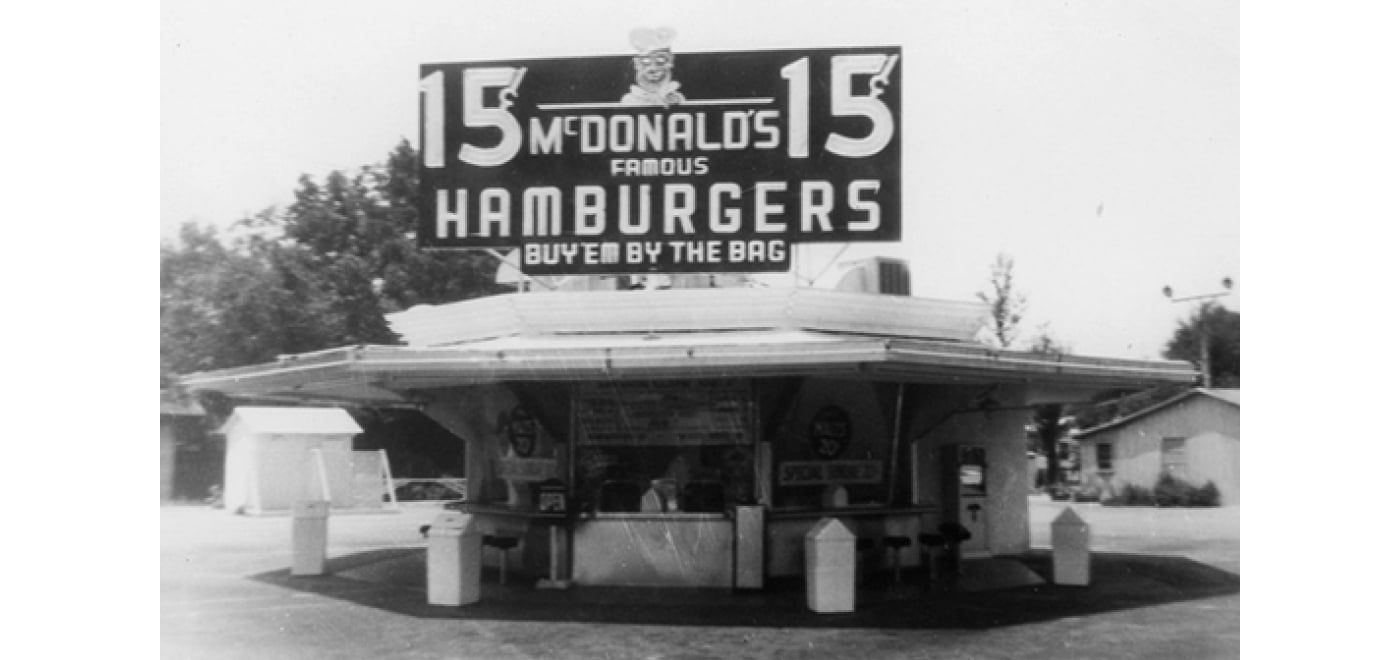
In 1948, Richard and Maurice McDonald made their restaurant less accommodating. They stripped the menu down and introduced the Speedee Service System. A hamburger cost fifteen cents. There was less to choose from, and less work standing between a hungry person and a paper bag. The interesting invention was the arrangement: a kitchen organized to repeat a small number of tasks, quickly.
- Repeatable work made a small California restaurant exportable.
- Franchisees run roughly 95% of the restaurants; corporate revenue measures only part of the system.
- Cheap, quick and familiar still has to feel cheap, quick and familiar.
Fifteen cents, fewer decisions
The brothers had opened their San Bernardino restaurant in 1940. Their later simplification supplied something more useful than another place to eat: a predictable transaction. For a parent between errands, a commuter before work or someone arriving in an unfamiliar town, predictability has a practical value. You can spend your attention on the rest of the day.
Ray Kroc, a milkshake-machine salesman, visited in 1954 and became their franchise agent. In April 1955, he opened a restaurant in Des Plaines, Illinois, for the corporate predecessor. In 1961, McDonald’s acquired the rights to the brothers’ company for $2.7 million. The distinction matters. The brothers devised the restaurant; Kroc helped build the machinery for multiplying it.
The restaurant belongs to somebody else
At the end of 2025, McDonald’s had 45,356 restaurants. Approximately 95% were franchised. That makes the familiar counter a meeting point between two businesses: a local operator serving meals and a corporation supplying a brand, standards and an economic arrangement.
Under conventional franchising, McDonald’s generally owns or leases the site; the franchisee invests in equipment and runs the restaurant. Rent and royalties flow back to the corporation. Developmental licensees shoulder more of the capital investment. This is expertise in property, purchasing, training and coordination, as well as food.
restaurants, approximately,
were franchised in 2025.
The accounting reveals the arrangement. In 2025, restaurants across the system sold more than $139 billion. Corporate revenue was $26.885 billion. The first number includes franchisees’ customer sales. The second includes rents, royalties and company-operated sales, among other revenue. They measure different things. Treating them as interchangeable hides the people who pay the wages, maintain the equipment and make the lunch rush work.
Buying into this arrangement takes money and work. Current U.S. guidance typically requires candidates to have at least $750,000 in qualifying non-borrowed personal funds, with additional recommendations for working capital and relocation. That threshold is not a restaurant’s total purchase price. A recognizable sign does not turn an operating business into a savings account.
The Big Mac came from downstairs
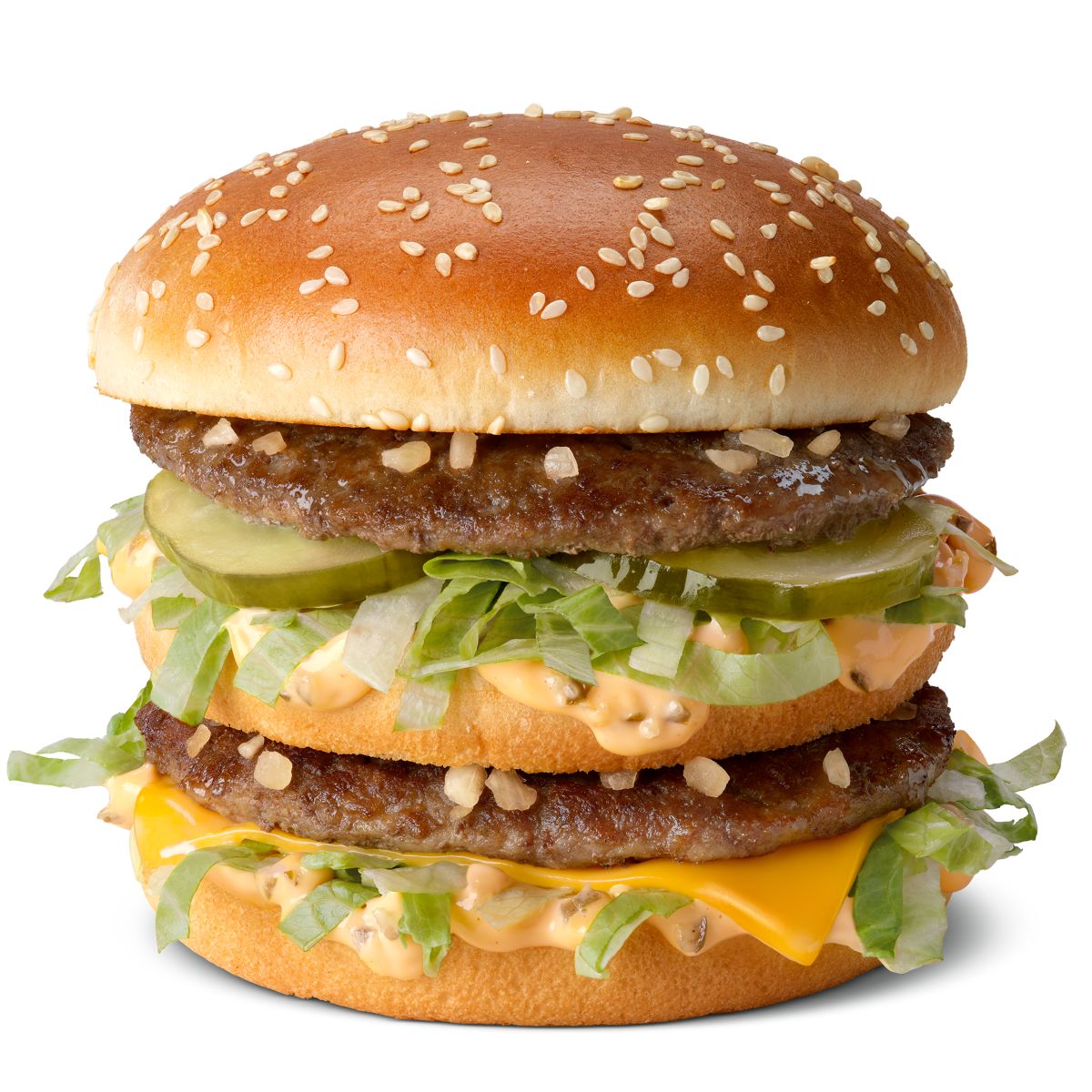
A system built around consistency can sound inhospitable to invention. Yet the Big Mac began with Jim Delligatti, a franchisee who introduced it in Uniontown, Pennsylvania, in 1967. The company took it nationwide in 1968. A local operator supplied an idea that the network could reproduce.
Today, the menu stretches from burgers and fries to chicken sandwiches, McNuggets, breakfast, Happy Meals and McCafé drinks. The operational problem stays recognizable: provide enough choice to win an occasion without making preparation unmanageable. Breakfast competes for a different moment from an afternoon coffee. Both must fit through the same business.
Burger King and Wendy’s offer alternatives in burgers. Chicken chains compete for another set of cravings. Convenience stores and a sandwich made at home compete for the same wallet. McDonald’s advantage is the combination of familiar products, locations, purchasing scale and repeatable service. Each part has to help the others.
When familiar stops feeling cheap
Price can interrupt that combination. McDonald’s introduced its U.S. McValue platform in January 2025, joining national promotions with local and app offers. By the second quarter of 2026, U.S. comparable sales grew just 0.8%. Management acknowledged execution problems and a reduction in digital offers that had discouraged purchases.
“We simply didn’t execute at the level we needed to in the second quarter.”Chris Kempczinski · August 2026
This is the awkward feature of familiarity: customers remember what a meal used to cost. A brand can retain recognition while losing the argument at the counter. The practical lesson is to measure what people actually buy after a price or promotion changes. A reassuring brand tracker cannot pay a restaurant’s bills.
The app gives McDonald’s another way to make that argument. At June 2026, it reported nearly 220 million 90-day active loyalty users across 70 markets. Customers can order ahead and use available rewards; delivery partners bring meals to participating addresses. Check the final price. Delivery prices and fees can differ from restaurant prices, and offers carry conditions.
An $8.5 billion bet on the next lunch
Technology has to pass the same practical test. McDonald’s ended its IBM automated drive-thru ordering pilot in 2024 after testing it at more than 100 restaurants, while continuing to consider voice ordering. The lesson for other operators is to keep a pilot small enough to stop. An experiment earns expansion through performance.
In September 2026, McDonald’s outlined approximately $8.5 billion in NEXT partnering support through 2036, combining rent relief and capital support for modernization. This is planned support, not money already spent. The company estimates roughly four-year franchisee payback after that support. Estimates still need a working kitchen to become cash.
What can another business copy? Simplify recurring work, test improvements locally and make the economics worthwhile for the person delivering the service. The approach needs sufficient repeat demand and disciplined execution. It becomes harder when customers want extensive customization, operators cannot fund upgrades, or prices outrun perceived value. McDonald’s next chapter turns on a familiar question: when lunch arrives, did the system make somebody’s day easier?