In the public credits for GPT-4, Kyle Kosic appears beside a phrase that sounds more like a maintenance log than a headline: “uptime and stability lead.” The model’s launch offered a new way to talk to a computer. Kosic’s job was tied to a much older demand. The machines had to keep working long enough for the model to be trained. Of all the descriptions attached to people building modern AI, few are as plain, and few explain so much.
A training run is a long chain of coordinated work. Software, hardware, data, and networks must keep pace with one another. A single person does not hold such a system together alone; OpenAI’s published GPT-4 contributions name a large team. But the company was precise about Kosic’s part. Alongside the uptime and stability credit, it listed him among contributors to distributed training infrastructure and hardware correctness. The language is technical. The stakes are easy to understand. A run interrupted at the wrong moment costs time, compute, and the attention of everyone waiting on it.
This is the thread that makes Kosic’s career legible. His name has appeared at OpenAI, on xAI’s original team roster, in reports about Jeff Bezos’s Project Prometheus, and most recently beside River AI. The names and ambitions around him changed. His visible specialty kept returning to the machinery that makes an AI project possible. He has moved among the industry’s famous logos while doing work that usually happens out of the frame.
Start with the unglamorous verb
The verb is run. Not “imagine,” “disrupt,” or “transform.” Just run. Kosic’s public GitHub profile describes his interest as building distributed systems for AI in Rust. Its repositories turn that sentence into smaller, more tangible examples. One demonstrates how to serve a trained TensorFlow model through Actix Web. Another shows a similar path for PyTorch. There is a command line tool for managing remote development instances, and an older project applying WaveNet to intraday Bitcoin forecasting. These are public experiments and examples, not a map of every system he has built. Still, they show an engineer looking at the distance between a model on disk and a service another person can use.
Serving a model is an ordinary phrase for a demanding handoff. Code written for training needs an interface. Requests arrive when they arrive, not when the engineer has a quiet hour. The service needs to respond, recover, and make failures visible. A repository example can be small; the questions it raises are not. What happens under load? Which layer owns an error? How quickly can the system be repaired? Those concerns recur at a much larger scale in a frontier lab, where the model itself may depend on thousands of coordinated machines.
Kosic’s path to those labs included work as a quantitative analyst at Lucena Research and as a software engineer at OnScale, a company known for cloud engineering simulation. His LinkedIn profile lists a Georgia Institute of Technology master’s degree in computer science with a machine learning specialization, completed in 2018-2019. Those facts make a coherent professional background: numerical work, software systems, and machine learning. They do not describe a childhood calling or a cinematic moment of revelation. The public record is more useful without one.
“Building distributed systems for AI in Rust”Kosic’s public GitHub description
A credit with unusually sharp edges
OpenAI’s GPT-4 contributions page is unusually detailed about technical labor. It names leads for throughput, software correctness, hardware correctness, model distribution, and the execution of pretraining. Kosic is named as the lead for uptime and stability. He is also included in the groups for distributed training infrastructure, hardware correctness, and “training run babysitting,” the team’s disarmingly domestic name for watching a very expensive process behave itself.
Those credits should be read carefully. They do not say Kosic designed GPT-4’s architecture, invented its capabilities, or acted alone. They say he was responsible for an essential condition of the work: continuity. A model that cannot complete its training run remains a plan. A run that finishes only through constant rescue consumes people as well as machines. Reliability is not a supporting character in that story. It is part of the plot, even if the final product rarely displays its name.
OpenAI also included Kosic among the contributors to its original ChatGPT announcement. Public credits are narrow windows, and they offer no diary of what his days looked like. They do, however, identify the sort of work a lab considered important enough to record. At a moment when discussions of AI often shrink to model scores and product screens, “uptime and stability” is a useful corrective. The conversation window is the last visible inch of a much longer system.
Twelve names and a new company
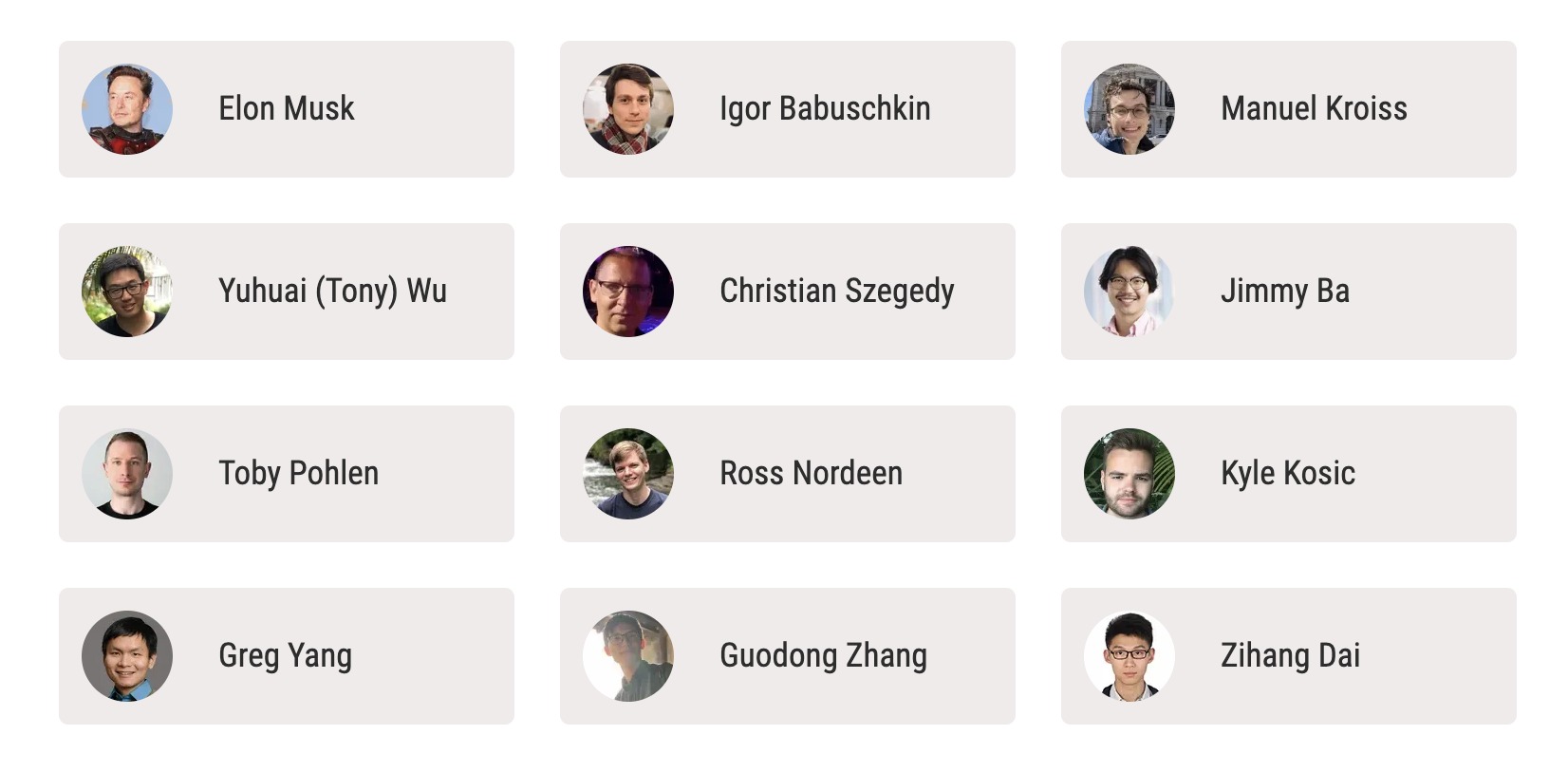
In July 2023, xAI announced its founding team. Kosic was one of the twelve names on its early roster, including Elon Musk. He had joined in May after roughly two years at OpenAI. The move gave him a place at a young lab intent on building its own large models and the infrastructure beneath them. Contemporary reporting described him in xAI materials as a full stack reliability engineer and data scientist whose work concerned automation, scalability, and distributed computing. Later reporting described him as leading infrastructure there.
The roster image is an artifact of the moment. Its faces are arranged in neat rows, as though a company can be understood in one glance. It cannot. Researchers, engineers, data centers, budgets, and the patience to debug all sit behind the image. Kosic’s position within that group is interesting because it places a reliability specialist near the start, before xAI had the years of organizational habit that older labs could draw on. A new company needs its basic systems built while the research program is already moving.
xAI introduced Grok in November 2023. Its original announcement described a system connected to information from X and still early in development. Kosic’s personal contribution to any single Grok feature is not publicly itemized, so the more honest account stays with what is documented: he was a founding team member, and his work was associated with infrastructure and reliability. There is enough there to see why the role mattered. New products draw attention to what they say. Engineers must also decide what keeps them available to say it.
His stay was short. Kosic left xAI in April 2024 and returned to OpenAI the following month, according to reports based on his LinkedIn profile. In the tidy version of a career, a return to a former employer looks like a backward arrow. In this one, it also shows how close and fluid the technical community around large models had become. The organizations competed, but the difficult systems problems and the people able to work on them crossed company lines.
Joined OpenAI after earlier software and quantitative roles.
Credited on GPT-4 pretraining; joined xAI’s founding team in May.
Left xAI and returned to OpenAI.
Reported at Project Prometheus in April; later announced a move to River AI.
Another turn, then a river
By April 2026, reporting placed Kosic at Project Prometheus, the AI venture associated with Jeff Bezos and Vikram Bajaj. The reported assignment was infrastructure, and the company’s broader interest lay in AI systems for engineering and the physical world. The reporting also said he had left his second stint at OpenAI the previous November. Public accounts did not specify his exact title at Prometheus. The details that do appear fit the existing pattern: the work of making ambitious systems function at scale was again the reason his name surfaced.
Then came a more personal statement. Later in 2026, Kosic said on X that he had joined River AI to work on personal AI. He wrote that as AI products become common in daily life, the technology needs to be “private & owned by the users.” That short phrase gives the career a different frame. The public milestones before it were mostly about institutional scale: the training of a major model, the founding of a new lab, the infrastructure of another venture. River’s stated aim brings the question of ownership closer to the person using the product.
River AI, founded by fellow xAI alumnus Igor Babuschkin, says it is building personal AI shaped by each individual. Kosic’s post expressed interest in products that offer alternatives to centralized control. It would be easy to turn those words into a prediction about what River will build. The company is young, and the public record does not assign Kosic a specific product or technical design there. His statement is enough to describe the direction he chose. He sees privacy and user ownership as practical requirements for AI entering ordinary life.
“private & owned by the users”Kosic on the appeal of personal AI, 2026
That ambition makes his infrastructure background newly interesting. Personal AI still needs dependable computation. It needs the model, the service around it, and a way to handle failure when a user expects an answer. The questions of who owns data and how a product behaves under pressure live in different parts of a system, yet both become real only when engineers make choices about them. Kosic’s earlier record does not guarantee River’s outcome. It explains why someone who spent years near giant training operations might care about how AI reaches one person.
The work that remains visible
There is a temptation to write any AI career as a sequence of increasingly grand company names. Kosic’s has plenty of those. But the more distinctive sequence is made of engineering nouns: uptime, stability, distributed training, hardware correctness, model serving. Each is a reminder that an AI system has to occupy the ordinary world of failed processes, finite machines, and human expectations. The model may attract the audience; the system must survive the performance.
Kosic’s public trail offers no confession about his motives for each move, and it does not need one. It offers something rarer in an industry fond of broad claims: specific credit. OpenAI named the work. His repositories show small examples of it. xAI’s first roster shows where he took it next. His own words at River show what he hopes the next chapter serves. Taken together, they form a portrait of an engineer whose best known job title sounds almost modest. Uptime is what people notice only after it is gone. For a career spent making AI run, that is precisely the point.
Follow the work
Profiles, projects and related reading