At a particle collider, the interesting thing is often a tiny irregularity buried in an ocean of routine events. Igor Babuschkin learned to look for those signals while working on the LHCb experiment at CERN. Years later, after helping build prominent projects in artificial intelligence, he found another irregularity worth examining. AI models were becoming more capable, but the people using them still had remarkably little say in how they learned. His new company, River AI, begins with that mismatch.
The question before the machines
Babuschkin studied physics at TU Dortmund University from 2010 to 2015. The work at CERN put him among researchers trying to understand the universe by measuring what happens when particles meet at extraordinary energies. Physics appealed to him for a reason that has never quite left his work: he wanted to understand the world and use what he learned to help people. His own account of the career switch is unusually clear. Around 2015 and 2016, the results coming out of DeepMind, particularly AlphaGo, persuaded him that artificial intelligence would be the most exciting place to ask big questions next.
He joined DeepMind in 2017. There he worked on generative models, text to speech research connected with WaveNet, and reinforcement learning. The last of these asks a computer to improve through feedback from its actions, a method that would recur throughout his career. The former particle physicist had traded detectors for training runs, but the appeal was familiar. He was still looking for patterns and trying to learn what complicated systems could do.
A 2019 university notice identified him as a technical lead on AlphaStar, DeepMind’s StarCraft II project. Strategy games make tidy demonstrations and unruly engineering problems. A system must make decisions while information is incomplete, time is passing and an opponent is responding. AlphaStar reached Grandmaster level. Babuschkin later said he started AlphaCode, DeepMind’s coding project, as his own idea. Coding systems eventually advanced faster than he had expected. It is a useful detail in his story: a researcher who helped set a difficult problem now says the field surprised him with the speed of its answer.
A tour of the large labs
At OpenAI, Babuschkin worked on pretraining and reasoning. In an interview with General Catalyst’s Hemant Taneja, he recalled being drawn by the lab’s approach to scaling models during the GPT-2 and GPT-3 era. He helped with large training runs and was interested in a stubborn limitation: language models were persuasive talkers before they were dependable reasoners. The path from that concern to today’s reasoning models was neither short nor guaranteed. It also left him with a conviction that no single organization should decide the terms on which everyone else uses AI.
Then came an hours-long conversation with Elon Musk about AI and what it might make possible. Babuschkin has described a shared interest in a company with a different mission, including models that might help with scientific problems. They co-founded xAI in 2023. He took on work across infrastructure, training, multimodal systems and product. On his personal site, he adds a small but memorable claim: he came up with the name Grok. It is a word for understanding deeply, an ambitious label to attach to a chatbot.
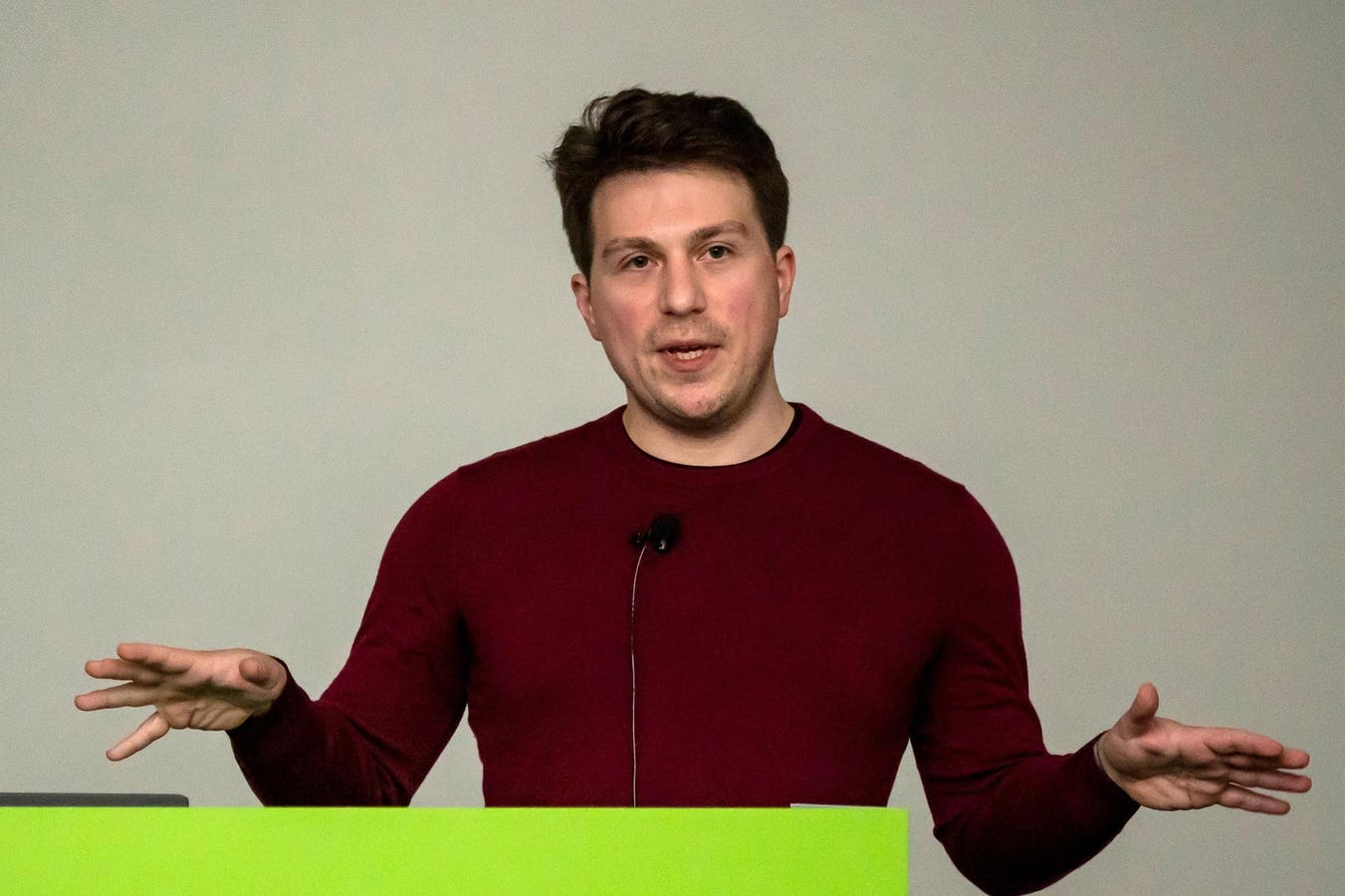
xAI’s engineering job was large in more than one sense. The company was building models and the infrastructure to train them, and Babuschkin was involved in that expansion. In a later interview, he discussed the rapid construction of the Colossus computing facility in Memphis, describing a roughly 120-day effort. A model may appear on a screen as a neat box for typing, but it rests on power, chips, networking and teams that know how to make all of those parts work together. Babuschkin’s résumé crosses both sides of that divide: research ideas and the stubborn physical business of running them.
He left xAI in August 2025. His announcement thanked Musk and described lessons in getting directly involved in technical problems and moving with urgency. He also introduced Babuschkin Ventures, an effort to support AI safety research and companies developing useful AI systems. It would have been easy to read the move as a departure from building. Within a year, he was building again.
That interval matters because his next move was more than another job at another lab. Babuschkin had seen how a handful of organizations could assemble the people, chips and capital needed to train large models. He had also watched those models become products used by people who could adjust a prompt but rarely the underlying system. His proposed answer would require some of the same large-scale engineering he knew well, aimed at distributing more of the power to adapt a model. The problem changed from how to build intelligence to who should be able to change it.
“It can’t be one large company that controls everything and decides what you’re allowed to do.”Igor Babuschkin, in conversation with Hemant Taneja
A river, and a difficult destination
River AI appeared publicly in June 2026. Its launch essay opened with a worry Babuschkin could now state from experience: if machines can perform more valuable work, what remains for people? His proposed answer is to make AI something people can shape and own. Today, a person can ask a model to change its tone or try a different method. The change usually lives in a prompt or a temporary conversation. Babuschkin wants systems that can learn from the person using them, with changes that persist in the model itself.
The first River product is more practical than that full vision. Its API lets developers train and adapt open models, including through reinforcement learning and lighter weight fine tuning. A company could use it to build a model suited to its own documents, tasks and standards. Babuschkin has been frank that the tools for a business with engineers are further along than a personal assistant for everyone. A product that quietly learns an individual’s preferences without forgetting useful knowledge remains a research ambition.
That distinction gives River its tension. The opening offer is model training as a service. The promised destination is something more intimate: an assistant that understands a person’s goals well enough to be useful over time, while remaining under that person’s control. Babuschkin has called the idea a kind of “guardian angel.” It is an image with charm and a demanding specification. The system must be capable, adaptive and trustworthy, and the person it serves must have more than the illusion of control.
River announced $1.1 billion in funding across seed and Series A rounds in August 2026. General Catalyst and AMP PBC led the round; Nvidia, AMD Ventures, Y Combinator and Temasek were among the participants. The amount gives the company room to hire, experiment and buy expensive computing time. It does not make the personal AI problem solved. River’s public changelog, updated in September, shows a more ordinary rhythm beneath the funding headline: model additions, fixes and improvements to the API. Grand visions still have release notes.
In the General Catalyst conversation, Babuschkin described two reasons to pursue open models. He sees them becoming stronger, and he believes a technology built from so much human knowledge should be broadly available. There is a commercial question inside that position: if model weights are free, what does a company sell? River’s answer is the machinery for customizing and running them. Babuschkin wants the model to be adaptable by the organization or person using it, rather than fixed by the lab that first trained it.
What he writes when he steps away
Babuschkin’s personal site shows a less corporate side of the same curiosity. He writes about physics, AI and philosophy, and says writing helps him discover what he actually believes. His reading list mixes history, fiction and ideas about how societies work. A January 2026 story, Life on Claude Nine, follows a fictional programmer who automates more and more of his life until the convenience becomes unsettling. The story is fiction, but its preoccupation is plainly adjacent to River’s pitch: when software takes more decisions, what happens to a person’s agency?
There is a wry symmetry in a former xAI chief engineer using fiction to test the questions engineering cannot settle by benchmark alone. His site also mentions hiking and looking at the night sky. The image fits the career, though it should not be turned into mythology. Babuschkin has spent years moving from one difficult technical project to another. The thread that joins them is a persistent interest in intelligence, first as something to understand and now as something people should be able to direct.
A physicist can spend years watching for a signal that may never appear. A founder has less patience available, especially with a billion dollars and a product already in public hands. River’s near-term test is whether developers can train useful models without running an entire AI lab. Its longer test is whether an assistant can learn from someone while leaving that someone in charge. Babuschkin has stood close to the construction of modern AI. The question he now asks is who gets the keys once it is built.