Kristen Cavallo had already left the advertising business when she began walking the Camino de Santiago. After three decades of strategy, pitches and leadership, she had made room for a different question: what should come next? The answer eventually took her to a Richmond museum. Then, in April 2026, it brought her back to the agency she had already joined twice.
There is something pleasingly untidy about this sequence. Corporate biographies tend to arrange a life into promotions, as though each job were a stair someone had thoughtfully installed in advance. Cavallo’s recent career has involved a departure, a pilgrimage, a museum appointment and a return. The stairs have given way to a much more interesting floor plan.
She is again CEO of MARTIN*, the Richmond agency long known as The Martin Agency. She also retains a role at the Branch Museum of Design, moving from executive director to artistic director. Advertising and exhibitions now share space in her working life. Both involve deciding what deserves attention, and how to persuade someone to stop long enough to look.
The second arrival required coffee
Her first arrival at Martin was in 1998. Her second, in December 2017, came with very little preparation time. She was working at MullenLowe when she was asked to lead an agency dealing with sexual harassment allegations and the departure of senior leadership. She became its first female CEO at a moment when employees and clients had urgent reasons to question what would happen next.
For an advertising executive, the temptation might have been to begin with a polished declaration. Cavallo made herself available. She invited employees to have coffee with her over the holiday break. People accepted. The resulting conversations became part of her education in the difference between announcing a future and helping people trust the person responsible for it.
Looking back in 2019, she described discovering that availability mattered more than she had expected. Employees were living through immediate uncertainty. A distant vision could only do so much. They needed someone who would listen, answer and remain within reach. There were clients to retain and pitches to win, but the agency’s internal relationships required attention too.
Her account is unusually practical for an industry that sells imagination. The invitation did not require a new positioning document or an elaborate launch. It required time. It also made the new CEO answerable in a setting where a title could not do all the talking. The humble coffee meeting had been promoted to serious organizational work.
“There were no heroes in this.”Kristen Cavallo, reflecting on Martin’s recovery in 2019
A strategist with a mathematical education
Cavallo’s preparation for creative leadership included a marketing degree from James Madison University and an MBA from George Mason University. For the latter, she chose a concentration in decision sciences and statistics. Having already studied business, she wanted the next degree to add something different. The choice is a useful detail in a career often described through creativity.
Statistics asks what the evidence will bear. Advertising asks what an audience will notice. A person working between those questions needs to respect the numbers without assuming that a spreadsheet supplies the idea. Cavallo’s education suggests an early interest in carrying more than one kind of tool, rather than becoming exquisitely equipped for a single problem.
Her first work included planograms for Clairol products: diagrams showing where merchandise would sit on a retail shelf. Before leading an agency, she helped arrange the conditions under which a shopper might see something. It is an unglamorous beginning, and therefore a welcome one. The shelf has very little patience for a product’s opinion of itself.
She entered Mullen as a strategic planner in 1994, moved to Arnold Worldwide the following year and joined Martin in 1998. Later came business development, a return to Mullen and leadership of its Boston office. These moves put strategy, growth and relationships into the same career. The CEO title arrived after years of work on the problems surrounding the creative work.
The decisions behind the campaign
At Martin, Cavallo and chief creative officer Karen Costello made pay equity an early priority. The agency reviewed salaries, brought in an outside firm for another analysis and made adjustments. A question that organizations can discuss indefinitely had become a matter of checking the actual arrangements and changing them.
In 2018, that concern also produced a design project. Martin created an open-format typeface with angles and spacing tied to the then-reported gender pay gap. It translated an economic disparity into the shape of letters. The timing matters: the public statement accompanied work on the agency’s own pay practices. Typography could carry the message; payroll had to carry the decision.
The same interest in who participates extended to production. Martin’s 50/50 Initiative, announced in October 2022, committed to hiring at least half of its creative talent for video production from underrepresented groups. By the first half of 2023, the agency reported a figure of 75.5 percent. Those figures describe a particular period and program, rather than a promise about every future campaign.
There is an editorial question underneath the hiring question. People writing, directing and designing an advertisement make decisions about what feels ordinary, funny, desirable or possible. Changing who gets those opportunities changes the range of experience available to the work. The discussion starts well before a viewer presses play.
Recognition, with other people in the frame
The industry recognized Cavallo as Ad Age’s Executive of the Year in 2019. Martin subsequently received Adweek’s Agency of the Year honors in 2020 and 2021, and Ad Age’s in 2023. Those are agency awards, earned by teams. Her habit of distributing credit is particularly appropriate in a business where the final advertisement rarely reveals all the people required to make it.
In November 2022, she became global CEO of MullenLowe while continuing to lead Martin. The assignment expanded her responsibilities beyond the Richmond agency into an international network. Her hometown base remained Richmond. A career can travel considerably without requiring its owner to treat the city where she lives as a temporary inconvenience.
She has also defended creative contributors outside her own organization. In 2022, she publicly challenged the account of how Coinbase’s Super Bowl advertisement came together, objecting to the dismissal of agencies’ contribution. In a later interview, she explained that she felt an obligation to defend the industry. Credit was part of the professional relationship, not merely a ceremonial flourish after the work succeeded.
Her university has described the value she places on asking good questions and transferring skills between problems. That seems apt for someone whose responsibilities have ranged from shelf layouts to international leadership. The common task is often to understand what a group needs before assuming that the familiar answer will fit.
The museum was allowed to misbehave
Cavallo announced her retirement from MullenLowe in March 2024, intending to put her experience toward political and social causes. Robinson had already succeeded her at Martin that January. She had spent roughly thirty years in advertising. Leaving created space for work whose purpose might be expressed through a different institution.
In January 2025, the Branch announced her appointment as executive director and its new name: the Branch Museum of Design. Dropping architecture from the name broadened the invitation while retaining architecture within its scope. Design could include the objects people wear, use, inhabit and overlook. A museum’s name is also an argument about what belongs inside.
Cavallo tested the board with a proposal about apocalyptic motorcycle design. She imagined motorcycles in the gallery, drawing on the work of Classified Moto’s John Ryland, who had built a bike for The Walking Dead. She was unsure how the idea would land. The board welcomed the rebelliousness. A museum meeting had acquired an agreeable possibility of engine noise.
The proposal reveals her appetite for connecting a familiar institution to something an audience might not expect. A historic setting need not confine its conversation to the past. The museum could invite contemporary questions, unusual objects and people who had not previously imagined it was a place for them.
“It’s our responsibility to not be neutral, but to be true.”Kristen Cavallo, discussing the museum in 2025
A return with an unfinished question
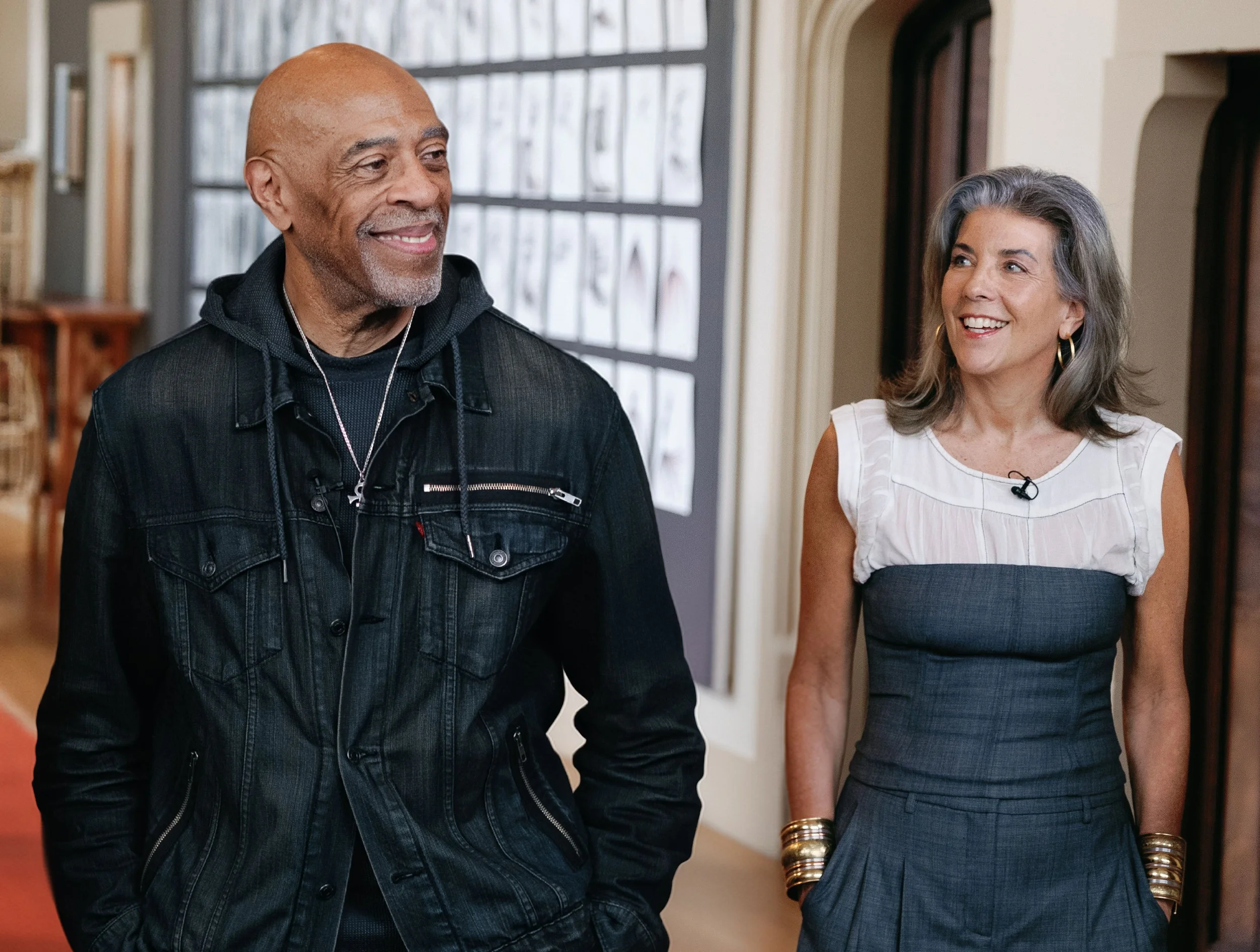
The April 2026 return involved another handoff with Robinson. He was leaving to pursue an artist residency in France. Cavallo came back to lead MARTIN*, while her museum responsibilities shifted toward curatorial and creative direction. The photograph of the two together is a useful accompaniment to the announcement: succession here also involves two people making room for the work they want to do.
MARTIN* reported that during her earlier CEO tenure the agency grew fifty percent over five years. On returning, her stated priorities included continuity for employees and clients and the agency’s creative standards. The number belongs to that earlier chapter. The new one must earn its own account.
Her argument for creativity remains direct. Difficult conditions, she believes, increase the need to make better work. That belief now has two Richmond settings: an agency trying to help brands register in public life, and a museum asking visitors to consider the designed world around them.
The Camino did not remove the questions that had occupied her in advertising. It gave her another way to approach them. Who has permission to contribute? What gets noticed? What does an institution owe the people inside it? Cavallo has returned to a familiar office with those questions still open. That leaves plenty to do, which appears to suit her rather well.
Keep the conversation going
MARTIN* · The Branch Museum of Design · Cavallo on LinkedIn · Cavallo on X
Watch: Running Toward Challenges
Watch: You Can Go Your Own Way, CreativeMornings/RVA
The 2026 return announcement
Rebel with a Rebrand, Style Weekly
A conversation about Martin’s recovery
The decisions behind pay equity and representation
Her education in decision sciences
Virginia Business Person of the Year profile
The Equal Pay Day typeface
JMU on her approach to leadership