Krishna Reddy had an AI company to build, and one of its early problems was finding people. The work required data scientists, engineers and analysts who could turn a customer’s untidy business question into something useful. His professional network helped him assemble the team. Before the company could do much with artificial intelligence, it needed the rather older art of getting acquainted.
That is a revealing place to enter the story of Amnet Digital’s founder and CEO. A technology business can be described through its software, its markets or its headcount. Reddy’s story also asks to be read through the people who make those things possible, and the habits a leader brings to working with them.
He began working while still at school. His mother was an educator, and her example helped shape his self-reliance and discipline. Those are modest details beside the vocabulary of enterprise AI. They have the advantage of belonging to a person. Long before there were platforms to launch, there was work to do and an example at home of taking it seriously.
The habits before the company
Reddy’s route to his present job passed through business operations. At Citicorp Overseas Software, he worked as a business operations manager. He later joined ValueLabs, where his responsibilities included operations, business expansion and strategic leadership, with an Americas regional leadership role also appearing in his career record.
These jobs put a person close to the machinery of a business: the teams, the customers, the commitments and the practical business of coordinating them. They also offer a useful background for understanding his present emphasis on execution. A product announcement occupies a day. Keeping an organization able to deliver occupies rather more of the calendar.
There was an entrepreneurial chapter in fashion e-commerce, too. Reddy co-founded Starobe.com in 2016 and served as its chief operating officer through 2019. His background also includes Profit.co. Across those settings, the recurring subject is how a business organizes itself around work that needs to get done.
His education record includes business administration studies in New Delhi and a Wharton program, Business Analytics: Data to Insights, in 2019-2020. The combination brings management and analytics into the same biography. It would be too convenient to turn every entry into a prediction of Amnet Digital. Careers acquire their apparent neatness later, when somebody has to fit them into a paragraph.
What matters here is the accumulated operating experience. Enterprise customers arrive with existing systems and existing ways of making decisions. A founder selling change has to understand why those arrangements are there, who depends on them and what happens when somebody proposes a replacement. Software enters an organization with a past.
Room to think, work to finish
In his account of leadership, Reddy gives employees room to exercise judgment. He places that freedom alongside an explicit roadmap, communication and collaboration. The pairing matters. A team can have plenty of discretion and still spend the afternoon discovering that its members were answering different questions.
His stated willingness to hear colleagues gives feedback a direction: toward the executive as well as away from him. That requires the person in charge to make room for suggestions he did not originate, including ones that change how he thinks about the work.
“I am open to hearing valuable feedback from my people”
Krishna Reddy, on his leadership approach
There is a practical argument inside that sentiment. The person closest to a delivery problem may see it before the person with authority to change it. A leadership structure that makes the journey between them unnecessarily difficult has invented a delay and given it an office.
Reddy’s comments describe a preference for encouragement and trust, with customer outcomes providing a shared purpose. These are statements of intent, and the daily test is whether a colleague can use that freedom when a recommendation is inconvenient. An open door earns its reputation through the conversations that actually pass through it.
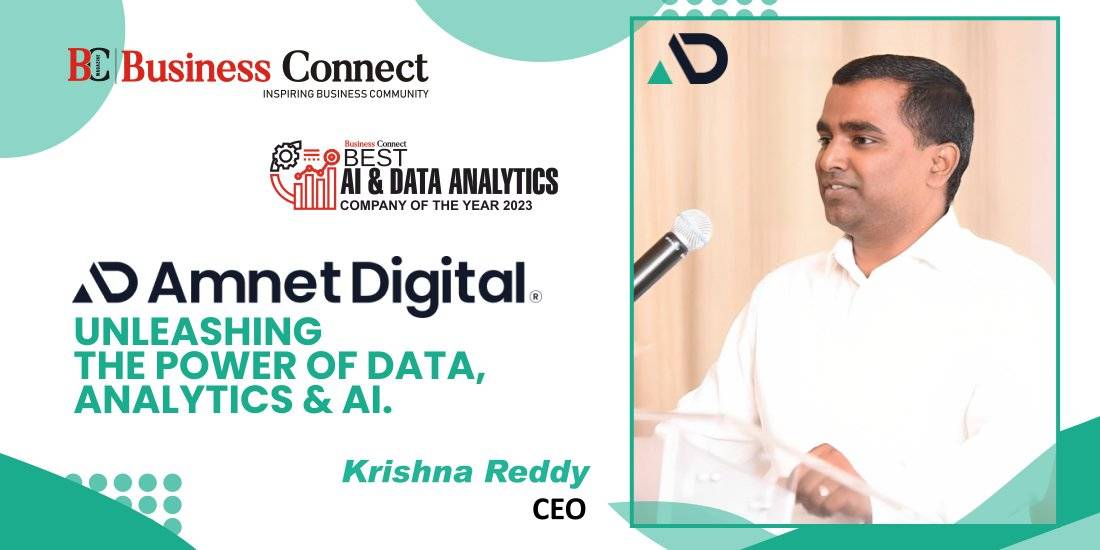
In 2023, Amnet Digital received recognition in the Telangana State Awards’ Best Services small category. Business Connect also selected the company for its AI and data analytics editorial recognition that year. The distinctions belong to a company, with many people behind them. That is consistent with the emphasis Reddy places on associates having the space to contribute.
For a reader, the interesting question extends beyond the award photograph. How does a founder preserve useful independence while making responsibilities clear? Growth gives that question more participants. It also makes informal understanding a less reliable substitute for saying plainly what a team is trying to achieve.
The question after the dashboard
Reddy has described Amnet Digital’s relationship with customers in unusually plain terms: “we work as an extension of our clients’ team”. The phrase puts the emphasis on understanding a business and its goals. The company’s earlier approach included examining existing systems and limitations, discussing requirements and designing a suitable solution.
It also gave attention to interfaces. Data scientists, engineers, product developers and quality assurance specialists had to help produce something a user could understand and use. The interface is where an organization’s investment meets somebody with a task and a limited amount of patience.
This is a helpful way to read the product chapter that followed. On January 10, 2024, Amnet Digital publicly announced Swift Insights, an analytics platform combining reports, predictive and prescriptive analysis, and questions answered from business data using language models.
The proposed uses concerned decisions about customers, retention and business performance. Report management brought information into a common place; question answering offered another way into it. Reddy described the launch as part of the company’s effort to put organizational data to use.
Amnet Digital publicly announces Swift Insights, connecting analytics, report management and questions asked of business data.
A question box changes how someone approaches a report. It does not remove the need to understand the information underneath. A manager asking about a customer still depends on the meaning of “customer”, the period being measured and the records included in the answer. Fluency is pleasant company; agreement about the numbers remains necessary.
That distinction gives the newer portfolio some context. Amnet Digital now presents data preparation, AI recommendations and execution as connected work. Data Foundry prepares information for use; Agent Foundry connects signals and recommendations with approved workflows. The company describes AIDLC as the engineering discipline for delivering these systems.
- 01PrepareBring business data into a usable, governed form.
- 02DecideAnalyze signals and recommend a next step.
- 03ActExecute approved work with human oversight.
For Reddy, this enlarges the operating assignment. A report offers an account of something. A system that can act introduces permissions, consequences and the need to establish who remains responsible. The founder who talks about giving colleagues freedom is now leading a business that sells tools requiring carefully bounded freedom of their own.
The connection is an interpretation of his career and the company’s products, rather than a claim that one mechanically caused the other. It is nevertheless a useful connection. Authority needs a purpose, whether it sits with an employee, a manager or a piece of software carrying out an approved task.
Four countries, the same human problem
Amnet Digital describes its launch in 2019, with its first delivery operation in Hyderabad. Its current footprint includes Austin, Hyderabad, London and Dubai. That geography places Reddy’s work across several business environments, with customers and colleagues who cannot all be gathered by walking into the next room.
International operations add another reason to care about clarity. A decision that seems obvious in one conversation may arrive elsewhere stripped of its context. Shared responsibility requires enough explanation to survive the journey. The working day continues even when the founder is unavailable to clarify what he meant.
On LinkedIn, where he uses the name Krishna Loka, Reddy has discussed representing Amnet Digital at the India AI Impact Summit in New Delhi in February 2026. His reflections emphasized responsible, human-centered AI and collaboration across borders. He also described a focus on getting enterprise data ready for AI and moving agentic systems into production.
Those ambitions bring the story back to the practical limits of an idea. An experiment can establish that something is possible. Putting it into everyday use asks whether an organization can depend on it, understand its boundaries and keep it working when the circumstances change.
In his year-end reflection on 2025, he also acknowledged areas where speed and communication could have been better. That admission gives the larger ambitions a useful human scale. A company can be working on autonomous systems while its people are still learning how to explain things to one another more clearly.
Reddy’s career offers no escape from that ordinary work. It keeps returning him to it: organizing, listening, giving responsibility and making the purpose legible. The technology has acquired new capabilities. The founder still needs people who understand what they are doing together, and enough confidence to let them get on with it.