A customer once paid Ravi Kopuri a compliment that arrived wearing the clothes of a warning. At a business review in Charlotte, the conversation turned to how thoroughly DATAECONOMY’s team had learned the customer’s business. The customer, NCM Associates, had roughly 75 years of history. Kopuri’s company had been founded in 2018. The newcomers had apparently been doing their homework.
Kopuri recalled NCM’s president and CEO, Paul Anton Faletti Jr., describing that familiarity as both flattering and a little scary. One line stayed with him: “Your team attentively listens and reciprocates.” The meeting reviewed work completed in 2022 and plans for 2023. There were the expected subjects: efficiency, savings, improvements. What pleased Kopuri was the recognition that his colleagues understood the organization they were serving.
It is a revealing place to begin a story about someone who sells expertise in data and artificial intelligence. A client noticed the listening. For Kopuri, the appreciation “made my day.” In a business fond of announcing what comes next, he had found something to celebrate in learning what was already there.
A long apprenticeship in other people’s businesses
Based in Dublin, Ohio, Kopuri is DATAECONOMY’s co-founder and CEO. His route to that position ran through the kind of large organizations that eventually became his company’s customers. He worked at Nationwide from 2000 to 2006 as a program and portfolio leader, then spent the next stretch of his career at Virtusa, through January 2018.
At Virtusa, his roles included program management, director of client services, and client partner. The titles describe a career spent around the meeting point between technical work and the people paying for it. A program needs delivery. A client relationship also needs someone who can understand why the work matters, explain its progress, and remain available when the conversation becomes awkward.
His education joined engineering to management. He earned an undergraduate degree at JNT University in India and an MBA at Ohio State University’s Fisher College of Business. His Fisher studies ran from 2004 to 2006, overlapping his Nationwide years. By the time DATAECONOMY began, he had experience on both sides of an enterprise technology relationship: inside a large business and at a company serving one.
That background helps explain the practical emphasis in his stated ambitions. Kopuri wants customers to earn a return from their data initiatives, with services they can afford. There is a useful bluntness to that ambition. An elegant system still has to justify the bill. Business school does occasionally survive contact with business.
Program & portfolio leadership
Delivery & client services
Co-founder & CEO
The other business involved homework
There is another entry in Kopuri’s career that gives the technology résumé a different texture: Mathnasium. Alongside his enterprise work, he was an owner and executive director in the mathematics tutoring business. His involvement began in 2016, before DATAECONOMY’s founding, and continued into 2025.
The connection is concrete. Mathnasium’s franchise disclosure records list Kopuri against centers in Lewis Center and Powell, Ohio. The Powell business also lists him as an owner and member alongside Satya Yarramsetty. This was a local education business, with an audience rather younger than a bank’s technology leadership team.
It would be too tidy to turn a tutoring franchise into the secret origin of an AI company. The overlap is interesting enough without that invention. For several years, Kopuri’s professional life included both enterprise technology and a business organized around helping students understand mathematics. One dealt with sprawling institutions; the other with a subject that can feel sprawling from the far side of a school desk.
Both businesses make the value of understanding unusually visible. Software has to work for the customer. A mathematics explanation has to work for the learner. The parallel is an editorial observation, but it makes that Charlotte compliment about listening feel especially well chosen.
Three founders, several kinds of experience
DATAECONOMY’s founding team brought distinct histories to the same enterprise problem. Kopuri became CEO. Siva Kondamadugula became chief operating officer. Reginald Mathews became chief technology officer. The division of roles gives the story more substance than a solitary founder staring into a laptop.
Kondamadugula had spent about 23 years with Tata Infotech and TCS, working across technology, delivery, and sales. Mathews had led data and analytics for banking and financial services at TCS. Their shared field was the large enterprise, where changing a system means working with existing operations, existing information, and existing responsibilities.
Kopuri’s ambition for the company combines innovation with a fairly demanding commercial condition: customers should get useful returns. The company’s work covers data engineering, cloud, analytics, governance, and AI. Those descriptions can sound abstract until an organization needs its information to mean the same thing in two different departments.
DATAECONOMY calls its innovation lab DE Garage. It calls its engineers Ninjas. The names supply a little theater to work whose success often depends on patience. The stated aim of the lab is to move useful ideas into production. A garage is an appealing metaphor; eventually, someone expects the vehicle to leave it.
“As a leader, you must install the culture of enablement to drive fellow employees to love their job as much as you do.”
Ravi Kopuri
A sign on a Hyderabad building
On December 27, 2024, Kopuri joined the opening of DATAECONOMY’s expanded delivery center at Aurobindo Galaxy in Hyderabad’s HITEC City. Telangana minister D. Sridhar Babu attended, alongside company leaders including Jawahar Tedla and Roshan Kumar. There were flowers, a ribbon, and the rather tangible pleasure of a growing business acquiring more room.
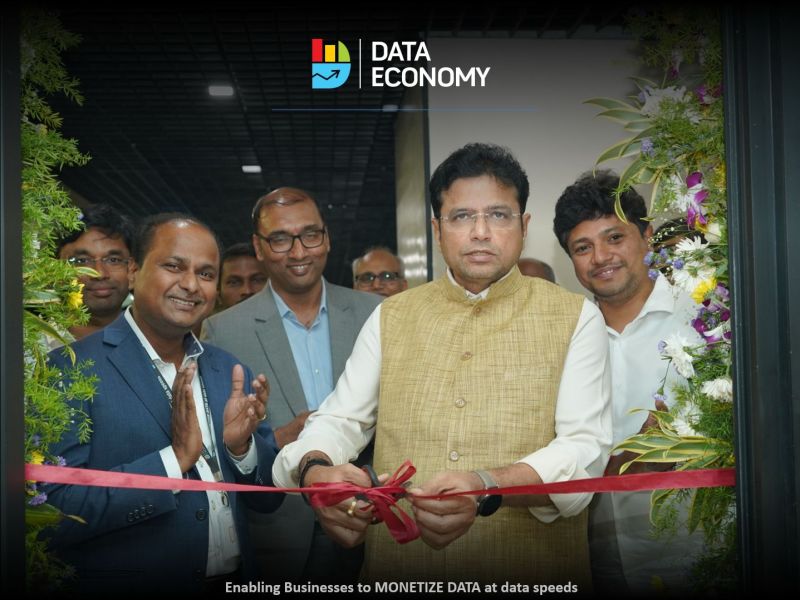
The conversations around the opening extended beyond office capacity. Kopuri and the minister discussed possible collaboration on startup incubation through T-Hub, developing talent in rural Telangana, and the planned AI City in Hyderabad. These were opportunities under discussion, with a common theme: connecting a technology business to the place and people around it.
Later, Kopuri celebrated the company logo appearing on the building. His account dwelt on the years spent assembling the team in Hyderabad and on practical signs of progress: attracting experienced technology leaders and improving the proportion of job offers that became actual hires.
There is something pleasingly ordinary about that measure. A logo can be illuminated in an evening. Becoming an employer someone chooses takes longer. For Kopuri, the sign represented the team and recruiting effort behind it. In his telling, Hyderabad was a foundation for delivery and innovation, with the company’s growing visibility a consequence of that work.
Growth acquires a regional address
The business also accumulated recognition in Ohio. EY named Kopuri an Entrepreneur Of The Year East Central finalist in 2024, again in 2025, and again in 2026. In the April 2026 announcement, he appeared among 32 finalists representing 28 companies. The repeated appearances place him within a regional entrepreneurial community as well as the international data industry.
DATAECONOMY’s Inc. Regionals Midwest record offers another view of its progress: No. 31 in 2024, No. 33 in 2025, and No. 24 in 2026. The 2026 listing reports 220 percent growth over two years. Each ranking belongs to its own annual list; the sequence is a record of repeated inclusion, rather than a continuous measurement of quality.
Reported company growth over two years
Growth makes the founder’s listening problem larger. More customers and more colleagues mean more opportunities for knowledge to get lost between people. A business that wins praise for understanding a client has to keep making room for that understanding as it expands. The work of retaining it does not receive a ribbon-cutting ceremony.
What he wants the next meeting to show
Kopuri’s own account of the company’s expansion has consistently returned to relationships. Looking back on 2023, he described enlarging delivery centers in the United States and India and entering Australia. He thanked existing customers for continuing to work with the company and new ones for giving it an opportunity. International expansion appeared alongside a roll call of people who made it possible.
A Thanksgiving message that year began with gratitude for his children reaching new stages in their lives, then turned to co-founders, team leaders, customers, and prospective customers who had made time for a new partner. It is a modest personal detail, but it gives the CEO’s public voice some scale. The business is one of several things for which he expresses thanks.
His leadership language can also be direct. In a reflection on enabling employees, he argued that leaders should create conditions in which colleagues could love their work as much as the leader did. The emphasis falls on what the leader makes possible for others. That is an aspiration, and a useful one to be held to.
At the end of 2025, his priorities for the following year included responsible AI, trusted data, execution, and continued investment in people and platforms. In January 2026, he welcomed Penu Putta to lead the insurance practice, describing a task of translating the company’s data and AI capabilities into solutions specific to insurers.
The next chapter, then, involves both technical development and an old professional obligation: learn the customer’s business well enough to be useful in it. The Charlotte meeting supplies a good test for that ambition. After the presentation, after the roadmap, after the numbers, does the person across the table recognize their own business in what the team has built?