Venkata Kiran Meduri has a question for the executive with the expensive data platform. It is a slightly awkward question, especially after the platform has been paid for: is anyone prepared to listen to it? The founder and CEO of Syren has spent his public working life discussing software, supply chains and the movement of information. Increasingly, his attention returns to the person making the decision. A warehouse can report its inventory. A model can flag trouble. The executive still has to let the evidence interrupt a perfectly comfortable opinion.
Meduri’s argument has developed across articles about control towers, shipping delays, automotive logistics and AI. Read together, they describe a founder moving closer to the human difficulty inside an engineering problem. He wants businesses to see what is happening across their operations, then organize themselves to respond. The software is essential. So is the willingness to have an inconvenient conversation before an inconvenient delivery.
A supply chain begins with a promise
Based in Hyderabad, Meduri leads a company focused on data, AI and supply-chain operations. His education includes Andhra University between 2000 and 2002. He describes more than two decades of experience across software, data and large organizational transformation. In his account of that work, launching Syren’s data-quality platform and developing AI-enabled operations belong to the same undertaking: helping enterprises work across the boundaries that separate their information.
The ambition is concrete enough to picture without a technical diagram. Someone orders a product. Somewhere else, a planner must know whether the parts, production capacity and transport can support the promised delivery. Every department may hold a respectable piece of the answer. The customer, reasonably, expects one answer. Meduri has built his professional argument around the awkward distance between those two arrangements.
Syren marked its fifth anniversary with a new brand identity in 2025. Meduri presented the change as part of a continuing commitment to supply-chain efficiency and visibility. An anniversary gives a young company permission to look back; his accompanying message pointed toward what its operations should enable next. The birthday announcement and the product argument shared a subject: making complicated enterprises easier to coordinate.
The tower that looks sideways
By June 2023, Meduri was publishing on supply-chain control towers. The name suggests an elevated room overlooking a runway. In the enterprise version, the view comes from connecting information scattered across planning software, warehouses, transport systems, suppliers and spreadsheets. Syren’s Optima Control Tower sits within this area of his work. Its purpose is to bring operational information into a shared view so that a disruption becomes visible across the people who need to deal with it.
There is a useful modesty in the underlying problem. A company can own sophisticated systems and still struggle to establish where its goods are. Each system may be doing its appointed job. The difficulty appears between them. Meduri’s control-tower writing examines inventory, fulfillment, transport and supply assurance as related concerns. A shipment delay has an unfortunate habit of crossing departmental boundaries whether the departmental software approves or not.
Information has to travel before a decision can.
That emphasis makes the control tower a useful introduction to Meduri himself. He keeps returning to the connections: between records, between teams, between an early warning and the authority to change a plan. Visibility becomes valuable at the point where somebody can use it.
The unglamorous business of getting there
In February 2024, he turned to unpredictable shipping times in consumer packaged goods. This is the world of frequently purchased products, where a distribution problem can leave an ordinary shelf unexpectedly empty. His discussion moved through demand forecasting, inventory planning, capacity, transport and order fulfillment. The appeal was practical: help businesses anticipate delays and make decisions while there is still room to adjust.
His treatment of inventory included the balance among holding costs, ordering costs and the cost of running out. That is a revealing choice of detail. Enterprise AI can be introduced with grand language; Meduri also writes about the arithmetic of ordering the right quantity. A forecasting system eventually has to earn its place beside the people paying for storage and explaining missing stock.
He extended the argument to automotive supply chains in March 2024, discussing demand forecasts, component sourcing, routing and maintenance informed by operational data. Cars require coordination among many businesses, and a missing component can upset a much larger production plan. His interest lay in anticipating these dependencies. Across these pieces, the recurring character is the planner trying to make a defensible decision before uncertainty turns into an expensive fact.
Atlanta, Orlando, and the systems people already own
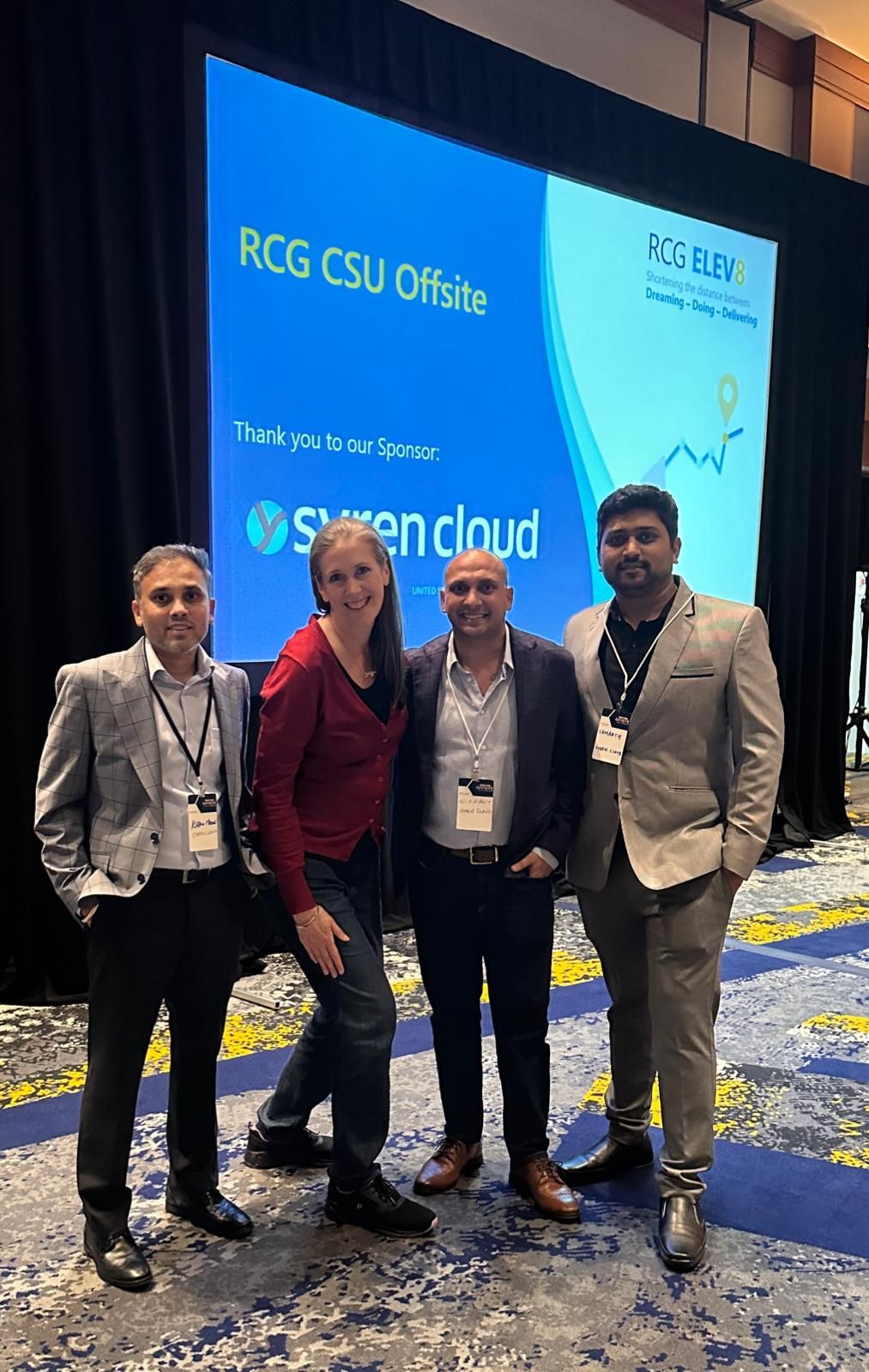
The same period took Syren into conversations with Microsoft’s retail and consumer-goods ecosystem. In March 2024, the company described a team led by Meduri, Samarth Patel and Nishant Gautam attending Microsoft’s RCG ELEV8 event in Atlanta. Their discussions concerned enterprise supply-chain challenges and opportunities to work together. The event photographs put faces around an otherwise abstract subject: people from different organizations trying to connect their work.
Two months later, Syren exhibited at the Gartner Supply Chain Symposium/Xpo in Orlando. The booth presented supply-chain analytics, integrated data management, visibility and demand planning supported by generative AI. Meduri’s reflection emphasized how differently prepared the companies they met were. Some needed help with legacy systems; others were refining operations that had already advanced further.
“No matter where they stand, the right expertise makes the difference.”Kiran Meduri, reflecting on Gartner’s 2024 symposium
That observation explains something about the job he has chosen. Customers arrive carrying years of decisions embedded in systems and working habits. They bring existing infrastructure, constraints and obligations to the next project. A founder selling change must understand that accumulated history. Meduri’s event account treated it as a starting condition for the work.
When departments win and the business loses
By April 2025, Meduri was making the organizational argument more explicitly. His essay on supply-chain silos examined the incentives that encourage procurement, logistics and production to pursue their separate targets. Each department can appear efficient while the combined operation struggles. The company may have acquired a collection of local successes with a rather disappointing total.
He described technological fragmentation alongside resistance to change. Legacy systems impede communication; people can hesitate when integration brings closer scrutiny or reduces their control. His account connected these barriers to everyday consequences such as excess ordering, underused warehouses and delayed decisions. The trouble has a social structure as well as a technical architecture.
In that argument, shared measures and coordinated decisions matter alongside connecting the software. Syren’s accompanying discussion of his essay included cross-team collaboration and dashboards suited to different operational roles. The point is easy to overlook during a demonstration: a common screen does not automatically create a common purpose. Teams need a reason to respond together when the screen shows trouble.
A founder makes room for other voices
Meduri’s professional posts also turn the spotlight toward colleagues. He has shared the writing of engineering leader Bharat Meda on leading teams through AI adoption, and of COO Mohammed Vasim on enterprise AI and leadership. He publicly recognized Avinash V. and Chaitanya Inguva representing Syren at the 2025 Databricks Data + AI Summit. These are specific acts of recognition within the wider company story.
The pattern is consistent with his stated emphasis on clarity, direction and team culture. It also makes his public account less solitary than the usual founder narrative. The engineering discussion belongs partly to an engineering leader. The operating discussion includes the COO. People carrying the work get named. Leadership appears here through the distribution of attention as much as through the CEO’s own arguments.
Syren’s declared mission similarly links AI and commercial intelligence to collaboration across supply-chain operations. Meduri’s personal ambition, expressed in his writing, is to help develop intelligent, adaptable supply chains and the teams capable of operating them. The company’s language and his own concerns meet around that combination of technical capacity and collective judgment.
The question waiting after the dashboard
In September 2025, Meduri set out a longer view of AI-enabled supply chains. His proposed actions included improving risk intelligence, making visibility measurable, investing in integrated data, developing AI skills within teams and testing changes against clear outcomes before expanding them. He also connected operational decisions to customers’ expectations for traceability and dependable delivery. Efficiency remained necessary; adaptability required additional work.
His April 2026 essay, Data Can Speak Now. Are We Ready to Listen?, brought that line of thought back to leadership. He described his own effort at Syren to examine operational evidence even when it challenges expectations about client engagements, growing services or delivery risk. The test begins close to the CEO’s desk. It would be convenient to prescribe evidence for everyone else and reserve intuition for oneself.
Meduri’s career in public view is a sustained attempt to shorten the distance between knowing and doing. The control tower supplies a shared view. The planning tools make consequences easier to examine. The team needs permission and responsibility to respond. After the platforms, demonstrations and conference conversations, his question remains waiting in the room: what will the people in charge do with what they can now see?