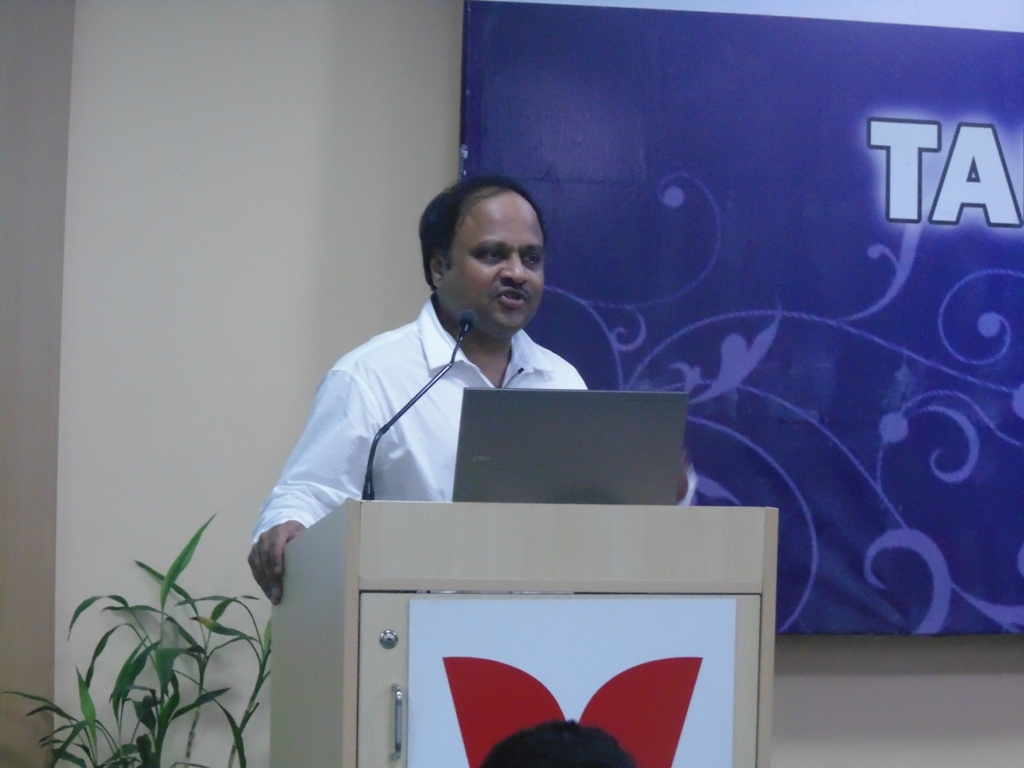
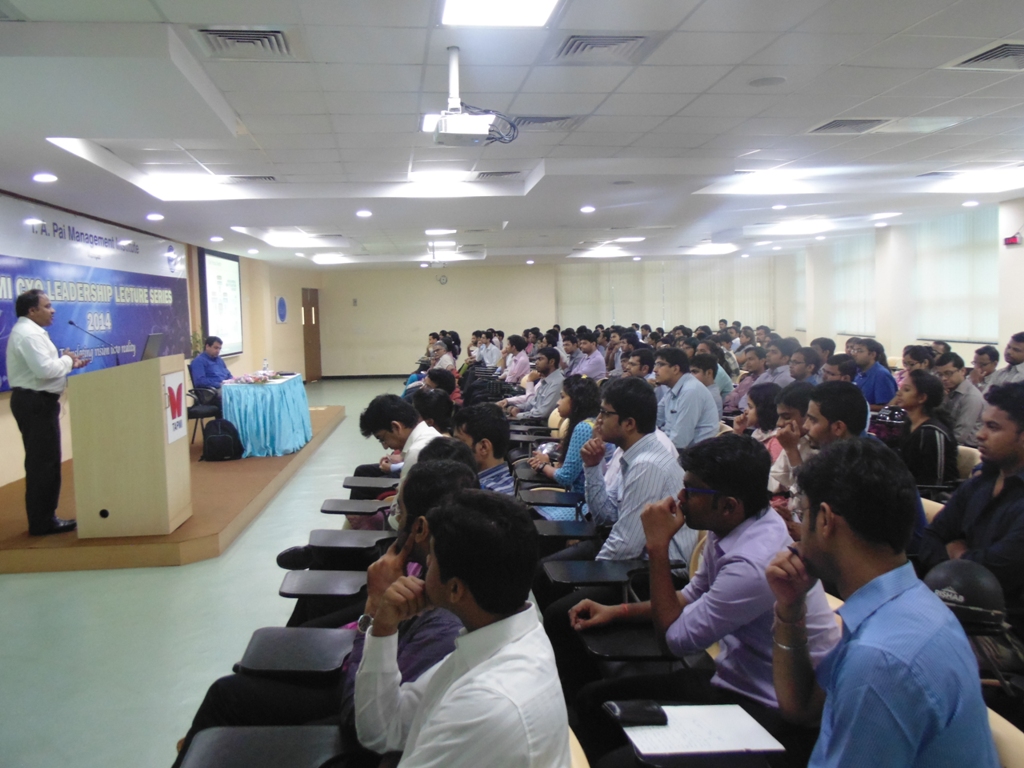
On September 29, 2014, Arun Gollapudi stood before students at T. A. Pai Management Institute with a message that would survive several changes in technology fashion. Practical application mattered more than theory alone. Decisions needed to happen quickly. Analytics belonged in that conversation because information had somewhere to go: into a choice somebody had to make.
He had come with Systech’s chief financial officer, Ashish Parikh. He noticed the campus’s Bloomberg Lab, spoke appreciatively of its founder, T. M. A. Pai, and ended by answering students’ questions with examples from working life. The details are modest, which is part of their appeal. Here was a technology executive discussing the equipment, the institution and the uses of knowledge before sending the room off toward entrepreneurship.
An audience of management students is a useful test for an analytics business. Eventually somebody will ask what the numbers are for. Gollapudi’s career makes an extended answer to that question. The names have changed from business intelligence to advanced analytics to AI. His work keeps circling the distance between possessing information and being able to act on it.
02The reporting problem that became a business
Before Systech, there was Nestlé. Gollapudi experienced the expense and complexity of building reporting and analysis systems on company premises. While pursuing his MBA at UCLA, he developed the idea for a business around that difficulty. A familiar corporate inconvenience became a prospective customer problem, and then a company.
His education crossed disciplines: civil engineering at the Indian Institute of Technology, graduate engineering study at UNB, and business school at UCLA Anderson. That sequence puts engineering and management in the same biography. One asks how a system works; the other asks what it costs, who needs it and whether the result is useful. Reporting systems provide ample opportunities for both questions. An answer that makes sense to an engineer still has to make sense to the manager using it. The two forms of understanding meet in a practical place: deciding which work is worth doing, and how to tell whether it helped.
Gollapudi and his longtime friend and business partner Srini Ramaswamy built Systech together. Its current history dates the firm to 1993 in Los Angeles. Both remain in leadership. Their partnership stretches across the years when enterprises built data warehouses, adopted cloud services and began asking how AI should fit into everyday operations.
The founding problem has an appealing lack of glamour. Reporting is rarely the part of computing that gets a dramatic soundtrack. Yet a report sits at an important junction: the organisation has accumulated information and now expects a person to understand it. Every awkward handoff at that junction creates work. Gollapudi found a business there, close to the daily frustrations of the people expected to make decisions.
- 1993Systech founded
Enterprise data & BI - 2017Dopplr launch
Cloud analytics - 2023IIT Madras partnership
Platform & research - 2026Both founders still lead
Data, analytics & AI
Selected company milestones. Dates follow Systech’s current history and partnership announcement.
03India needed customers, and better questions
In August 2017, Gollapudi was in India meeting potential customers as Systech prepared to enter the domestic market. Chennai already housed a delivery centre serving American clients. The next move was to serve businesses in India too, with an initial focus on financial services, manufacturing and consumer products.
“We see a big opportunity in any company that is working with a large number of customers,” he said at the time. It was a useful description of a market because it began with a business condition. A company with many customers has many encounters to understand. Somewhere inside those encounters may be a pattern worth finding, provided someone knows what to ask.
“We see a big opportunity in any company that is working with a large number of customers.”
Arun Gollapudi · 2017
The proposed work included helping organisations establish their own analytics academies and training people to frame questions when dealing with large volumes of data. That detail deserves a little space. A business can purchase tools. It still needs people who can turn a commercial concern into a question the data can answer, and recognise when the answer requires another question.
There is a pleasing inconvenience in that proposition. The customer remains part of the work. An analytics academy assumes that understanding cannot be entirely boxed up and delivered by a supplier. The organisation has to develop some of its own judgement. For a founder whose business sells expertise, helping clients build expertise of their own is a consequential choice of service.
04A classroom belongs in the company
By January 2018, Systech and Ganesh Natarajan’s 5F World were setting out plans for a Chennai-based Center for Artificial Intelligence and Advanced Analytics. The proposed academy would serve students and employees, with practical datasets, case studies and industry trainers. Research, training and business applications were meant to share a roof, intellectually if not always physically.
At the launch, Gollapudi spoke about bringing Systech’s American corporate experience to India. The ambition was specific: apply experience in advanced analytics while developing people able to use it. Training was part of the venture’s purpose from the beginning, rather than an agreeable paragraph added after the product description.
At Systech itself, his biography credits a bootcamp with graduating more than 1,100 business intelligence and data integration specialists. The figure describes the programme’s accumulated graduates at the time of that account. Behind the number sits a recurring task for a long-running technical firm: teach people the work well enough that they can carry it into a customer’s organisation.
The TAPMI visit, the academies proposed for clients and the training venture form a visible pattern. Gollapudi repeatedly appears where technology meets instruction. This is a narrow, observable point about his work, and a revealing one. The businesses he has helped build need people who can explain a problem as well as configure a system. A new tool arrives with documentation; understanding usually requires a conversation.
Business intelligence and data integration specialists graduated through Systech’s bootcamp, as recorded in Gollapudi’s official biography.
05Dopplr takes the conversation out of the classroom
In 2023, Gollapudi joined Systech product leader Sunil Kumar Arjun Prasad in the “Rise of Dopplr” video series. Its opening episode explored the platform’s beginnings and the challenges of fragmented data. Later instalments addressed AI, language models and voice-based interaction. The founder was discussing a product with a colleague responsible for building it, giving the subject a more concrete setting than a general forecast about technology.
Dopplr adds a platform to the consulting story. Systech describes it as an end-to-end analytics and machine-learning environment. The appeal of such a platform is easy to understand: businesses would like the stages between collecting information and using it to fit together. Each handoff is another place for work to slow down or meaning to get lost.
That July, Systech announced a partnership with IIT Madras centred on Dopplr. The announcement connected the platform with research and real-world applications, including Project Kaatru’s environmental data work. The collaboration also appears in the IIT system’s listing of national academic partnerships for 2023–24. An educational relationship had become part of the company’s product development story.
The progression is interesting without requiring a victory lap. The student who developed an entrepreneurial idea during his MBA became an executive helping connect a company platform with university research. These are different kinds of learning, with different obligations. In each, the useful question is how an idea travels beyond the place where it was first explained.
His recorded appearances continued into cloud modernisation and generative AI. An April 2024 video introduced his perspective on DBShift, Systech’s migration tool. The subject had moved from reports built on premises to moving enterprise workloads between environments. The awkwardness that started the business had acquired new machinery and a fresh set of acronyms. Enterprise computing is generous that way.
06Thirty-three years, with the work still attached
In 2026, Gollapudi remains Systech’s CEO and co-founder, based in Glendale, California. Ramaswamy continues alongside him. The present leadership team includes technology, enterprise architecture, delivery, product innovation and customer success roles. That spread of responsibilities offers a useful picture of what the founders now lead: a company that must connect technical work with the experience of using it.
The current portfolio includes WizarD for enterprise AI, aiDE for data pipeline engineering, DBShift for database migration and Dopplr for analytics. These are company products, built and delivered by teams. A founder’s place in that picture is organisational as well as technical. A promise made in a product conversation has to survive implementation, support and the next change in the customer’s business.
The Chennai delivery centre features in the founders’ public account of how Systech operates. They describe it as an extension of customers’ businesses, with responsibility for outcomes. The vocabulary is familiar to anyone who has hired a services firm. Its practical test comes later, when somebody needs a result and the people doing the work have to decide how much of the problem they own.
Continuity supplies the distinctive shape of Gollapudi’s story. The same partnership has remained in charge while the technical setting changed around it. Training, customer questions and the conversion of information into action recur across the documented episodes. They connect a corporate reporting problem, an MBA idea, a student lecture and a platform conversation without requiring any of them to be a grand turning point.
Return to that room at TAPMI. The lecture ended with questions, answered through examples. It is an apt place to leave a founder whose work depends on making abstract possibilities useful to other people. A question can sound small beside an enterprise technology budget. Asked well, it determines what that budget is supposed to accomplish. Gollapudi has spent much of his working life in the space between the two.