The founding object was not a camera. It was a cable - specifically, a D-Tap lead needed to power Blackmagic Design's newly released Pocket Cinema Camera 4K. In late 2018, filmmaker Lukas Colombo was preparing a production with fellow filmmaker Vincent Laforet and found that the part was available from one company for more than $80. This was a tiny annoyance attached to a much larger signal: a popular new camera was entering the world without the support gear required to make it behave like a production tool.
Colombo had early access to the Pocket 4K and knew the rhythms of a set. He had been shooting Super 16 as a teenager, later directing commercials, music videos and documentary work. When budgets were lean, he built dollies, sliders and rigs from hardware-store parts. Some were heavy, by his own account, but they worked. Other filmmakers asked for copies. The instinct was already there; the camera launch supplied the deadline.
Kondor Blue officially arrived in 2019 with a Mini Quick Release, a Pocket 4K cage and top handle, and XLR cables. By year's end, the company says it had released 60 products and landed B&H Photo Video as a distributor. That is the whole business in miniature: identify what a camera body forgot, design the fix before the excitement cools, and get it onto a shelf professionals already trust.
The expensive failure is usually the cheap part
A camera cage is a machined frame that wraps a camera body and gives the operator places to attach handles, monitors, microphones, power, storage and support. It sounds prosaic. On set, it is a physical operating system. The cage determines whether a camera moves quickly from tripod to shoulder to gimbal; whether a cable gets yanked from a fragile port; whether a monitor rotates loose in the middle of a take.
Colombo's original frustrations were similarly unglamorous. He had broken HDMI and SDI cables, discovered dead power leads before a take and watched crews waste time screwing pieces together while a client waited. A cable that costs a few dozen dollars can idle a crew, talent and location worth thousands. Kondor Blue designed braided, reinforced cables in useful lengths, handles with start-stop control, and quick releases meant to reduce those dead minutes.
“I'm my own customer. If something solved a problem for me, I knew it would help a lot of other filmmakers too.”Lukas Colombo, founder and CEO
That sentence contains both the advantage and the trap. A working filmmaker notices details a generic manufacturer can miss. But one expert's habits are not a market. Kondor Blue's answer has been collaboration: products co-designed with reviewers and creators such as Gerald Undone, iJustine and Tyler Stalman, plus development relationships the company names with Sony, Canon, Fujifilm, Lumix, SanDisk and Angelbird. The creator does not simply hold the finished object for a thumbnail. At its best, the creator's peculiar workflow becomes the brief.
A catalog designed to keep growing
Today the catalog runs from $15.99 USB-C cables to camera rigs priced above $1,000. There are cages for Sony, Canon, Blackmagic, Nikon, Lumix, Fujifilm, RED and other bodies; NATO rails and ARRI-style anti-twist mounts; quick-release plates; baseplates; battery systems; monitor arms; matte boxes; suction cups; and fiber links for broadcast. Customers range from film students and YouTube creators to camera assistants, cinematographers, production companies and broadcasters.
The product architecture is modular by design. A buyer can begin with a cage and add a handle, plate, power system or cable later. Industry-standard mounting points keep the system from becoming completely proprietary, while camera-specific fit gives Kondor Blue something generic hardware cannot. The company sells directly through a Shopify store and through retailers and resellers, including the early B&H relationship. This is ecommerce with a hardware flywheel: every additional component makes the first purchase more useful.
Reported catalog expansion - milestone snapshots
The moat is not a secret alloy. SmallRig, Tilta, Wooden Camera, SHAPE, Zacuto, Bright Tangerine and a long tail of generic sellers all compete for the same threaded holes. Kondor Blue differentiates through release timing, conspicuous blue accents, creator relationships, production-specific details and a lifetime warranty. That warranty matters because many metal accessories look interchangeable on a product page. Service turns a commodity-shaped object into a promise that someone will answer when it fails.
What failed first - and what can fail next
The first failure was literal: cables broke, connectors were unavailable, rigs took too long to reconfigure. The first company constraint was capital. Colombo has said he did not come from wealth and built from the ground up; keeping inventory aligned with fast year-over-year growth still requires strategy and partners. A public funding round, valuation and revenue figure have not been disclosed.
Then there is the arithmetic of nearly 1,000 SKUs. Breadth is useful when the pieces interoperate. It is punishing when each camera launch demands new tooling, forecasts and warehouse space. Some customers publicly complained about long backorders and weak shipping communication during 2024-25, while others reported reliable products and service. The fair conclusion is narrow: hardware growth exposes fulfillment seams, especially when preorder demand outruns supply. A lifetime warranty cannot make an unavailable part arrive faster.
This strategy is less likely to work when a founder lacks early visibility into platform launches, when products are generic and isolated, or when catalog growth outruns cash, quality control and fulfillment. Modularity only compounds if yesterday's purchase remains useful tomorrow.
From the rig to the image
By 2023-24, Kondor Blue says it had moved into a facility with five times the office and warehouse space, reached every U.S. state and every continent, and worked with major camera and media brands. Its SanDisk Pro-Blade Handle received Videomaker recognition in 2023. The $275 base version of its modular 4x5 Matte Box System won an NAB Show Product of the Year award in 2024. In 2025, the company added Kofi suction cups and Cine Jaws for specialty mounting, plus fiber and PTZ tools for broadcast.
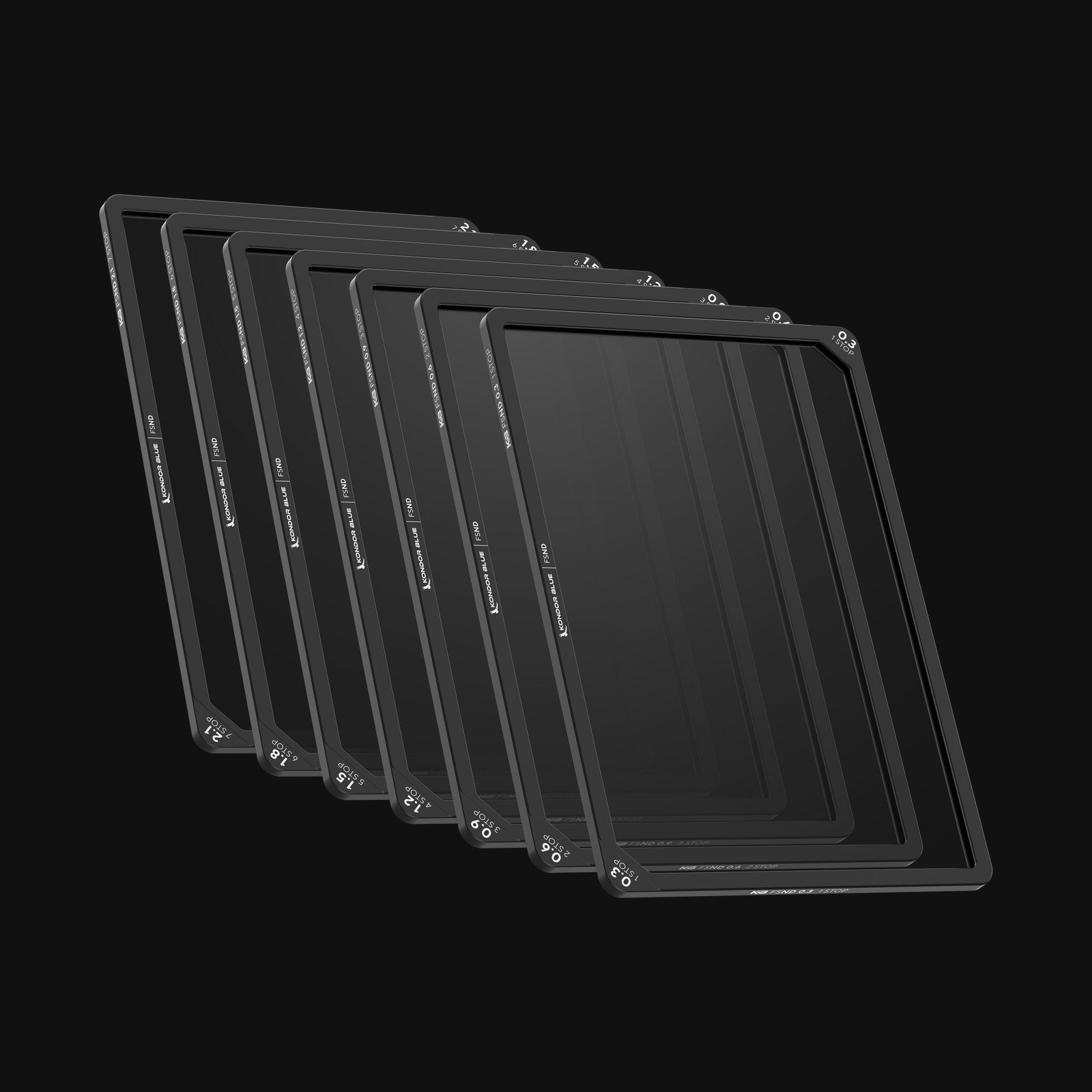
The strategic turn came in April 2026, when Kondor Blue acquired and began integrating Element Filters. The deal brought filter formulations, intellectual property, manufacturing processes and supplier relationships in-house. Kondor Blue skipped exhibiting at NAB that year, putting resources into the integration while its gear appeared in partners' booths. The first result was FullSpec ND: 4-by-5.65-inch filters using Schott B270 glass in aluminum frames, listed at $229 each.
For years, Kondor Blue built everything around the camera. Filters let it touch the image itself. That is a more consequential promise than another threaded plate: neutral-density and diffusion glass change exposure, contrast and highlight behavior before footage reaches a sensor. The acquisition saves years of optical trial and error, but it also moves the brand into a category where a machining reputation is not enough. Color consistency has to survive testing, rental abuse and the grading suite.
The bit worth stealing
The copyable lesson is not to release 60 products in a year. It is to attach a narrowly observed problem to a platform with momentum. Colombo saw a hit camera before the surrounding market caught up. He began with failures he had personally paid for, shipped products while demand was forming, borrowed trust from a respected retailer, and turned expert collaborators into research and distribution.
A founder can reproduce that sequence without owning a CNC mill. Start with the workaround experts already carry in their bags. Price the full cost of failure, not merely the replacement part. Design the second product so it increases the usefulness of the first. Time the launch to the platform's news cycle. Then make support part of the product. Kondor Blue says its service team comes from creative or on-set backgrounds and that ten percent of earnings goes to its current charity, World Vision. Those choices tell customers what kind of company they are dealing with after checkout.
The conditions matter. This model works best when customers feel the pain repeatedly, the host platform keeps launching, standards allow accessories to connect, and the brand can finance inventory without compromising delivery. It works poorly when the annoyance is rare, a platform owner closes the interface, or low-cost rivals can copy the object before trust and distribution take hold.
Kondor Blue's bet is that the modern camera is never really finished. Bodies get smaller, creators shoot with phones, broadcasts move through fiber, and every new configuration creates another loose end. The company does not need to invent the camera. It needs to be standing nearby, wrench in hand, when the expensive little part fails.